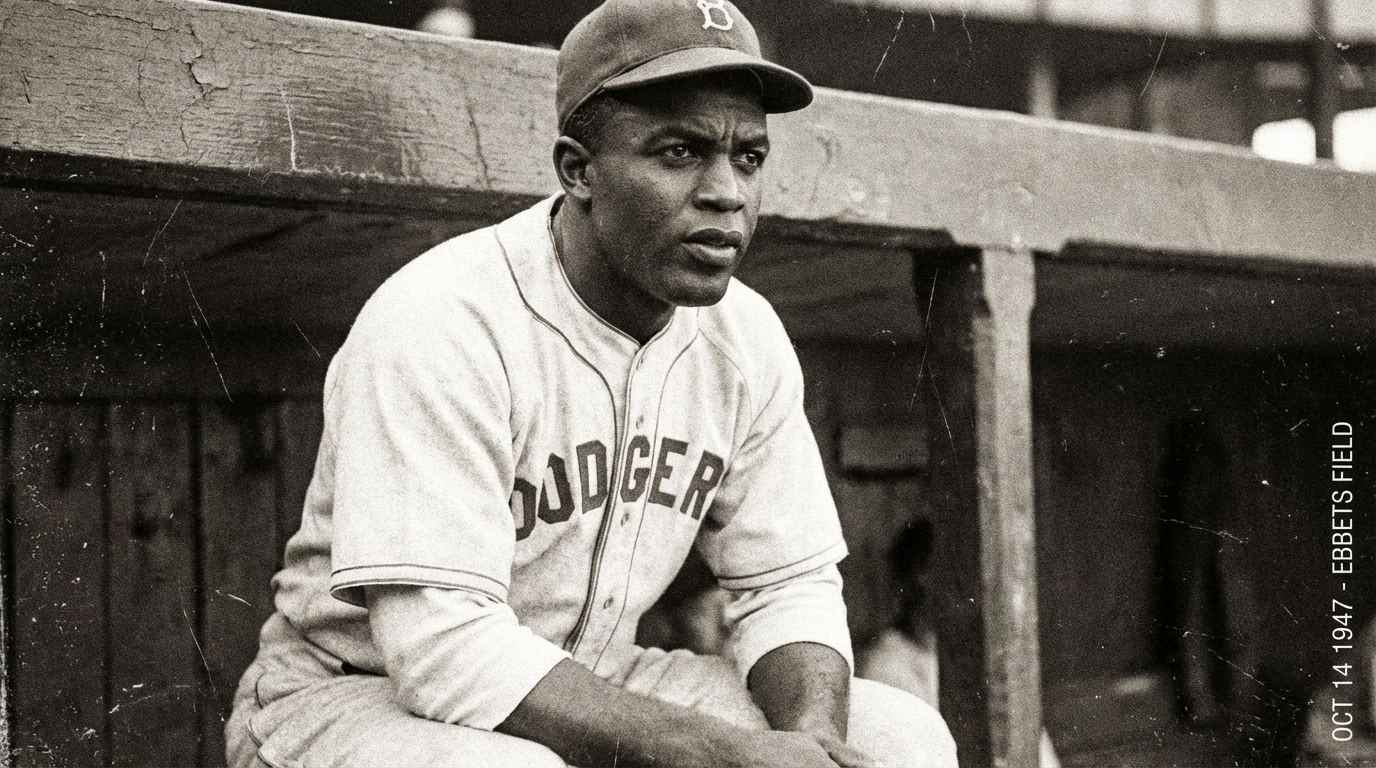
Reexamining Jackie Robinson: Legacy, Struggle, and Progress
It is often easy to reduce the history of American progress to a series of dates and inevitable victories, smoothing over the jagged edges of struggle until they feel like folklore. However, when we examine the life of Jackie Robinson, we are confronted with a narrative that refuses to be purely ceremonial. As we move through 2025, the commemoration of Robinson’s life has shifted from a celebration of baseball statistics to a deeper interrogation of the American soul. The number 42, emblazoned on every jersey once a year, represents a fracture in the timeline of the United Statesa moment where the stated ideals of the nation collided violently with its reality. Today, from the historic ballparks of the Northeast to the community centers of Florida, the effort to contextualize Robinson’s sacrifice is more active, and perhaps more necessary, than ever before.
The Irony and Progress of Modern Commemoration
The geography of Robinson’s legacy is filled with ironies. Perhaps none is more poignant than the recent celebrations in Boston. Historically, the Red Sox were the last Major League team to integrate, a fact that remained a stain on the franchise for decades. Yet, in a profound turn of events, Fenway Park has become a hub for honoring the very man the organization once shunned.
Recently, the Red Sox hosted a massive Jackie Robinson birthday event, welcoming over 1,000 students from Boston Public Schools. This was not merely a photo opportunity; it was a pedagogical intervention. The “Jackie Robinson Celebration of Life” utilized the venue to teach students about resilience and the breaking of barriers. By engaging the youth, the organization acknowledges that the story of integration is not a static chapter of the past but a continuous lesson in equity. The sight of students filling the stands to learn about a man who would have once been barred from playing on that field serves as a potent metric of how far the conversation has evolved.
The Southern Crucible: Orlando’s Tribute
While the major league cities often dominate the narrative, the crucible of Robinson’s ordeal was frequently found in the Spring Training sites of the Deep South. It was here, away from the bright lights of Ebbets Field, that the enforcement of Jim Crow was most visceral. Recognizing this specific regional history, the City of Orlando has taken significant steps to cement Robinson’s presence in the local landscape.
Just this year, city officials moved to formally honor the baseball legend, emphasizing that his impact transcended the diamond. According to a recent press release from the City of Orlando, the renaming of local landmarks and the revitalization of Jackie Robinson Park are central to preserving the city’s African American heritage. This is not just about naming rights; it is about reclaiming space. In the 1940s, a Black man entering a “whites only” space was a radical, dangerous act. By etching his name onto the map of Florida, the city ensures that the geography of segregation is overlaid with the geography of triumph.
These municipal actions in Florida serve as a reminder that Robinson’s battle wasn’t limited to nine innings. It was fought in hotels he couldn’t sleep in, restaurants he couldn’t eat in, and towns where his very presence was viewed as an insurrection against the social order.
The Enduring Relevance of Jackie Robinson in America250
As the United States prepares for its semiquincentennialthe 250th anniversary of the signing of the Declaration of Independencehistorians and cultural critics are expanding the pantheon of “Founders.” The traditional definition, limited to the men in Philadelphia in 1776, is being widened to include those who actually forced the country to live up to its founding documents.
In this context, Robinson is being reframed as a “Guardian” of the American way of life. A compelling analysis regarding the America250 initiative argues that Robinson struck a blow for equality that was as foundational as any legislative act. By integrating the “National Pastime,” he integrated the national consciousness. The argument posits that you cannot tell the story of American liberty without the story of American segregation, and Robinson is the bridge between the two.
This intellectual shift is crucial. It moves Robinson from being just a sports hero to being a civic architect. His stoicism in 1947 was a political strategy, a non-violent protest enacted before the term became popularized by Dr. Martin Luther King Jr. He absorbed the vitriol of a nation so that the generations following him might walk through doors he kicked open.
The Cost of the Pioneer
Investigative scrutiny into Robinson’s life reveals the immense cost of his role. The narrative often praises his restrainthis promise to Branch Rickey that he would not fight back. However, contemporary writers and historians are increasingly focusing on the psychological and physical toll of that silence. Robinson was a fiery, competitive man. Suppressing his natural instinct to retaliate against abuse caused him immense internal stress, contributing to the health issues that led to his premature death at age 53.
To treat him solely as a passive vessel of integration is to do him a disservice. He was an active combatant in a psychological war. After his baseball career, Robinson did not fade away; he became a vocal columnist and activist, often criticizing the slow pace of progress in baseball management and American society at large. He marched, he raised funds, and he spoke out. The modern commemoration must embrace this complexity: the man who turned the other cheek in 1947 became the man who demanded answers in 1967.
Education as the New Frontier
The thread connecting the Red Sox event, the Orlando dedication, and the America250 retrospective is education. The current generation of students is removed from the Civil Rights Movement by over half a century. For them, segregation can feel like ancient history. This is why the hands-on approach seen in Boston is critical. It transforms Jackie Robinson from a black-and-white photo into a three-dimensional figure of resistance.
When students stand in Fenway Park, they are standing in a laboratory of social change. They are learning that institutions can change, but only if individuals are willing to bear the burden of that change. The legacy is no longer about whether a Black man can play baseball; it is about who has access to the front office, who owns the teams, and how the economics of the sport reflect the diversity of its fanbase.
Frequently Asked Questions
Q: Why is the number 42 retired across all of Major League Baseball? A: The number 42 was retired universally in 1997 to honor the 50th anniversary of Robinson breaking the color barrier. It is the only number retired across the entire league, signifying that his impact went beyond any single team and fundamentally changed the sport and the country.
Q: How did Jackie Robinson’s role extend beyond baseball? A: After retiring from baseball, Robinson was a tireless civil rights activist. He served on the board of the NAACP, helped found the Freedom National Bank (a Black-owned financial institution), and wrote a syndicated newspaper column where he addressed issues of racial inequality and politics.
Q: What is the significance of the recent Red Sox celebration mentioned in the column? A: The Red Sox were the last MLB team to integrate (in 1959). Their hosting of a massive 106th birthday celebration for Robinson represents a significant institutional pivot, using their platform to educate youth about the history of segregation and the importance of inclusion.
Q: Did Jackie Robinson have a connection to Florida? A: Yes. Like many players of his era, Robinson spent time in Florida for Spring Training. It was there that he faced some of the most severe enforcement of Jim Crow laws, being barred from team hotels and restaurants. Cities like Orlando are now honoring that difficult history by dedicating parks and landmarks in his name.
Conclusion: The Unfinished Work
As we look toward the future, the story of Jackie Robinson remains a vital, living document of American history. It is not a story that ended with his induction into the Hall of Fame or the retiring of his number. It is a narrative that is rewritten every time a city like Orlando reclaims a space for equality, or a franchise like the Red Sox teaches a child about the cost of exclusion. Robinson’s life serves as a mirror; when we look at it, we see not just who we were, but who we aspire to be. The monuments and the birthday celebrations are essential, but they are merely the framework. The true work lies in the daily application of the values he died forvalues that suggest the American experiment is only as strong as its willingness to include everyone in the game.