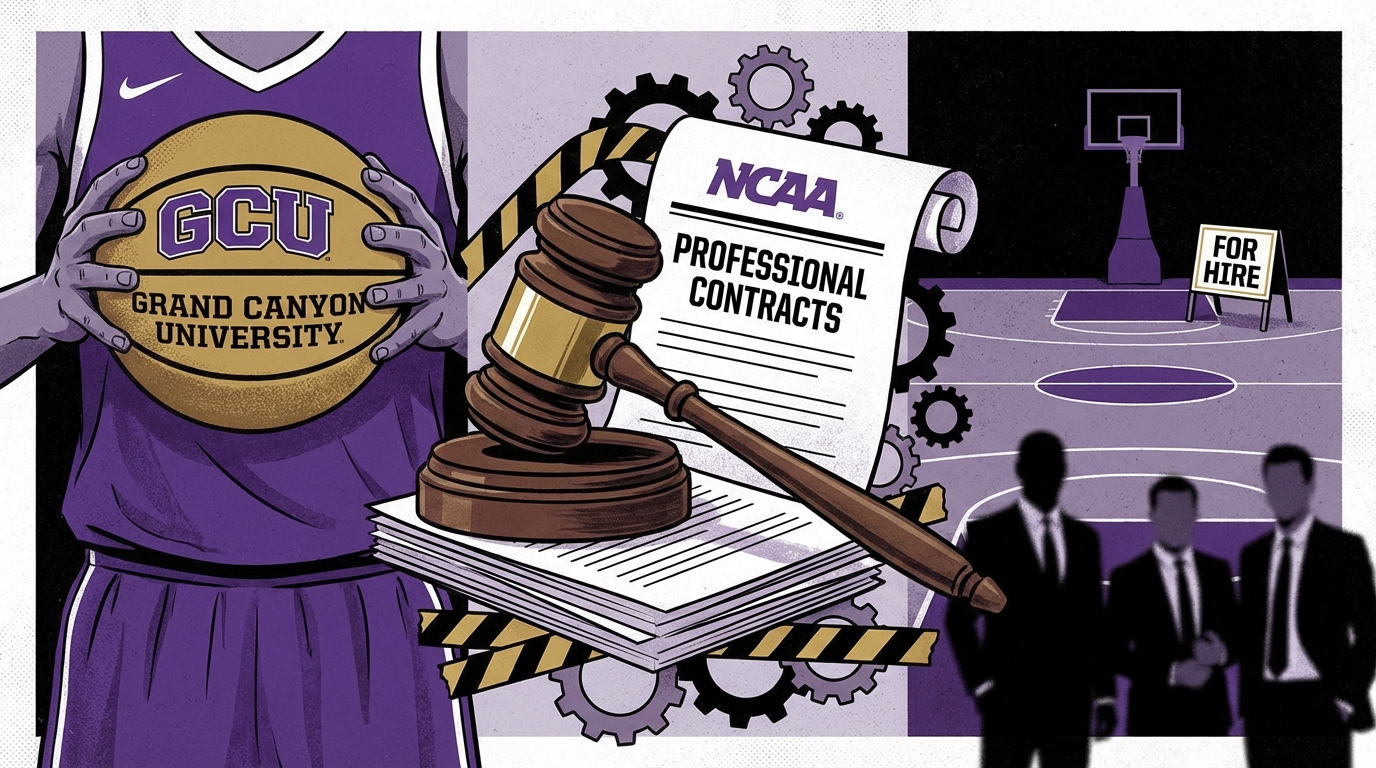
Amari Bailey Visits Grand Canyon University for NCAA Return
The modern landscape of collegiate athletics is less about amateurism and more about arbitrage. Players are constantly weighing the value of a scholarship and Name, Image, and Likeness (NIL) packages against the grind of professional development leagues. In a move that epitomizes this chaotic new era, former UCLA guard and Charlotte Hornets draft pick Amari Bailey is attempting a reverse migration. He is looking to trade the professional ranks for a return to campus, and Grand Canyon University has emerged as the surprising, yet fitting, epicenter of this experiment.
This is not merely a transfer story; it is a stress test of the NCAA’s evolving rulebook. Bailey is not a standard transfer student. He is a professional athlete who has signed contracts, accepted a salary, and appeared in the National Basketball Association. His scheduled visit to Phoenix suggests that the Lopes are willing to gamble on talent even when the regulatory path is obscured by legal fog.
The Bailey Profile: From Sierra Canyon to the Hornets
To understand the magnitude of this potential acquisition, one must look at Bailey’s pedigree. A former five-star recruit out of Sierra Canyonwhere he played alongside Bronny JamesBailey was a standout at UCLA. During his freshman season in Westwood, he averaged 11.2 points per game and showed flashes of NBA-level athleticism. He declared for the draft, was selected 41st overall by the Charlotte Hornets, and signed a two-way contract.
Usually, this is where the college story ends. The door closes, the lock clicks, and the player enters the workforce. However, Bailey’s professional tenure was mixed. While he dominated the G-League, averaging over 19 points per game, his NBA exposure was limited to ten games. He was eventually waived, leaving him in the precarious position of a free agent with high upside but no guaranteed roster spot.
According to recent reports, Bailey has set a visit to Grand Canyon University, signaling a serious intent to leverage his remaining eligibility. This pivot speaks volumes about the current state of the G-League versus the NCAA. For a player on the fringe of the NBA, a top-tier college program with a robust NIL collective can often offer more financial stability and exposure than a standard G-League contract.
The Eligibility Minefield
The excitement surrounding Bailey’s potential arrival in Phoenix must be tempered by the cold reality of NCAA bylaws. The governing body of college sports has relaxed many rules regarding amateurism, specifically concerning NIL and the ability of players to return to school if they go undrafted. However, Bailey was drafted, he signed, and most importantly, he played.
Current NCAA regulations generally prohibit a student-athlete from returning to collegiate competition if they have participated in a professional league. There is a distinction often made between the G-League and the NBA. While the NCAA has softened its stance on pre-draft processes, actual participation in the NBA regular season has historically been a hard line. As noted by analysts, Bailey’s eligibility faces significant hurdles because he logged minutes in official NBA games. This is not a case of a player merely attending training camp; the box scores exist.
If Grand Canyon University proceeds with this recruitment, they are likely banking on one of two scenarios: a specific waiver from the NCAA based on procedural nuances, or a belief that the current legal environment renders the NCAA toothless to enforce such restrictions. In a post-House v. NCAA world, rules that restrict athlete movement and earning potential are being challenged daily. GCU might be betting that the NCAA has no appetite for a lawsuit over a student-athlete wishing to pursue an education.
The Aggressive Rise of the Lopes
Why is Grand Canyon University the destination for such a high-stakes gamble? The answer lies in the program’s meteoric rise and aggressive culture. Under head coach Bryce Drew, the Lopes have transformed from a curiosity into a legitimate mid-major power. They have reached the NCAA Tournament three times in the last four years and recently secured their first tournament victory against Saint Mary’s.
GCU operates differently than traditional non-profits. Its history as a for-profit institution (and its subsequent complex return to non-profit status) has instilled a business-like aggression in its athletics department. They invest heavily in facilities, marketing, and talent acquisition. The “Havocs” student section creates one of the most hostile environments in college basketball, providing a stage that rivals high-major programs.
Landing a talent like Bailey fits the Bryce Drew archetype: high upside, high visibility. The program has successfully rehabilitated and showcased transfers before, turning Phoenix into a destination for players looking for a second act. If Bailey is cleared to play, he would instantly become one of the most talented guards in the country, potentially elevating GCU from a tournament participant to a second-weekend threat.
The Broader Trend: The Professional Retreat
Bailey is not an isolated case; he is a symptom of a shifting market. The financial dynamics of basketball have inverted for the lower tier of professionals. A two-way NBA contract pays approximately half a million dollars, but nothing is guaranteed if the player is waived. Conversely, top college players are reportedly commanding NIL packages that rival or exceed these salaries, with the added benefits of housing, education, and national marketing exposure.
We are seeing a trend where the “professional” tag is losing its permanence. The NFL and other leagues are watching closely as athletes challenge the one-way street of professionalization. If Bailey successfully reintegrates into the NCAA system, it could open the floodgates. Imagine a world where late second-round picks or undrafted free agents play a year in the G-League, realize the path is blocked, and return to college to develop further while earning NIL money.
This creates a fascinating dilemma for the NCAA. If the organization’s stated goal is the education and welfare of student-athletes, denying a 20-year-old the chance to return to school simply because he played ten games for the Charlotte Hornets seems increasingly indefensible in court. However, allowing it blurs the line between college basketball and a minor professional league to the point of invisibility.
The Risk and Reward for GCU
For Grand Canyon University, the risk is calculated. Even if Bailey is ultimately ruled ineligible, the mere fact that a player of his caliber is visiting campus serves as a marketing coup. It signals to other recruitsboth high schoolers and transfersthat GCU is a place where NBA talent considers playing. It validates the program’s stature on a national level.
However, the roster implications are real. Allocating a scholarship and practice reps to a player who might be barred from competition is a tactical gamble for Coach Drew. The team must prepare for a season with Bailey as the focal point, while simultaneously preparing a contingency plan if the NCAA drops the hammer. This requires a flexible coaching staff and a locker room with strong chemistry to handle the uncertainty.
Furthermore, the Western Athletic Conference (WAC) is growing more competitive. GCU cannot afford to waste a roster spot if they intend to maintain their dominance. Yet, the potential rewarda lottery-talent guard leading the Lopes in Marchis a siren song too sweet to ignore.
Conclusion
The saga of Amari Bailey is far from over. It represents a collision of ambition and regulation. On one side, a player seeking to reclaim his career trajectory; on the other, an NCAA rulebook struggling to remain relevant in a commercialized ecosystem. Sitting in the middle is Grand Canyon University, a program unafraid to push boundaries in its quest for national relevance. Whether Bailey ever suits up for the Lopes is almost secondary to the statement his visit makes: the walls between the pros and college are crumbling, and GCU intends to be the first to walk through the rubble.
Frequently Asked Questions
Q: Why is Amari Bailey’s eligibility in question? A: Bailey was drafted by the Charlotte Hornets and played in official NBA regular-season games. Historically, the NCAA views this as a permanent forfeiture of amateur status, unlike players who only participate in the pre-draft process or summer league.
Q: Has Grand Canyon University signed former pros before? A: While GCU has been aggressive in the transfer portal, signing a player with actual NBA regular-season experience is unprecedented for the program and rare for the NCAA as a whole. Most of their transfers come from other Division I programs.
Q: What is the “House settlement” mentioned in the context of eligibility? A: The House v. NCAA settlement is a major legal agreement involving back pay for athletes and revenue sharing. It signifies the weakening of the NCAA’s legal ability to restrict athlete compensation and movement, potentially giving lawyers ammunition to challenge Bailey’s ineligibility.
Q: Can Amari Bailey play immediately if he commits to GCU? A: That depends entirely on the NCAA’s ruling. Without a waiver or a successful legal injunction, he would likely be ineligible under current bylaws. The process could take months to resolve.