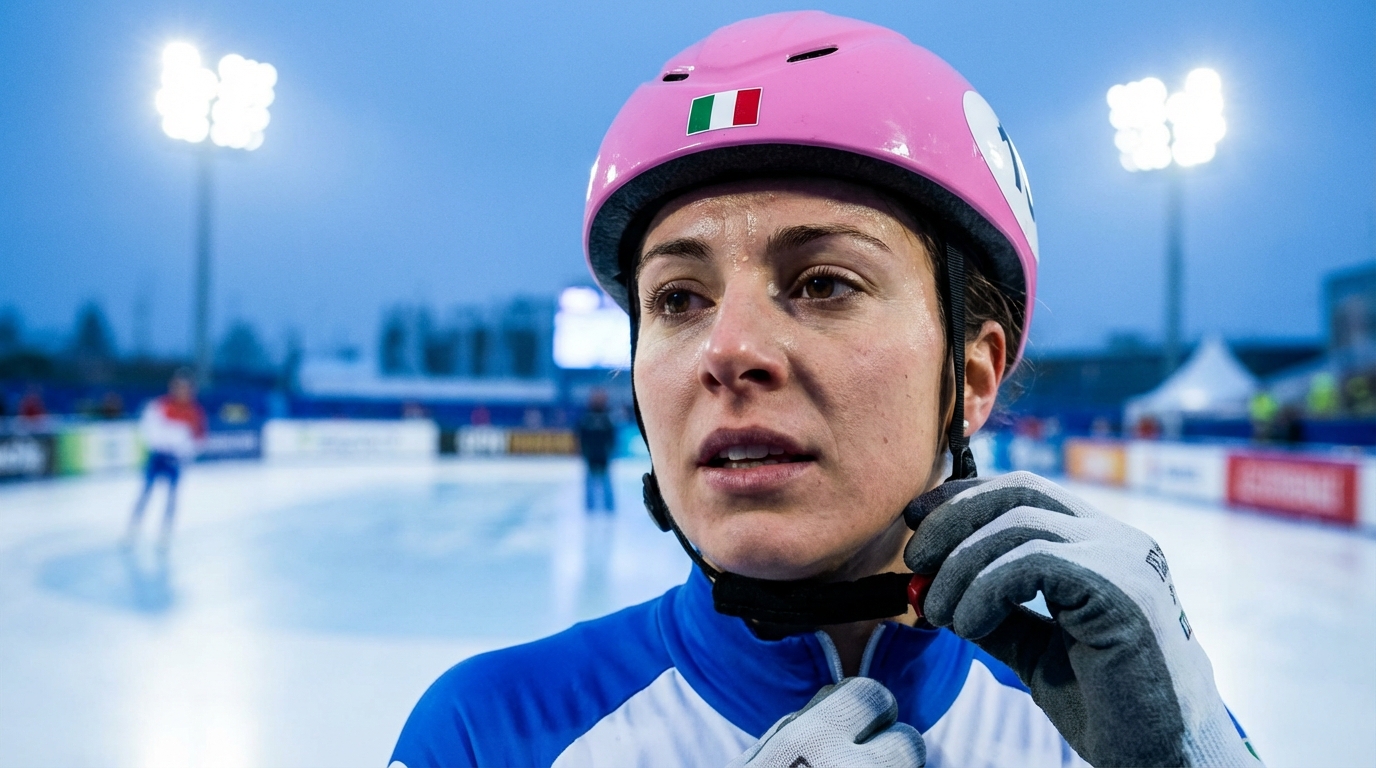
Francesca Lollobrigida: From Hollywood Lineage to Olympic Ice
In the annals of Italian cultural history, the surname “Lollobrigida” has long been synonymous with the golden age of cinema, evoking images of flashbulbs, red carpets, and the timeless allure of Gina Lollobrigida. However, on the icy ovals of the Winter Olympics, that name has been repurposed to represent grit, aerodynamic precision, and anaerobic endurance. Francesca Lollobrigida, the great-niece of the legendary actress, has spent the last decade carving a distinct identity into the ice, moving beyond the shadow of her lineage to become one of Italy’s premier winter athletes. As the sporting world pivots its gaze toward the 2026 Milano-Cortina Games, Lollobrigida’s narrative is shifting from one of breakthrough success to a complex story of resilience, motherhood, and the relentless pursuit of gold on home soil.
The Intersection of Hollywood Lineage and Athletic Grit
For most athletes, the primary burden is the weight of their own expectations. For Francesca Lollobrigida, the burden is historical. Being related to “La Lollo,” one of the most recognizable figures in 20th-century film, provided an immediate media hook, but it also created a skepticism that she had to skate hard to outrun. The press is often quick to focus on the glamour of the name rather than the grueling reality of the sport. Yet, Francesca has consistently redirected the spotlight to her performance metrics rather than her pedigree.
According to a profile by Quotidiano.net, Francesca’s rise was not paved by her famous aunt’s influence but by a relentless work ethic forged on asphalt before it ever touched the ice. Before she was an Olympic silver medalist, she was a world champion in roller skating, a discipline where Italy has historically excelled. The transition from wheels to blades is notoriously difficult; while the cardiovascular engine translates well, the friction coefficients and biomechanics of the push are radically different. Lollobrigida did not just adapt; she thrived, becoming a symbol of the modern multidisciplinary athlete.
The Physics of the Oval: Understanding the Arena
To appreciate the magnitude of Lollobrigida’s achievements, one must understand the unforgiving nature of long-track speed skating. It is a sport governed by the ruthless laws of physics, where wind resistance is the ultimate adversary. Unlike the chaotic, elbow-to-elbow nature of short track, long track is often a solitary battle against the clock, even when skating in pairs. The athletes must maintain a crouched positionthe “skating position”that restricts blood flow to the legs while demanding maximum power output, a physiological paradox that induces searing pain.
As detailed in a technical breakdown by Men’s Health IT, the rules of the sport are designed to test pure speed and tactical endurance. Competitors race on a 400-meter oval, switching lanes every lap to ensure they cover the same distance. This lane swap requires immense spatial awareness and timing, particularly at speeds exceeding 50 km/h. For an athlete like Lollobrigida, who specializes in mass start and distance events, the challenge is compounded by the need for tactical draftingusing the opponent to break the air resistance before launching a sprint in the final lap. This strategic layer turns a physical race into a high-speed chess match, where a single miscalculation in the crossover turn can cost a podium spot.
The Maternity Pivot: A New Physiological Reality
The narrative of the “athlete mother” is becoming increasingly prominent in elite sports, yet it remains a physiological and logistical tightrope. After her success in Beijing 2022, where she claimed silver in the 3000m and bronze in the mass start, Lollobrigida stepped away to give birth to her son, Tommaso. This hiatus is not merely a pause; it is a reset of the body’s core mechanics. Returning to the ice involves rebuilding the pelvic floor, reclaiming core stability, and reacclimating to the hypoxic stress of high-intensity interval training.
Critics often view a maternity break as the twilight of a speed skater’s prime, but recent trends in endurance sports suggest otherwise. The “mom strength” phenomenonoften attributed to increased pain tolerance and psychological shiftshas seen athletes return with renewed focus. For Lollobrigida, the motivation has shifted. She is no longer skating just to prove she is more than a famous name; she is skating to define a legacy for her son. However, the road back is steep. The international field has not remained static, and younger skaters, unburdened by time away from the oval, have continued to lower lap times.
The Road to Milano-Cortina 2026
The upcoming Winter Olympics in Milano-Cortina represent the ultimate horizon for the current generation of Italian winter athletes. Competing on home ice offers a distinct advantage in terms of crowd support and familiarity with the venue, but it also brings a crushing weight of expectation. The Italian speed skating federation is currently in a state of high alert, optimizing training regimens to ensure their athletes peak exactly in February 2026.
The competitive landscape within Italy is fierce. As noted by OA Sport, the men’s side, led by Davide Ghiotto, is setting a blistering pace, creating a training environment of excellence that permeates the entire national team. Ghiotto’s status as a luxury outsider in the 5000m indicates the depth of the field, and this internal competition serves as a crucible for Lollobrigida. She is not merely the default leader of the women’s team; she must earn her spot against rising talent and the relentless clock. The synergy between the men’s and women’s squads, sharing technical insights and training data, is crucial. In a sport decided by hundredths of a second, the collective intelligence of the teamanalyzing ice conditions, blade curvature, and suit aerodynamics can be the difference between gold and obscurity.
Analyzing the Mass Start Strategy
One of Lollobrigida’s strongest events is the Mass Start, a chaotic 16-lap race that resembles a cycling peloton on ice. This event, reintroduced to the Olympics recently, favors athletes with a background in roller skating, where pack racing is the norm. In roller skating, physical contact and tight maneuvering are constant; on ice, these skills translate to an ability to navigate traffic without losing momentum.
In the Mass Start, raw speed is insufficient. An athlete must possess the “kick”an explosive burst of power available even when lactate levels are critical. Lollobrigida’s history on wheels gives her a tactical edge here. She understands the fluid dynamics of the pack, knowing instinctively when to shelter behind a rival and when to break into the wind. However, the unpredictability of the Mass Start means that even the best preparation can be undone by a crash or a boxed-in position. As we approach 2026, her training will likely focus heavily on these high-variability scenarios, simulating the chaotic conditions of an Olympic final.
The Cultural Impact of a Second Act
If Francesca Lollobrigida succeeds in Milano-Cortina, the cultural impact will be profound. It would cement the transition of her family name from a symbol of mid-century cinema to a symbol of 21st-century athletic resilience. It would also serve as a powerful case study for the longevity of female athletes, proving that a career does not end at motherhood. The Italian media, often prone to nostalgia, would be forced to reconcile the two “Lollobrigidas”one of art, one of sportas equal pillars of national pride.
The stakes are incredibly high. A failure to perform on home ice would be scrutinized heavily, given the resources invested in the team. But Lollobrigida has spent a lifetime managing scrutiny. From the moment she first laced up skates, she has been answering questions about her aunt. Now, the questions are about her lap times, her recovery metrics, and her medal count. In many ways, this is the victory she has already won: she has forced the world to engage with her on her own terms, defined by the edge of a blade rather than the lens of a camera.
Conclusion
As the countdown to Milano-Cortina continues, Francesca Lollobrigida stands at a pivotal juncture. She is no longer the upstart trying to prove she belongs, nor is she simply the relative of a movie star. She is a veteran, a mother, and a tactician of the ice. The path ahead requires navigating the brutal physics of speed skating and the emotional complexities of a comeback. Whether she stands on the podium in 2026 remains to be seen, but her journey has already rewritten the script attached to her famous surname, turning it into a synonym for Olympic excellence.
Frequently Asked Questions
Q: Is Francesca Lollobrigida related to the actress Gina Lollobrigida? Yes, Francesca is the great-niece of the famous Italian actress Gina Lollobrigida. While she acknowledges the connection, she has built her own independent career in sports.
Q: What events does Francesca Lollobrigida specialize in? She specializes in long-track speed skating, particularly in middle to long distances like the 1500m and 3000m, as well as the Mass Start event.
Q: Has she won any Olympic medals? Yes, at the Beijing 2022 Winter Olympics, she won a silver medal in the 3000m and a bronze medal in the Mass Start.
Q: What was her sport before ice speed skating? Before transitioning to the ice, Francesca was a highly decorated world champion in inline speed skating (roller skating), a background that significantly aids her technique in mass start races.
References
- Men’s Health IT. “Pattinaggio di velocit: regole, storia e benefici.” www.menshealth.com
- Quotidiano.net. “Chi Francesca Lollobrigida.” www.quotidiano.net
- OA Sport. “Speed Skating, Davide Ghiotto outsider di lusso in un 5000 olimpico di livello stellare.” www.oasport.it