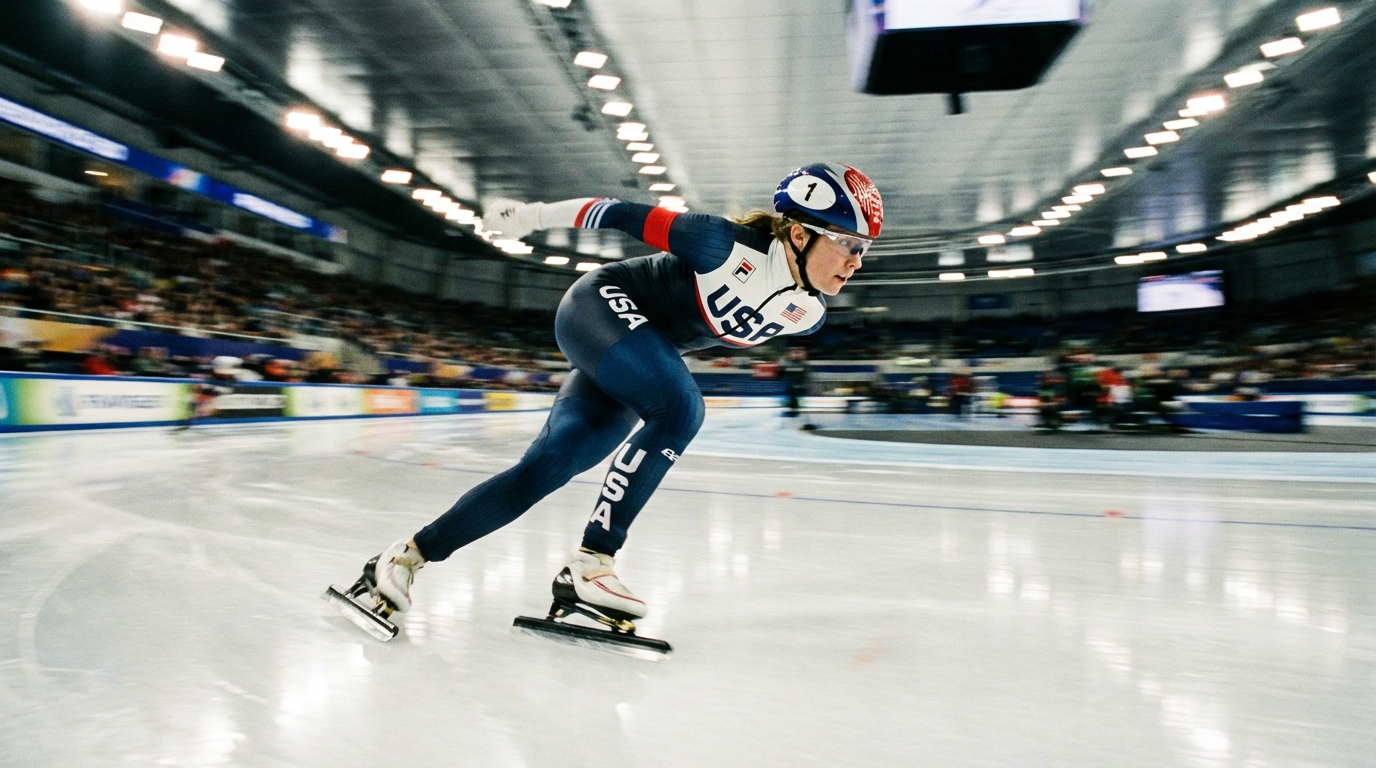
Casey Dawson Finishes 10th in 5000m, Focuses on Team Pursuit
The atmosphere at the 2026 Milano-Cortina Winter Olympics is electric, a stark contrast to the sterile, locked-down environment of Beijing four years prior. For Casey Dawson, this Games represents something more than just another shot at a medal; it is a testament to stability, routine, and the sheer grit required to remain at the pinnacle of speedskating. While the headlines in 2022 were dominated by his frantic, last-minute dash across the globe to make the starting line, the narrative in 2026 is one of settled determination. However, as the results from the 5000m indicate, the road to the podium is paved with razor-thin margins and relentless international rivals.
The Long Road from Beijing to Milan
To understand the weight of Dawson’s current campaign, one must revisit the chaos of his Olympic debut. In 2022, Dawson became a folk hero of sorts, not immediately for his skating, but for his odyssey. Trapped in the United States due to positive COVID-19 tests, he missed the 5000m event entirelya race he had trained his whole life for. He arrived in Beijing with hours to spare for the 1500m, competing on borrowed blades because his luggage was lost in transit. That chaotic prelude culminated in a triumphant bronze medal in the Team Pursuit, proving his resilience.
Fast forward to February 2026. The chaos has subsided, replaced by the regimented precision of an elite athlete’s schedule. There were no lost bags or quarantine hotels this time. Yet, the absence of logistical drama does not guarantee athletic supremacy. In the men’s 5000m, a grueling test of aerobic capacity and technical efficiency, Dawson faced a field that has only grown faster and deeper in the intervening quadrennial.
Analyzing the 5000m Performance
On the ice in Milan, the reality of long-track speedskating’s evolution became apparent. Dawson, skating in the earlier pairs, posted a time of 6:18.46. It was a solid, workmanlike performance, indicative of a skater who belongs in the top tier, but it lacked the explosive closing laps required to unseat the European powerhouses. As the competition progressed, the times tumbled, eventually pushing Dawson to a 10th-place finish.
According to USA Today, the event was a showcase of the sport’s current hierarchy, with Dawson finishing roughly 10 seconds off the podium pace. While a top-10 finish at the Olympics is an achievement that eludes most athletes, for a competitor of Dawson’s caliber, it serves as a diagnostic tool. It highlights the gap between the “very good” and the “transcendent” skaters currently dominating from the Netherlands and Sweden.
The 5000m is a brutal distance. It requires the skater to maintain a lap time that varies by only tenths of a second for over six minutes. Dawson’s race showed consistency, but to crack the top five, an athlete must possess the ability to accelerate in the final 1600 metersa gear that Dawson couldn’t quite find on this specific day. However, in the grand scheme of the Games, the 5000m is often a precursor for Dawson, a way to open the lungs and feel the ice before his signature event: the Team Pursuit.
Culture, Camaraderie, and the Pink Backpack
Elite sports are often viewed through a lens of stoic seriousness, but the internal dynamics of Team USA reveal a different, more human side to the pressure cooker of the Olympics. Investigative reporting into the team’s culture uncovers that their bond is forged not just in the weight room, but through shared downtime and humorspecifically, fantasy football.
In a delightful twist of human interest reported by the Press Republican, the US Speedskating team maintains a high-stakes fantasy football league where the punishments are as rigorous as the training. This year, the “loser” of the league was saddled with a bright pink backpack, a punishment that befell none other than Dawson’s teammates and staff at various points, creating a running joke that permeates the Olympic village experience.
These seemingly trivial anecdotes are vital for understanding athlete psychology. The pink backpack and mandated odd phone cases serve as grounding mechanisms. They remind the athletes that despite the millions of eyes watching their every stride, they are still a group of friends playing a game. For Dawson, who endured isolation in 2022, this integration into the team’s social fabric is crucial. It suggests a mental state that is relaxed and supported, a key ingredient for success in the high-stress environment of the Team Pursuit.
The Technical Landscape of Milano-Cortina
The ice at the Milano-Cortina Games has been a subject of intense scrutiny. Every Olympic oval has a unique charactersome are “fast” ice, aided by altitude (like Salt Lake City) or specific humidity controls, while others are “heavy,” requiring more force per stride. The live updates from The Athletic suggest that the 2026 surface is fair but unforgiving. It rewards technical perfection over brute strength.
For a skater like Dawson, whose technique is built on rhythm, the ice conditions are favorable for the team events. In individual races, a minor slip in technique costs hundredths of a second that cannot be recovered. In the pursuit, the draft effectskating in the slipstream of a teammatemitigates some of the ice’s friction. Dawson’s 10th place individual finish indicates his fitness is there; the challenge now is synchronizing that fitness with his teammates Emery Lehman and Ethan Cepuran.
Beyond the Individual: The Team Pursuit Focus
While the 5000m result goes down in the record books, the internal strategy for Casey Dawson and US Speedskating has always weighed heavily toward the Team Pursuit. This event, introduced to the Olympics in 2006, turns an individual sport into a tactical ballet. Three skaters must move in unison, trading the lead to manage wind resistance, with the clock stopping only when the third skater crosses the line.
The US team enters this discipline with a chip on their shoulder. After the bronze in Beijinga medal won despite the logistical nightmaresthey have spent the last four years refining their exchanges. Dawson is the engine of this team. His ability to hold high speed for long durations (demonstrated by his 5000m background) makes him an ideal anchor. The 10th place finish in the individual event should not be viewed as a failure, but rather as a calibration. He has felt the ice under race conditions. He knows where the limits are.
The Evolution of US Speedskating
Dawson’s career trajectory mirrors the broader shifts in US Speedskating. Following the drought of medals in previous cycles, the program retooled, focusing heavily on the science of the sport and team cohesion. The fantasy football league mentioned earlier is a symptom of a tighter, more cohesive unit. In previous years, US skaters often operated as silos, individual contractors under a national flag. Today, the integration is palpable.
This cultural shift is essential because the rest of the world has not stood still. The Dutch remain the gold standard, with a depth of talent that allows them to field multiple medal contenders in every distance. The Scandinavian countries have seen a resurgence, particularly in the endurance distances. For the US to compete, they cannot rely solely on freak athletic talent; they must rely on efficiency and strategy. Dawson represents this new breed of American skater: technically sound, scientifically trained, and psychologically integrated into a support system.
Conclusion
As the Milano-Cortina Games continue, the spotlight on Casey Dawson will shift from his individual performance to his role as a team leader. The 5000m race was a necessary step, a clearing of the throat before the main aria. Finishing 10th in the world is a formidable achievement, but for an athlete who has tasted Olympic hardware, it is merely the prelude. The pink backpack may be a punishment in their fantasy league, but the burden Dawson carries now is the weight of expectationnot to just show up, as he fought to do in 2022, but to lead Team USA back to the podium. The chaotic rookie has become the seasoned veteran, and his true test awaits in the pursuit.
Frequently Asked Questions
Q: How did Casey Dawson finish in the 2026 Olympic 5000m? A: Casey Dawson finished in 10th place in the men’s 5000m speedskating event at the 2026 Milano-Cortina Winter Olympics, with a time of 6:18.46.
Q: What was the controversy surrounding Casey Dawson in the 2022 Olympics? A: In 2022, Dawson tested positive for COVID-19 just before the Games, causing him to miss the 5000m event. He arrived in Beijing just hours before the 1500m, competing on borrowed blades because his luggage was lost, before eventually winning bronze in the Team Pursuit.
Q: What is the story behind the pink backpack mentioned in reports? A: The pink backpack is a humorous punishment for the loser of the US Speedskating team’s internal fantasy football league. It highlights the close-knit culture and camaraderie among the athletes.
Q: What is Casey Dawson’s strongest event? A: While he is a strong individual distance skater, Dawson is widely considered a specialist in the Team Pursuit, where he helped Team USA win a bronze medal in 2022.