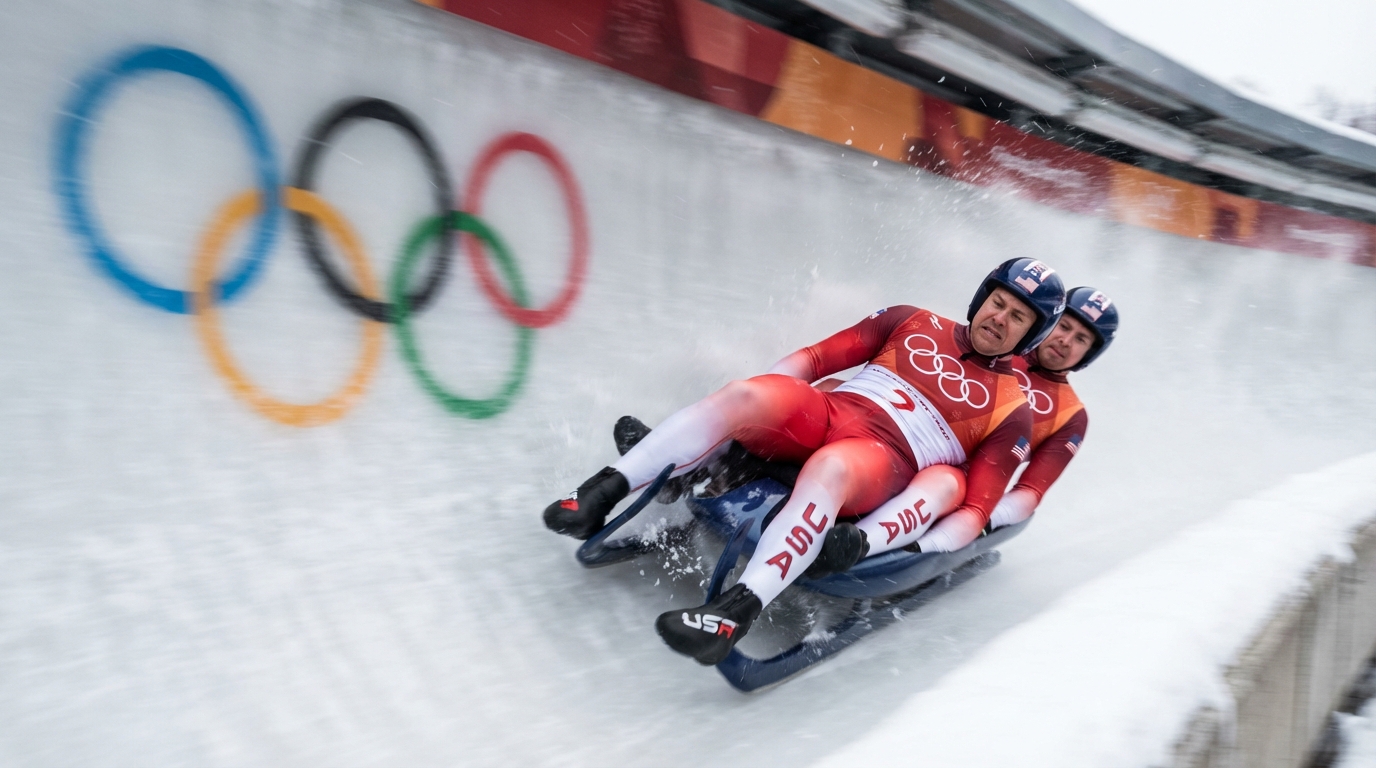
The Physics of Doubles Luge: Speed, Trust, and Team USA
The Vertical Coffin: A Study in Trust and Aerodynamics
Gravity is a harsh mistress, but nowhere is she more demanding than on the icy tracks of the Winter Olympics. Among the sliding sports, doubles luge stands out as a peculiar anomaly of physics and bravery. While skeleton involves a head-first plunge and bobsled requires a team inside a chassis, luge demands that athletes lie supine, feet-first, on a tiny fiberglass shell. In the doubles discipline, this danger is compounded by adding a second human body directly on top of the first, creating a stack of humanity hurtling down a frozen chute at highway speeds. It is a sport defined not just by athleticism, but by an almost telepathic level of trust between partners.
TL;DR
- The Mechanics: Two athletes stack vertically; the top slider has visibility, while the bottom slider steers largely by feel and head position.
- The Speed: Sleds reach speeds between 80 and 90 mph, with athletes experiencing up to 5 Gs of force.
- The Stakes: Races are timed to the thousandth of a second, meaning a single steering error or aerodynamic drag can cost a medal.
- The Watch: NBC and Peacock hold the rights for the 2026 cycle, offering both live broadcasts and on-demand streaming for the US audience.
- The Team: USA’s Gustafson and Greiner are currently logging critical runs to establish seeding and synergy.
The Architecture of the Slide
To the uninitiated observer, a luge run looks like a chaotic blur. However, the mechanics of doubles luge are a sophisticated dance of aerodynamics. The taller athlete typically takes the top position, while the shorter or stouter partner lies underneath. This stacking is not arbitrary; it is designed to create a streamlined profile that cuts through the air with minimal resistance. According to KARE11, the sport is timed to the one-thousandth of a second. This precision means that the “top man” and “bottom man” must move as a single unit. If the top slider shifts their weight to the left to navigate a curve, the bottom slider must instantly mirror that adjustment, often without being able to see the track ahead.
The bottom slider is essentially flying blind. Their view is obscured by the helmet and body of their partner. They rely on neck cuesthe tilting of the top partner’s headand the G-forces pressing against the sled to know when to apply pressure to the runners (the blades in contact with the ice). The sleds themselves have no mechanical brakes and no steering wheel. Steering is accomplished by flexing the sled’s runners with the calves and exerting shoulder pressure. In the doubles discipline, this requires a synchronization that takes years to perfect. A misunderstanding at 90 mph can result in a crash or, more commonly, a “skid” that bleeds valuable time.
Comparison Table
The following table outlines how doubles luge compares to other sliding disciplines regarding configuration and viewer experience.
| Option | Best for | Pros | Cons | Pricing/Cost |
|---|---|---|---|---|
| Doubles Luge | Fans of technical teamwork | Highest complexity of coordination; visually unique | Hardest to follow individual contributions; higher crash risk | High (Equipment + Travel) |
| Singles Luge | Pure speed enthusiasts | Clear focus on individual skill; slightly faster speeds | Less dynamic than team events; extremely repetitive | High (Custom Sleds) |
| Skeleton | Adrenaline junkies | Head-first perspective is thrilling; easier to understand | Slower than luge; less aerodynamic nuance | Moderate to High |
| Bobsled | Team sport fans | High energy; relatable “car-like” mechanics | Expensive equipment; driver gets all the glory | Very High (Sleds cost $50k+) |
The American Push: Gustafson and Greiner
The landscape of American luge is currently in a state of aggressive development. The focus has shifted toward the next Winter Games, with athletes grinding through World Cup circuits to secure qualifying points. Recent footage has highlighted the efforts of Team USA’s Chevonne Forgan and Sophia Kirkby, as well as the men’s teams. Specifically, NBC Olympics reports on the progress of USA’s Gustafson and Greiner, who have taken their first significant luge runs of the season. These initial runs are critical for “dialing in” the sleda process of adjusting the steel runners and the fiberglass pod to match the specific ice conditions of a track.
For Gustafson and Greiner, the challenge is twofold. First, they must maintain physical peak condition to ensure an explosive start. The start is the only time athletes can physically propel themselves using spiked gloves to paddle against the ice. Once gravity takes over, physics dictates the rest. Second, they must refine their communication. In doubles luge, silence is often the sign of a good run. If partners have to shout commands, they are likely already in trouble. The silent coordination of shifting weight into a high-G turn is what separates podium contenders from the rest of the pack.
Pros and Cons of the Discipline
Pros
- Extreme Precision: The sport showcases the absolute limit of human reflexes, with decisions made in milliseconds.
- Team Dynamics: Unlike singles, the success of the run depends entirely on the symbiotic relationship between two athletes.
- Speed: Reaching speeds of nearly 90 mph on ice without a roll cage provides a visceral thrill for spectators.
- Inclusivity: The sport has recently expanded to include women’s doubles and mixed team relays, broadening the field.
Cons
- High Barrier to Entry: Access to luge tracks is extremely limited (only a few exist globally), making it a niche sport.
- Danger: The lack of protection compared to bobsled makes crashes potentially severe.
- Visibility: For the bottom slider, the experience is claustrophobic and relies entirely on trust rather than sight.
- Cost: The technology required for competitive sleds is prohibitively expensive for many developing nations.
The Broadcast Ecosystem: 2026 and Beyond
As the sport heads toward the 2026 Winter Olympics, the consumption of luge is changing. The days of delayed tape broadcasts are fading in favor of live streaming models. According to NJ.com, NBC and its streaming arm, Peacock, remain the central hubs for American viewers. The network has structured its coverage to include both prime-time showcases and live daytime coverage of final runs. This is crucial for a sport like luge, where weather conditions or track delays can shift start times unpredictably.
The viewing experience for doubles luge is enhanced by modern technology. High-definition phantom cameras now capture the oscillation of the sled runners, showing viewers the violence of the vibration that athletes endure. Furthermore, the timing systems have evolved. We are no longer just watching a clock; we are watching split times at four or five different intervals down the track. This data allows commentators to pinpoint exactly where a team lost momentumwhether it was a poor line through the labyrinth (a series of quick turns) or a slight skid at the start. For the viewer, understanding that the difference between gold and silver is often less than the blink of an eye adds a layer of tension unique to sliding sports.
FAQ
Q: How do luge athletes stop the sled at the end of a run? A: Luge tracks are designed with an uphill section at the finish line to naturally slow the sled down using gravity. Additionally, athletes sit up to create aerodynamic drag and may pull up on the runners to increase friction against the ice.
Q: Why do doubles luge partners lie on top of each other? A: The stacked position is the most aerodynamic configuration allowed. It reduces the surface area exposed to wind resistance, allowing the heavy sled (combined weight of two athletes) to maintain higher velocities than if they were side-by-side.
Q: Is there a weight limit for the athletes? A: Yes and no. There are weight restrictions for the sleds, and lighter athletes are allowed to carry additional lead weights to reach a maximum competitive weight. This ensures that heavier teams do not have an unfair gravity advantage over lighter, skilled teams.
Q: Can the bottom person see anything? A: Very little. The bottom slider’s view is largely blocked by the top slider’s helmet and shoulders. They rely on peripheral vision, memory of the track layout, and physical cues from their partner’s body movements to anticipate turns.
The Razor’s Edge
As Team USA continues its preparation for the upcoming winter season, the focus on doubles luge remains intense. The sport is a testament to the extremes of human engineering and courage. It requires athletes to suppress the natural instinct of self-preservation in favor of aerodynamic efficiency. With Gustafson and Greiner pushing for position and the broadcast infrastructure of NBC ready to capture every millisecond, the stage is set for a high-stakes cycle. In a sport where a thousandth of a second dictates a career, there is no room for hesitation.