CNN Analyzes Trump's 2026 Labor Market Approval Ratings
The political landscape of February 2026 has become dominated by a singular, flashing warning light on the dashboard of the Trump administration: the labor market. As the initial economic surges of the term settle into a complex stagnation, the media apparatus has turned its full attention to the widening gap between White House rhetoric and voter reality. At the forefront of this coverage is CNN, which has begun dedicating significant airtime to dissecting the granular data of voter sentiment. The network’s pivot to hard numbers reflects a broader trend across the Fourth Estate, as outlets scramble to quantify exactly how much political capital has been lost over the winter.
This is not merely a story about percentage points; it is a narrative about the erosion of a political identity built on job creation. When the self-proclaimed “greatest jobs president” faces a skeptical electorate, the coverage itself becomes a crucial part of the political ecosystem. By examining the distinct approaches of CNN, PBS, and MSNBC, we can piece together a comprehensive picture of an administration facing its most significant domestic hurdle to date.
TL;DR
- The Trend: Voter approval regarding the management of the US job market has hit a critical low point as of February 2026.
- The CNN Angle: The network is utilizing probability models and “The Odds” segments to showcase the statistical difficulty of reversing this sentiment.
- The Base: MSNBC reports indicate that the collapse in approval is most acute among the working-class demographics that comprised the President’s core base.
- The Context: PBS offers a historical lens, comparing current low approval ratings to past administrations at similar junctures.
- The Stakes: With midterms approaching, the media narrative is shifting from general political intrigue to specific economic accountability.
Comparison Table: Media Analysis of Economic Polling
| Option | Best for | Pros | Cons | Pricing/Cost |
|---|---|---|---|---|
| CNN Analysis | Data-driven probability visualization | Offers granular “odds” and statistical modeling of voter sentiment changes. | Can sometimes feel detached from the human element of economic hardship. | Free (Ad-supported) / Cable Sub |
| PBS Newshour | Historical context and bipartisan paneling | Provides depth via experts like Tamara Keith and Amy Walter; less sensational. | May lack the immediate, breaking-news urgency of cable competitors. | Free (Public Broadcast) |
| MSNBC Morning Joe | Political strategy and base analysis | Excellent for understanding the emotional and demographic shifts in the electorate. | Analysis often leans heavily into dramatic narratives regarding “collapse.” | Free (Ad-supported) / Cable Sub |
| Google Trends | Raw interest tracking | Allows verification of public interest in specific news topics (e.g., “CNN” or “jobs”). | Raw data requires interpretation; offers no editorial context. | Free |
Pros and Cons of Current Media Coverage
Pros
- Data Density: Networks are increasingly relying on hard numbers rather than just punditry to explain the economic mood.
- Demographic Specificity: Coverage is successfully identifying exactly who is unhappy (e.g., the key base groups), rather than treating voters as a monolith.
- Historical Benchmarking: Outlets like PBS are effectively using history to determine if these approval dips are normal or anomalous.
- Visual Storytelling: Enhanced graphics and “magic wall” segments help visualize complex economic dissatisfaction.
Cons
- Echo Chambers: Different networks frame the same data in vastly different ways, potentially confusing the casual viewer.
- Lagging Indicators: Media analysis often reacts to polling, which can lag behind the real-time economic reality on the ground.
- Over-Politicization: Economic news is frequently framed solely through the lens of Trump’s reelection odds rather than policy impact.
- Short Attention Spans: Complex labor market dynamics are often reduced to soundbites about “approval ratings.”
FAQ
Q: Why is the media focused on the job market in early 2026? A: While headline employment numbers may show one story, voter sentiment often tracks with inflation, wage growth, and job security. The current media focus is driven by a disconnect where voters feel less secure despite government assurances.
Q: How does CNN’s coverage differ from MSNBC’s regarding this topic? A: CNN tends to focus on the statistical probability of political recovery and the breadth of the disapproval across the country. MSNBC, particularly shows like Morning Joe, focuses more on the political betrayal felt by the specific coalition of voters who elected the President.
Q: Are these approval ratings unusual for a second-term President? A: Second-term slumps are common, often referred to as the “six-year itch” in American politics. However, the severity of the drop among a President’s own base, as noted in recent reports, is a notable deviation from the norm.
The Anatomy of a Polling Collapse
To understand the gravity of the situation, one must look beyond the daily headlines and into the methodology of the dissent. The narrative emerging from MSNBC’s Morning Joe is particularly telling. Their analysis suggests that the President’s approval rating is not just sliding; it is “collapsing” among the key group that helped put him in the White House. This is a critical distinction. A general dip in approval is a weather event; a collapse among the base is a climate change event for an administration.
This specific demographicoften characterized by non-college-educated voters in the Rust Beltwas the firewall against Democratic encroachment. If this wall is indeed crumbling, as the reporting suggests, it indicates that the economic populism that fueled the initial movement has failed to deliver tangible results in the eyes of its beneficiaries. The media’s role here has shifted from covering the spectacle of the presidency to auditing its receipts.
CNN and the Statistical Reality
The approach taken by CNN offers a different, yet equally damning, perspective. In their recent segment titled “The Odds,” the network moved away from emotional anecdotes to focus on the cold calculus of voter views. According to a CNN video report, the sentiment regarding Trump’s handling of jobs across America has shifted statistically in a way that makes political recovery difficult.
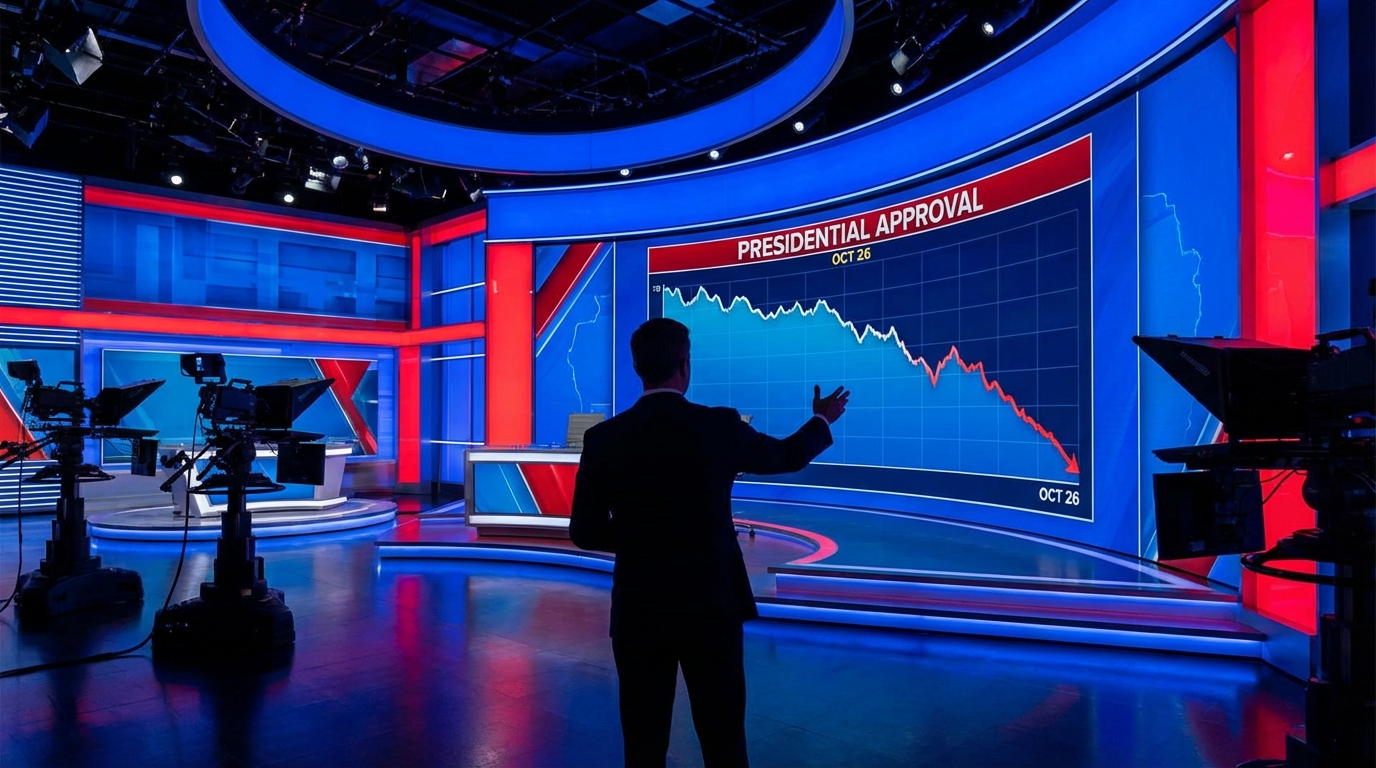
The visual language of the broadcastanchors flanking large digital readouts of the Presidentunderscores the gravity of the data. By framing the discussion around “odds,” the network is implicitly telling viewers that this is not a temporary fluctuation but a structural deficit. The “jobs market” is no longer just an economic term; it has become a proxy for competence. When voters lose faith in the President’s ability to manage the economy, history suggests that faith in other areas of governance follows suit.
The Historical Lens: PBS Newshour
While cable news often operates at a fever pitch, public broadcasting has provided necessary context. In discussions featuring Tamara Keith and Amy Walter, PBS Newshour has analyzed these low approval ratings through a historical prism. Their coverage reminds us that modern presidencies are increasingly polarized, meaning that approval ceilings are lower and floors are harder to break.
However, even within this polarized context, the current numbers are an outlier. The PBS analysis suggests that the stickiness of inflation or the perceived lack of quality jobs has penetrated the partisan armor that usually protects a President. When Amy Walter speaks on the shifts in the electorate, she highlights that economic anxiety is one of the few forces capable of overriding tribal political loyalty.
Search Interest as a Proxy for Concern
Beyond the broadcast networks, digital behavior confirms that the public is actively seeking answers. Data from Google Trends reveals sustained interest in CNN and related political news, suggesting that voters are turning to established outlets to validate their economic anxieties. The spikes in search traffic often correlate with major economic announcements or negative polling releases, indicating a reactive and engaged populace.
This digital footprint is essential for understanding the 2026 voter. They are not passively receiving news; they are actively verifying it. If the search volume for “Trump approval” and “jobs report” overlaps, it signals that the electorate is connecting the dots between their personal financial situations and political leadership, a connection that the White House would likely prefer to sever.
Conclusion
As we move deeper into 2026, the convergence of media narratives paints a stark picture. Whether it is the “collapse” identified by MSNBC, the statistical “odds” calculated by CNN, or the historical context provided by PBS, the conclusion is uniform: the President is facing a crisis of confidence regarding the economy. The job market, once the crown jewel of the administration’s argument for power, has become its Achilles’ heel.
For the investigative observer, the story is no longer about whether the approval ratings are downthat is an established fact. The story is now about whether the administration can alter a narrative that has been solidified by data, amplified by cable news, and validated by the lived experience of the American worker. As CNN continues to track these odds, the window for a turnaround narrows with every jobs report.