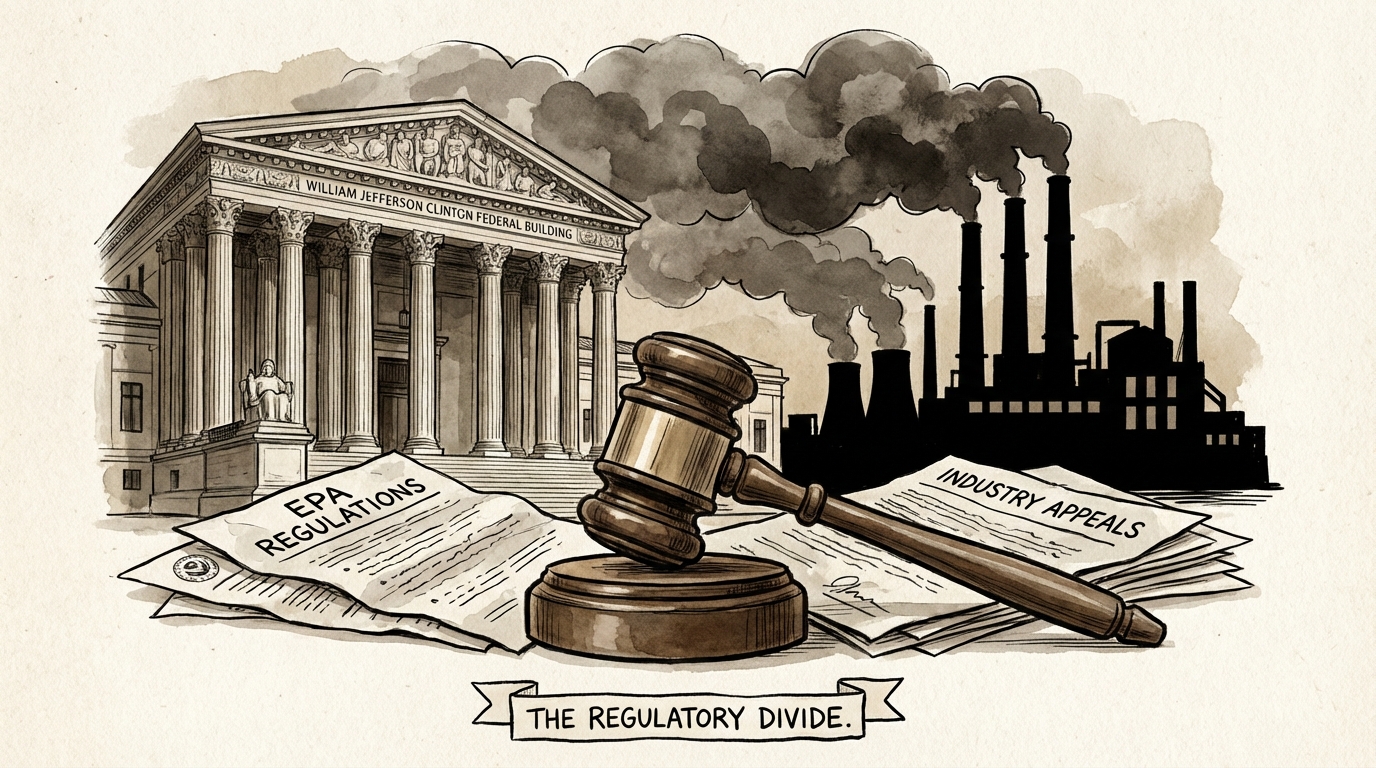
Administration Moves to Revoke EPA Endangerment Finding
Washington, D.C. The corridors of the William Jefferson Clinton Federal Building are quieter than usual this week, but the silence belies the seismic shifts occurring within. In a move that redefines the scope of federal power, the administration has officially initiated the process to dismantle the regulatory framework of the EPA. This is not merely a pause on enforcement or a tweak to fuel efficiency standards; it is a fundamental assault on the legal mechanisms that allow the federal government to address climate change. As of mid-February 2026, the Environmental Protection Agency stands at the precipice of the most significant rollback in its fifty-five-year history, a maneuver that promises to reshape the American economy and its environmental trajectory for decades to come.
TL;DR
- Core Action: The administration is moving to revoke the 2009 “endangerment finding,” which classifies CO2 as a pollutant.
- Economic Goal: Supporters claim this will lower energy costs and remove bureaucratic shackles from the coal and auto industries.
- Legal Reality: The move will trigger immediate lawsuits, likely freezing regulatory certainty until a Supreme Court ruling.
- State Conflict: California and allied states are preparing to defend their independent waivers, threatening a fractured national market.
- Health Impact: Public health experts project a rise in respiratory ailments if particulate matter regulations are relaxed alongside CO2 rules.
The Nuclear Option: Targeting the Endangerment Finding
For years, deregulation advocates have chipped away at the edges of environmental policy. However, the strategy unveiled this week strikes at the root. The target is the 2009 endangerment finding, a scientific determination that greenhouse gases threaten public health and welfare. This finding is the trigger that compels the EPA to regulate carbon emissions under the Clean Air Act. By seeking to reverse this finding, the administration is effectively arguing that the science justifying the regulation of carbon dioxide is invalid or that the agency overstepped its statutory bounds.
According to a recent analysis by The Guardian, this represents the “biggest rollback” in the history of the agency. The strategic logic is clear: if the endangerment finding is voided, the legal obligation to set fuel economy standards for vehicles and emissions caps for power plants evaporates. This is not just about pausing rules; it is about deleting the authority to make them.
Legal scholars have long debated the durability of the finding. While the science of climate change is robust, the administrative process of the finding is now under the microscope. The administration’s position relies on a strict interpretation of the Clean Air Act, suggesting that Congress never intended for a 1970s law to govern 21st-century climate policy. This interpretation aligns with the “major questions doctrine” recently favored by the judiciary, which posits that agencies cannot resolve questions of vast economic and political significance without clear congressional authorization.
The Economic Argument: Unshackling Industry
The rationale driving this purge is rooted in a philosophy of economic liberation. Proponents argue that the EPA has morphed from a guardian of clean water and air into a central planner of the energy economy. By dictating the energy mix of the power grid and the drivetrain technology of the American automobile, the agency, they argue, has stifled innovation and inflated costs for consumers.
A recent opinion piece in The Washington Post articulates this view, suggesting the agency is right to reverse what is termed “Obama-era overreach.” The argument posits that market forces, rather than federal mandates, should determine the lifespan of coal plants and the adoption rate of electric vehicles. By removing the regulatory floor, the administration hopes to extend the viability of fossil fuel assets and reduce the cost of internal combustion vehicles, which remain popular in vast swathes of the country.
However, the industry reaction is far from monolithic. While coal operators and some independent oil producers celebrate the move, the automotive sector faces a nightmare scenario: uncertainty. Automakers plan product lines five to seven years in advance. A sudden reversal of emissions targets renders billions of dollars in EV investments precarious. Furthermore, if the federal standard collapses, the US market could fracture, with California and a coalition of other states enforcing strict standards while the federal government enforces none.
A Legal Quagmire: The Courts Await
The path from announcement to implementation is paved with litigation. Environmental groups have already prepared filings to challenge any attempt to revoke the endangerment finding. They will argue that the administration is acting “arbitrarily and capriciously” by ignoring the massive body of peer-reviewed science that supports the original finding. Under the Administrative Procedure Act, an agency cannot simply change its mind; it must provide a reasoned explanation based on the evidence.
Vox reports that the legal battle will likely center on the interpretation of “harm.” The administration may argue that while climate change is real, the specific threshold of harm required to trigger the Clean Air Act has not been met, or that the economic harm of regulation outweighs the environmental benefits. This utilitarian calculus is a risky legal strategy, but one that may find a receptive audience in the current appellate courts.
If the courts stay the rollback, the industry remains in limbo. If they allow it to proceed, the US becomes the only major developed nation without a federal mechanism to regulate carbon. The implications for international trade are stark; the European Union has already signaled that it may impose carbon border adjustment tariffs on US goods if American climate policy regresses significantly.
Comparison Table: The Regulatory Fork in the Road
The following table outlines the divergent paths currently facing the US energy and transportation sectors.
| Option | Best for | Pros | Cons | Pricing/Cost |
|---|---|---|---|---|
| Retain Endangerment Finding | Green Tech & Public Health | Legal certainty for automakers; alignment with global climate goals; reduced healthcare costs from pollution. | Higher short-term energy costs; accelerated closure of coal plants; potential strain on grid reliability during transition. | High initial capital expenditure; lower long-term social costs. |
| Revoke Endangerment Finding | Fossil Fuel Industry | Deregulation stimulates short-term GDP; extends life of legacy assets (coal/gas); lowers sticker price of gas cars. | Massive legal uncertainty; fractured state-by-state markets; loss of global trade competitiveness; increased climate risk. | Lower immediate consumer costs; Unknown long-term environmental liability. |
| Legislative Reform (Hypothetical) | Congressional Authority | Clarifying agency power; democratic legitimacy for climate policy. | Incredibly difficult to pass in a polarized Congress; likely to be watered down. | Varies based on specific carbon tax or cap-and-trade mechanisms. |
Pros and Cons of the Rollback
Pros
- Regulatory Relief: Immediate reduction in compliance costs for power plants and heavy manufacturing.
- Consumer Choice: Potential for lower prices on traditional internal combustion engine vehicles as manufacturers face fewer penalties.
- Energy Independence: Encourages the maximization of domestic fossil fuel extraction without carbon penalties.
- Administrative Check: Restores a stricter interpretation of separation of powers, limiting agency overreach.
Cons
- Climate Acceleration: Removes the primary US tool for meeting Paris Agreement targets, accelerating global temperature rise.
- Market Fragmentation: Likely splits the US into two car markets (California standards vs. Federal), increasing manufacturing complexity.
- Health Outcomes: Likely increase in co-pollutants (PM2.5, NOx) often emitted alongside CO2, leading to higher rates of asthma and heart disease.
- Global Standing: Diminishes US leverage in international climate negotiations and trade deals.
The Human Cost of Deregulation
Beyond the dry language of statutes and court filings lies the tangible reality of public health. The endangerment finding was not drafted in a vacuum; it was a response to evidence linking emissions to extreme weather events, heat waves, and respiratory illnesses. By decoupling the EPA from climate science, the administration is effectively betting that technological adaptation can outpace environmental degradation.
Critics argue that this gamble ignores the “co-benefits” of regulation. Rules designed to cut CO2 often necessitate scrubbers and filters that also trap mercury, sulfur dioxide, and particulate matter. If the pressure to decarbonize is lifted, the pressure to clean up these immediate, local toxins also subsides. Communities living in the shadow of power plantsoften low-income and minority populationswill bear the brunt of this policy shift.
FAQ
Q: Can the President simply cancel the endangerment finding via Executive Order? A: No. The finding is a formal scientific determination. To revoke it, the EPA must go through a rulemaking process, proving that the original science was flawed or that the interpretation of the law was incorrect. This process is subject to public comment and judicial review.
Q: How does this affect the California waiver? A: The Clean Air Act allows California to set stricter standards than the federal government if it gets a waiver. The administration is likely to revoke this waiver simultaneously. This sets up a Supreme Court battle over states’ rights versus federal supremacy in commerce.
Q: Will gas prices go down because of this? A: Not necessarily. Gas prices are determined by global oil markets, supply chains, and refining capacity. While regulatory costs are a factor, they are rarely the primary driver of pump prices compared to geopolitical events.
Q: What happens to the tax credits for Electric Vehicles (EVs)? A: The endangerment finding is separate from the Inflation Reduction Act (IRA) tax credits. However, without the regulatory “stick” of emissions standards, the “carrot” of tax credits may be less effective in driving manufacturer behavior, and the administration may target those legislative credits separately.
Conclusion
As the dust settles on the announcement, the EPA finds itself at the center of a cultural and economic war. The coming months will be defined by injunctions, appeals, and heated rhetoric. Whether one views this rollback as a liberation of American industry or a capitulation to short-term greed, the outcome is undeniable: the United States is voluntarily stepping back from the global consensus on climate regulation. The courts will ultimately decide if the agency has the right to abdicate its role, but the atmosphereboth political and physicalwill not wait for a verdict.