High On Life 2 Analysis: New Mechanics and Platform Shift
The Gatlian Gambit: How High On Life 2 Rewrote the Indie Blockbuster Playbook
It is rare for a sequel to not only change its mechanics but to fundamentally alter its allegiance in the console wars. Yet, as we navigate the crowded release window of February 2026, High On Life 2 has done exactly that. The follow-up to the 2022 cult hit has arrived, bringing with it a chaotic blend of potty-mouthed weaponry and, surprisingly, a robust skateboarding engine that feels lifted from the golden era of arcade sports games. But beyond the kickflips and the alien gore, a more intriguing story is unfolding in the business sector: the strategic pivot from Xbox Game Pass darling to a PlayStation-centric launch.
This column investigates how Squanch Games managed to scale their divisive comedy shooter into a polished franchise, the risks taken with the new traversal systems, and what the industry data tells us about their platform-agnostic future.
The Great Platform Migration
To understand the significance of this launch, we must look back at the predecessor. The original title was a flagship moment for Xbox Game Pass, breaking engagement records and proving that a AA studio could dominate the conversation against AAA titans. However, the sequel tells a different story regarding market dominance and hardware utilization.
In a move that surprised industry analysts, Squanch Games leadership has been vocal about their shift in development priorities. While the first game leveraged Microsoft’s subscription model to find an audience, the sequel is chasing direct sales on a massive install base. According to a recent interview with TechRadar, the studio’s CEO confirmed that despite the history with Xbox, PlayStation served as the “lead platform” for the sequel’s development cycle.
This is not merely a technical detail; it is a business statement. The decision to optimize for the DualSense controller utilizing haptic feedback to give every talking gun a distinct “voice” in the player’s hands suggests that Squanch Games is no longer content with being a subscription filler. They are positioning this franchise as a premium, standalone purchase. The shift indicates a broader trend in 2026 where mid-sized studios are re-evaluating the long-term sustainability of exclusivity deals versus the immediate revenue of cross-platform ubiquity.
Kickflipping the Shooter Genre
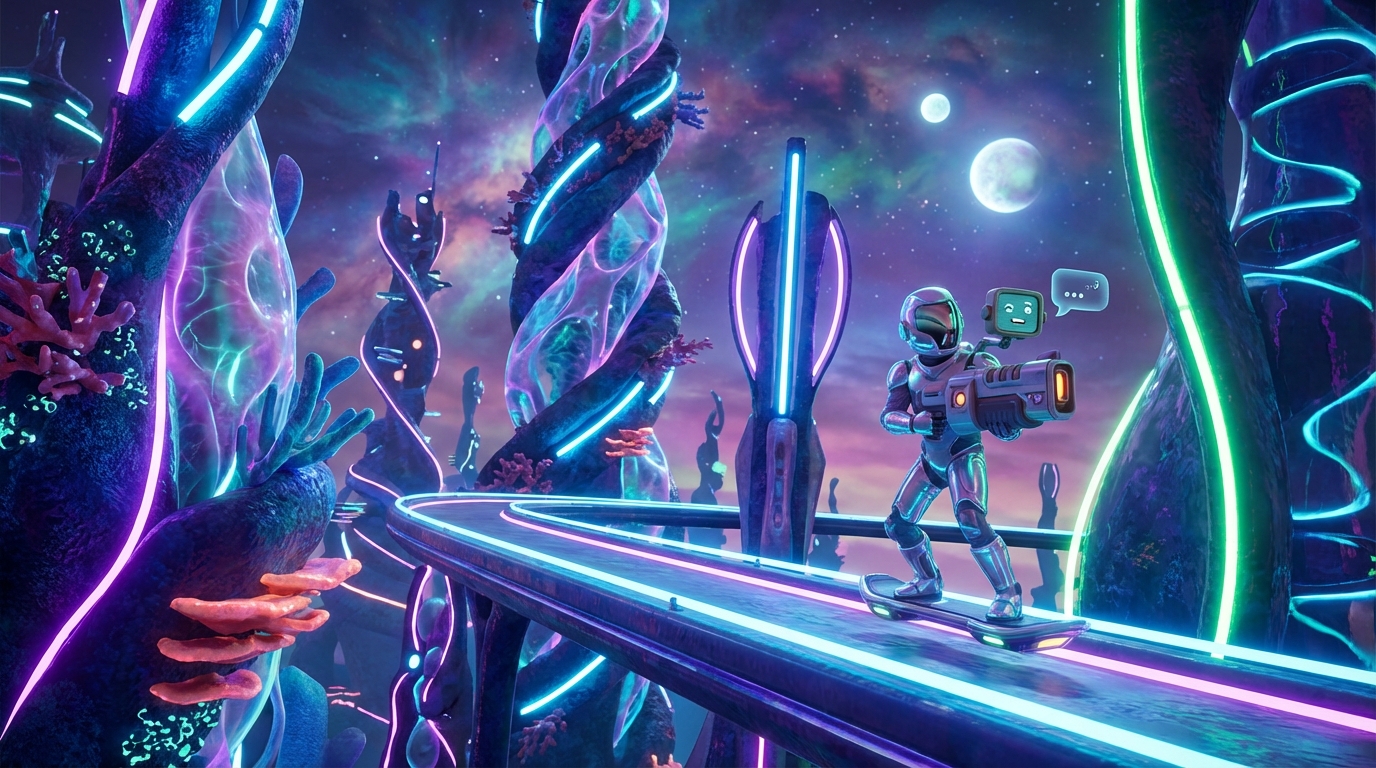
The most jarring, yet innovative, addition to the franchise is the introduction of a fully fleshed-out skating mechanic. In the first game, movement was functionala means to get from one combat arena to the next. In High On Life 2, movement is the combat.
The developers have integrated a hover-board system that interacts directly with the gunplay. It is no longer enough to strafe and shoot; players are now encouraged to grind rails, perform wall rides, and execute tricks to reload weapons or buff damage output. As detailed in a deep dive by Xbox Wire, this system “kickflips the shooter genre on its head,” creating a kinetic flow state that resembles Tony Hawk’s Pro Skater merged with Doom Eternal.
This mechanical pivot addresses one of the primary criticisms of the original: the repetitive nature of the encounters. By tying ammunition regeneration and health drops to style points and traversal combos, the game forces players to engage with the environment creatively. You aren’t just taking cover behind a crate; you are grinding off the crate, ollieing over a G3 cartel grunt, and firing a shotgun blast at the apex of the jump. It is a risky design choice that alienates players looking for a traditional cover shooter, but for those willing to master the controls, it offers a ceiling of skill expression rarely seen in comedy games.
Critical Consensus and the Humor Factor
Comedy in video games is notoriously difficult to land, and the first title was perhaps the most polarizing release of its year. The sequel appears to have refined its approach, though it remains unapologetically loud. The “Gatlians”the sentient alien gunsreturn with more dialogue lines than ever, but the implementation has matured.
Early impressions suggest that the developers have implemented a “chatter frequency” toggle right out of the gate, a feature that was patched into the first game only after launch. This allows players to customize their narrative experience, focusing on the environmental storytelling if the constant barrage of jokes becomes overwhelming. In their assessment, IGN noted that the game manages to balance its chaotic energy with genuinely tight gameplay loops, preventing the humor from overshadowing the mechanical improvements.
The narrative stakes have also been raised. The G3 Cartel is in disarray, leading to a power vacuum that introduces new villain archetypes. The writing team has moved beyond simple shock value, attempting to build a coherent lore around the galaxy’s drug trade where humans are the product. It is a dark satire that lands better in 2026, perhaps because the gameplay supporting it is finally robust enough to carry the weight of the script.
Technical Performance and Visual Fidelity
Visually, the game is a showcase for the current generation of hardware. Utilizing the latest iteration of Unreal Engine 5, the neon-soaked alien metropolises are denser and more vertical than the flat arenas of the predecessor. This verticality is essential for the new skating mechanics, requiring a draw distance and asset streaming speed that would have choked last-generation consoles.
The art direction retains the “squishy,” biological aesthetic that defines the studio’s style. Everything pulses, oozes, or vibrates. However, the technical leap is most evident in the animation blending. Transitioning from a sprint to a skate grind, and then to a grapple-hook swing, is seamless. For a game that relies on momentum, any stutter in framerate would be fatal. Reports indicate that on both PlayStation 5 Pro and Xbox Series X, the game holds a steady 60 frames per second, a non-negotiable requirement for a shooter with this level of speed.
The Business of Weird
Why does this release matter in the grand scheme of the US gaming market? Because it proves there is a viable middle ground between indie darlings and massive AAA live-service failures. Squanch Games has carved out a niche for “AA+” titlesgames with high production values but distinct, risky creative visions that wouldn’t pass a corporate boardroom committee at a major publisher.
The success of this sequel validates the single-player model in an era where publishers are desperate for recurring revenue. There are no battle passes here, no loot boxesjust a complete, bizarre experience sold at a premium price point. By prioritizing the PlayStation ecosystem this time around, the studio is betting that players are willing to pay upfront for creativity, rather than waiting for it to drop on a subscription service.
Frequently Asked Questions
Q: Do I need to play the first game to understand High On Life 2? A: While there are recurring characters and references to the G3 Cartel’s defeat, the sequel is designed as a standalone adventure. The intro provides a quick recap, so new players can jump in without feeling lost.
Q: How does the skateboarding mechanic work with a controller? A: It functions similarly to classic skating games. You use the triggers to accelerate and face buttons to jump or grind. The game utilizes auto-aim assists while grinding to help players focus on traversal without losing combat effectiveness.
Q: Is the game coming to Xbox Game Pass on day one? A: Unlike the first game, the sequel is not a day-one Game Pass release. It is available for direct purchase on Xbox and PlayStation, reflecting the studio’s shift in distribution strategy.
Q: Can you turn off the talking guns? A: Yes, the game features a granular “Gun Chatter” slider in the audio settings, allowing you to reduce the frequency of dialogue or turn off non-essential banter entirely.
Conclusion
As we move further into 2026, the gaming landscape continues to fragment, but titles like High On Life 2 provide a necessary jolt of adrenaline. By successfully marrying the precision of an arena shooter with the flow-state mechanics of a skating game, Squanch Games has avoided the sophomore slump. They have taken a polarizing property and polished it into a legitimate franchise contender.
The pivot to a PlayStation-led development cycle, despite the studio’s history with Microsoft, serves as a case study in studio independence and market adaptability. Whether you are there for the crude humor or the surprisingly deep combo system, the game demands attention. It stands as a testament to the fact that in a market of safe bets and remakes, weird still sells.