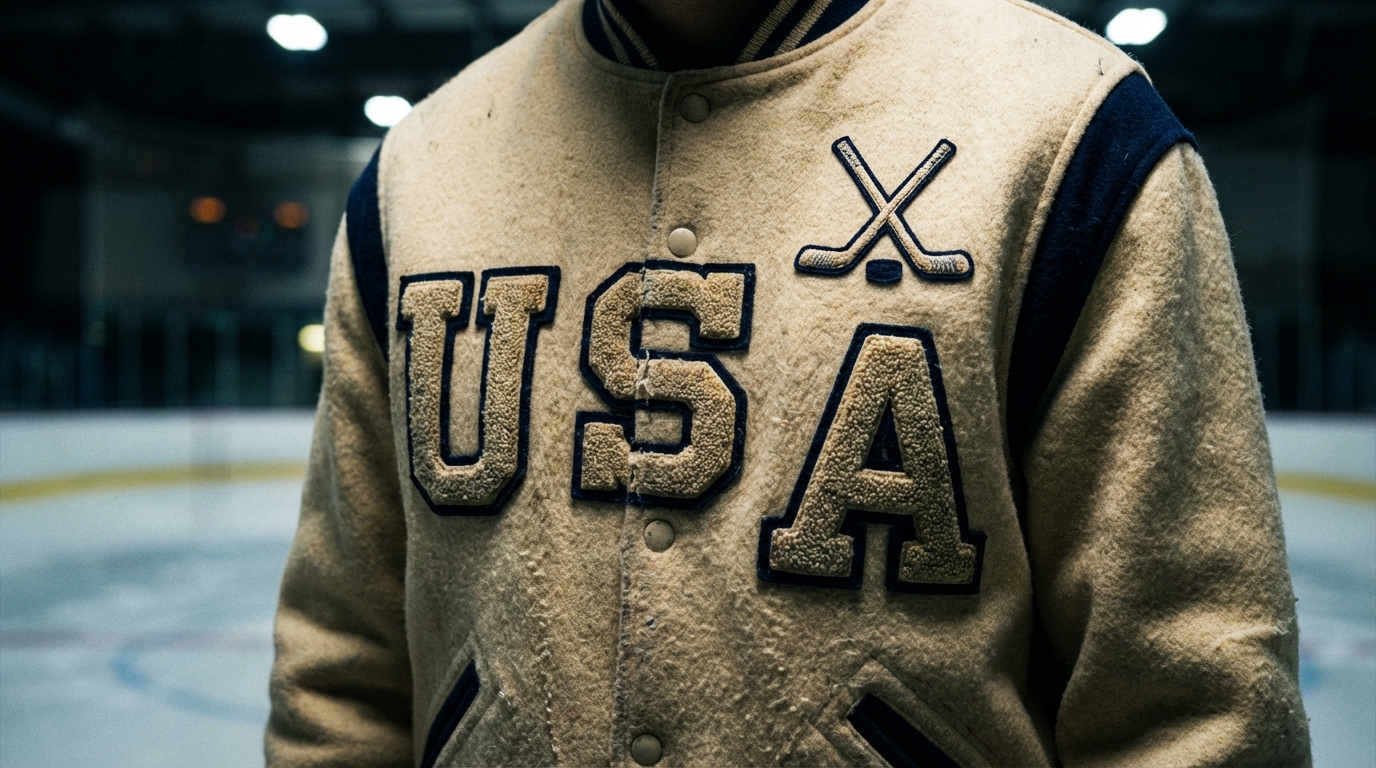
John Wroblewski Honors Hockey History with Vintage Jacket
In the high-definition, neon-lit spectacle of the Winter Olympics, where athletic wear is usually defined by moisture-wicking polymers and aerodynamic cuts, the most talked-about piece of equipment on the American bench wasn’t a stick or a skate. It was a heavy, cream-colored wool varsity jacket worn by John Wroblewski, the head coach of the US Women’s National Hockey Team. As the cameras panned across the bench during the opening rounds in Milan-Cortina, social media platforms lit up with inquiries about the coach’s retro aesthetic. But this was far more than a stylistic choice or a nod to vintage fashion trends; it was a calculated, emotional tribute to the very architecture of American hockey history.
To understand the significance of the garment, one must look past the stitching and into the soul of the sport in the United States. Wroblewski, tasked with guiding the women’s team to gold, chose to literally wear the history of the game on his back. The jacket did not come from a high-end vintage boutique in Brooklyn or a Nike concept store. It was pulled from the archives of the Bush family, originally belonging to the late Walter Bush, a man whose influence on the sport is so profound that without him, the women Wroblewski coaches might not be playing on this stage at all.
The Sartorial Statement Heard ‘Round the World
The immediate reaction to Wroblewski’s sideline attire was visceral. In an era where coaches often look like corporate managers in suits or fitness trainers in tracksuits, the varsity look struck a chord. According to Country Living, the internet’s obsession was instantaneous, with fans clamoring to find replicas. The jacket features a distinct cream body, likely wool or heavy cotton, with bold “USA” lettering stitched across the front and a hockey stick graphic that screams mid-century Americana. It evokes a time when the Olympics were less about brand synergy and more about amateur grit.
However, for those inside the hockey world, the jacket signaled something deeper than a viral fashion moment. It represented a bridge between eras. Wroblewski is known for his intensity and his intellectual approach to the game, and his choice of attire was consistent with a coach who understands that culture is built on stories. By donning a piece of authentic memorabilia, he wasn’t just keeping warm in the chilly Italian rinks; he was invoking a spirit of resilience. The visual contrast was stark: the modern, elite athletes of the 2026 squad skating in front of a coach wrapped in the fabric of 1964.
Unstitching the History: The Walter Bush Connection
To fully appreciate the gravity of this tribute, we must investigate the original owner: Walter Bush. Often called the “Godfather of Minnesota Hockey,” Bush was a titan of the sport. He was a member of the US Olympic Committee and served on the IIHF Council for decades. But his most enduring legacy, particularly relevant to Wroblewski’s current role, was his tireless advocacy for women’s hockey. Bush was instrumental in lobbying the International Olympic Committee to include women’s ice hockey in the Winter Games, a dream that was finally realized in Nagano in 1998.
The jacket itself is believed to date back to the 1964 Innsbruck Olympics, where Bush served as the team manager for the US men’s squad. As reported by Russian Machine Never Breaks, the garment is a genuine artifact from that campaign. For Wroblewski to wear this specific item while coaching the women’s team is a poetic closing of the circle. He is leading the very team that Bush fought to create, wearing the armor Bush wore when he was fighting for the sport’s recognition on the global stage.
From the Archives to the Bench
The journey of the jacket from a closet in Minnesota to the bench in Milan is a story of personal connection. Wroblewski didn’t just stumble upon the item; it was entrusted to him. The Bush family, recognizing the coach’s reverence for the game’s history, allowed him to borrow the piece for the tournament. This transfer of custody transforms the jacket from a piece of clothing into a talisman. It suggests a blessing from the founders of USA Hockey, a signal that the current generation is worthy of the legacy they have inherited.
In interviews surrounding the viral moment, the backstory began to emerge. As detailed by NBC DFW, the jacket had been preserved for decades, a silent witness to the growth of American hockey. Its re-emergence at the 2026 Games serves as a reminder that while the speed of the game has changed, the valuespatriotism, teamwork, and gritremain constant. For the players on the bench, seeing their coach in such a historic garment likely reinforces the idea that they are part of a continuum, not just a roster for a single tournament.
A Talisman for the Women’s Game
The symbolism of the jacket extends beyond general hockey heritage; it is specifically poignant for the women’s game. Walter Bush’s advocacy was not passive; he faced significant resistance in the 1980s and 90s when pushing for the inclusion of women in the IIHF World Championships and the Olympics. By wearing Bush’s jacket, Wroblewski is acknowledging that the platform his team currently enjoys was built by the man who originally wore those threads.
This gesture aligns with a broader trend in sports where current stars and coaches pay homage to pioneers. However, this is distinct because it involves a tangible object. It is not a digital tribute or a patch on a jersey; it is the physical weight of history. The cream-colored wool serves as a visual anchor. When the game gets chaotic, and the pressure of the Olympic stage mounts, the presence of that jacket on the bench serves as a grounding force. It reminds the squad that the path was cleared for them long ago, and their job is simply to skate it.
The Psychology of the Sideline Wardrobe
Coaches have long used their attire to project authority or solidarity. Herb Brooks had his plaid pants and blazers; Bill Belichick had his cutoff hoodies. John Wroblewski has carved out a unique niche with this vintage aesthetic. It projects a sense of “old school” reliability mixed with a reverence for the institution of USA Hockey. It tells the referees, the opposing coaches, and the global audience that the US team is not just a collection of talent, but an institution with deep roots.
Furthermore, the viral nature of the jacket has provided a massive PR boost for the team. In the crowded media landscape of the Olympics, where stories fight for oxygen, the mystery of the “cool coach’s jacket” drew eyes to the women’s hockey tournament. People came for the fashion and stayed for the history lesson. This is the power of visual storytelling in sports. Wroblewski likely knew that the jacket would turn heads, but he also knew it would provide an opportunity to talk about Walter Bush, thereby educating a new generation of fans about the origins of the sport they love.
FAQ: The Story Behind the Coat
Q: Can I buy a replica of John Wroblewski’s jacket? A: Currently, exact replicas are not mass-produced as official merchandise. The jacket is a vintage item from the 1960s. However, due to the viral response, third-party vintage retailers and potentially USA Hockey may explore releasing heritage-inspired lines in the future.
Q: Who was Walter Bush, the original owner of the jacket? A: Walter Bush was a pivotal figure in American ice hockey. He was a member of the US Olympic Committee, a long-time administrator for USA Hockey, and a key advocate who successfully lobbied for the inclusion of women’s hockey in the Winter Olympics.
Q: Why did the Bush family give the jacket to Wroblewski? A: The loan was a gesture of support and a way to honor Walter Bush’s legacy. It connects the history of USA Hockey’s administration with the current on-ice leadership, symbolizing a unified front and a respect for the past.
Q: What year is the jacket from? A: The jacket dates back to the 1964 Winter Olympics in Innsbruck, Austria, where Walter Bush served as the general manager for the United States men’s Olympic ice hockey team.
A Legacy Worn on the Sleeve
As the 2026 Milan-Cortina games progress, the image of the US bench will remain inextricably linked to that cream-colored silhouette. In a world of fleeting digital trends, the physical presence of Walter Bush’s jacket is a heavy, comforting reminder of the permanence of legacy. John Wroblewski has managed to do something rare: he has made a fashion statement that is entirely devoid of vanity.
By wearing the jacket, he has brought the spirit of the “Godfather of Minnesota Hockey” back to the Olympic village. He has reminded his players, and the world, that the road to gold is paved by those who came before. When the final buzzer sounds, regardless of the color of the medal, the US team will have succeeded in honoring their heritage, wrapped in the wool and leather of a true pioneer.