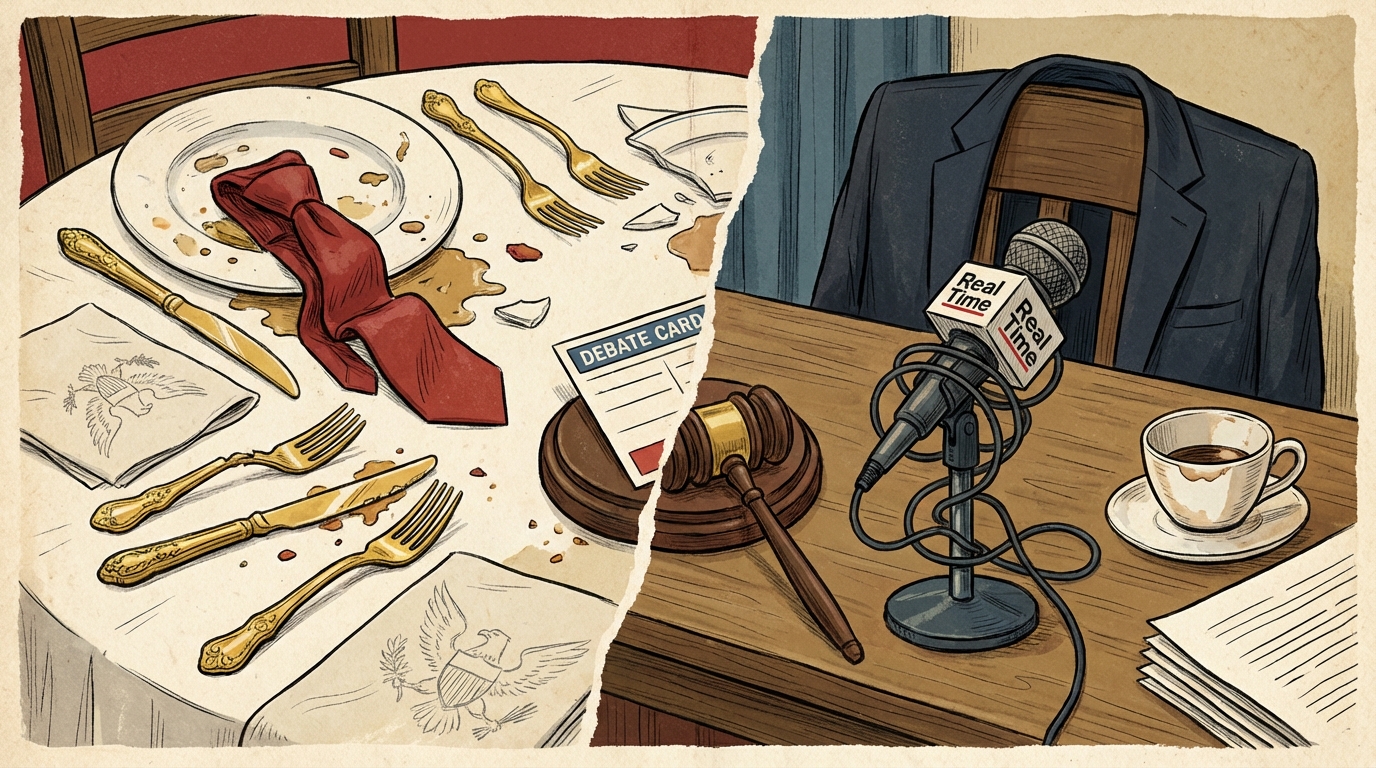
The Failed Summit: Bill Maher and President Trump's Clash
The experiment in dtente has officially failed, and in spectacular fashion. It was a scene that screenwriters for a political satire might have rejected as too on-the-nose: the populist President, fresh in his second term, breaking bread with the libertine comedian who has spent decades skewering the very concept of piety in politics. The recent dinner at the White House involving Bill Maher was supposed to be a meeting of the mindsor at least a convergence of shared grievances against the cultural far-left. Instead, it has erupted into a predictable, yet fascinating, war of words that reveals much about the current state of American political discourse.
For years, Donald Trump has operated under the assumption that the enemy of his enemy must be his friend. He observed Maher’s increasing alienation from the progressive wing of the Democratic Partythe woke mind virus, as it is often termed in conservative circlesand calculated that the Real Time host was ripe for conversion. It was a miscalculation of character that only a narcissist could make. Trump mistook Maher’s intellectual consistency on free speech for a pliability of loyalty. The result? A dinner that Trump has since lashed out at, calling it a total waste of time and disparaging the comedian’s intellect and ratings.
The courtship of the contrarian
The genesis of this ill-fated summit lies in the shifting sands of media alignments. As traditional cable news viewership fragments, figures like Maher have occupied a unique space: the IDW (Intellectual Dark Web)-adjacent liberal who isn’t afraid to punch left. Trump, always a voracious consumer of television, likely saw clips of Maher dismantling progressive gender ideology or campus cancel culture and saw a reflection of his own rhetoric.
However, the President failed to account for the comedian’s long memory. This is, after all, the same Bill Maher who once sued Trump to prove he wasn’t the spawn of an orangutana joke that led to a very real lawsuit. The friction is foundational. While they may share a disdain for political correctness, their motivations are diametrically opposed. Maher critiques the left to save liberalism; Trump attacks the left to destroy it.
According to recent reports, the invitation was extended under the guise of an off-the-record discussion on media fairness. Trump lashed out at Bill Maher shortly after the event, suggesting that the conversation did not go according to the script the President had written in his head. The expectation was likely a ring-kissing ceremony; the reality was a debate. And if there is one thing this administration has proven intolerant of, it is a guest who refuses to sing for their supper.
Breaking bread and breaking bad
Details of the dinner remain somewhat opaque, filtered through the prism of Trump’s social media posts and leaks from West Wing insiders. However, the trajectory of the evening is clear. Sources indicate that the President attempted to solicit Maher’s public support for his latest executive actions on media regulation. Maher, a First Amendment absolutist, reportedly balked.
The swiftness of the fallout was jarring even for veteran Trump watchers. Within hours of Maher leaving the executive residence, the digital barrage began. Trump took to his platform to label the Real Time host as overrated, boring, and a radical left maniac who tricked the public. This pivot is classic Trumpian theater: anyone who cannot be co-opted must be immediately destroyed.
In a report detailing the encounter, it was noted that the President felt the evening was a waste of time, a sentiment that implies a transactional goal was not met. Trump does not do dinners for the sake of philosophy; he does them for the sake of acquisition. He wanted Maher as an asset. He found out that a comedian who answers only to an HBO audience is an asset to no one but himself.
The clash of egos and ratings
One cannot ignore the role of ego in this collision. Both men are creatures of television, obsessed with ratings, relevance, and the ability to control the news cycle. Trump measures success in votes and rallies; Maher measures it in laughs and renewals. When these two forces meet, the gravitational pull is immense, but the atmosphere is toxic.
Maher has spent the last few years warning Democrats that their elitism is driving voters to Trump. Ironically, by inviting Maher to dinner, Trump validated Maher’s relevance. But by attacking him afterward, Trump has given Maher exactly what a satirist needs: fresh material. The monologue writes itself.
The dynamic is further complicated by the media landscape of 2026. With the fragmentation of audiences, a feud is mutually beneficial. It gives Trump a foilthe Hollywood elite who pretends to listen but is actually a hater. It gives Maher proof of his independencehe went into the lion’s den and didn’t bow. As reported by entertainment outlets, the White House dinner has already dominated the weekly news cycle, overshadowing substantive policy debates.
The illusion of the anti-woke alliance
This episode serves as a stark reminder of the limits of the anti-woke coalition. There has been a prevailing theory among political strategists that the cultural divide is reshaping the parties, bringing classical liberals and populists together. The Trump-Maher disaster proves the fragility of this theory.
Agreement on one issuethat cancel culture has gone too fardoes not constitute a governing philosophy or a personal friendship. Trump demands fealty. Maher offers skepticism. The two cannot coexist in the same political tent. Trump’s frustration stems from his inability to understand why someone who agrees with him on Issue A won’t blindly support him on Issues B through Z.
Maher’s audience is comprised largely of people who are exhausted by the extremes of both sides. Trump’s base thrives on the extreme. When Bill Maher sits down with the President, he is representing the exhausted middle. Trump, however, is incapable of speaking to the middle; he only speaks to the converted. The dinner failed because they were speaking different languages: one of nuance (however abrasive) and one of absolute submission.
The fallout for the Fourth Estate
Beyond the celebrity gossip aspect, this incident has chilling implications for the relationship between the press (or satirists acting as the press) and the presidency. If a dinner invitation is essentially a loyalty test, then access becomes contingent on compliance. Trump’s reaction to Maher’s refusal to bend suggests that in this term, the administration views independent commentary not as a democratic necessity, but as an obstacle to be bulldozed.
Maher will survive this. In fact, he will thrive on it. His brand is resilience and thick skin. But for lesser-known journalists or commentators, the message is clear: do not accept the invitation unless you are prepared to kiss the ring. The “waste of time” comment is a warning. It says, “If you aren’t useful to me, you don’t exist.”
Conclusion
In the end, the dinner between the President and the pundit was a perfect microcosm of the American political stalemate. It was loud, it was focused on personalities rather than policies, and it ended in insults rather than understanding. Bill Maher walked out of the White House the same man he was when he walked in: a critic. Donald Trump remains the same man he has always been: a ruler who cannot abide a jester who doesn’t follow the script. The bridge between the MAGA right and the disgruntled left hasn’t just been burned; it was never built in the first place.