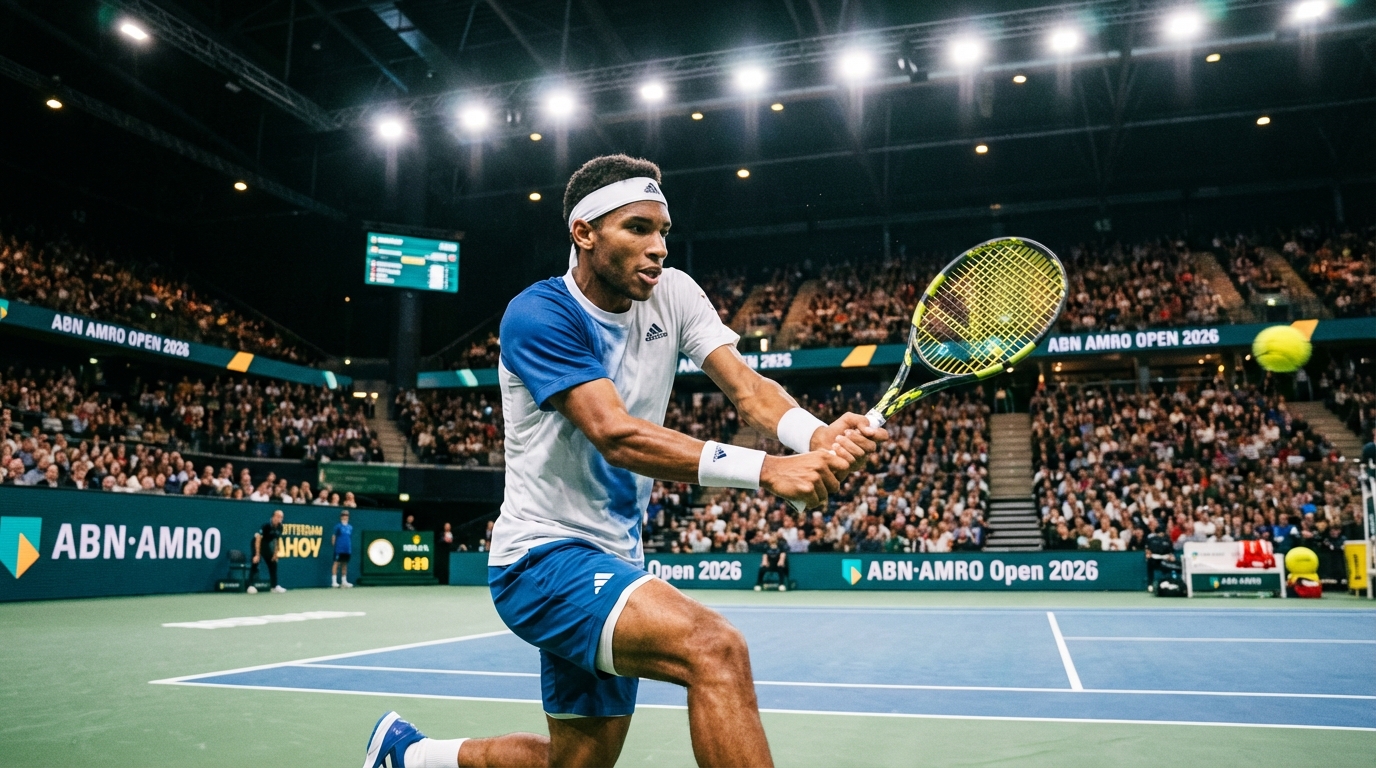
Felix Auger-Aliassime Returns to Rotterdam Final vs De Minaur
The echo of the ball inside the Rotterdam Ahoy has always sounded different for Felix Auger-Aliassime. In the cavernous, controlled environment of indoor tennis, where the wind is a non-factor and the bounce is true, the Canadian’s game finds a rhythmic precision that often eludes him under the glare of the outdoor sun. As we look at the 2026 ABN AMRO Open, the narrative is no longer about potential unfulfilled but about a fortress defended. Auger-Aliassime has once again navigated the treacherous waters of the ATP 500 event to book a place in the Sunday final, a scenario that feels both nostalgic and refreshingly urgent for his career trajectory.
This week in the Netherlands has served as a reminder of the specific conditions required for the Canadian to thrive. The narrative leading into Sunday’s showdown against Alex de Minaur is not just about two exceptional athletes; it is a clash of philosophies. On one side, the relentless counter-punching of the Australian, and on the other, the heavy, penetrating ball-striking of Auger-Aliassime. To understand how we arrived at this 2026 title match, we must dissect the pivotal moments of the week, particularly the mental fortitude displayed against unorthodox opponents and the tactical shifts that have defined this tournament run.
The Bublik Test: Order Against Chaos
The road to the final was far from a straight line. One of the most critical junctures came earlier in the draw when Auger-Aliassime faced Alexander Bublik. Matches against Bublik are rarely just tennis contests; they are psychological examinations. The Kazakh player is known for disrupting rhythm with underarm serves, sudden drop shots, and immense power variance. For a player like Felix, who relies on groove and repetition, this was the ultimate trap.
However, the outcome revealed a matured version of the Canadian. According to recent analysis of the ATP Rotterdam best bets, the match was viewed by oddsmakers as a potential stumbling block due to the volatility Bublik brings. Yet, Auger-Aliassime refused to take the bait. He neutralized Bublik’s serve not by over-attacking, but by blocking returns deep down the center, forcing Bublik to generate his own pace from awkward positions. This disciplined approach was a stark contrast to previous seasons where unforced errors might have piled up in moments of frustration.
The ability to maintain a high first-serve percentage while keeping his unforced error count low against a chaotic player suggests that Auger-Aliassime has refined his match management. He did not try to out-trick the trickster; he simply suffocated him with high-percentage, aggressive baseline play. This victory was the stabilizer he needed, providing the confidence to swing freely in the subsequent rounds.
Felix Auger-Aliassime and the Indoor Advantage
Why does Rotterdam bring out the best in Felix Auger-Aliassime? The physics of the court surface play a massive role. The ABN AMRO Open utilizes a medium-slow hard court that takes spin well but, crucially, sits low enough to reward flat hitting. Felix’s forehand, with its significant backswing, is less prone to timing errors when the elements are removed. In 2026, we are seeing him step inside the baseline more frequently, utilizing the predictable bounce to take the ball on the rise.
This week, his serve has been the anchor. In indoor conditions, the toss is stationary, allowing him to hit his spots with surgical accuracy. Against the field this week, his service hold percentage has hovered near the top of the tournament statistics. When the serve is firing, it alleviates the pressure on his return games, allowing him to take calculated risks on break points. This dynamic was evident in his semi-final performance, where he protected his service games with authority, transferring all the scoreboard pressure onto his opponent.
The betting markets reacted swiftly to this dominance. As noted by Sportsbook Wire, the odds shifted significantly as the tournament progressed, recognizing that an in-form Auger-Aliassime indoors is statistically one of the most dangerous propositions in the sport. He transitioned from a contender to a co-favorite, a status he has justified with his play.
The De Minaur Challenge: Speed vs. Power
The final hurdle is Alex de Minaur, a player who presents a vastly different challenge than Bublik. De Minaur is arguably the fastest player on tour, a man who shrinks the court and forces opponents to hit one, two, or three extra balls to win a point. This matchup will be determined by Auger-Aliassime’s patience and his willingness to finish points at the net.
Historically, De Minaur thrives on pace. If Felix simply bludgeons the ball from the baseline, De Minaur will absorb and redirect that energy. The key for the Canadian in this 2026 title match will be variety using the slice to keep the ball low out of De Minaur’s strike zone and approaching the net to cut off the angles. The ATP Tour extended highlights of their previous encounters suggest that when Felix dictates the rally length (keeping it under 5 shots), his success rate skyrockets. Conversely, if he allows De Minaur to turn the match into a track meet, the advantage shifts to the Australian.
The “Demon,” as De Minaur is known, will look to exploit the Auger-Aliassime backhand. While that wing has improved, it remains the side that can break down under sustained pressure. Felix must be proactive in running around his backhand to unleash the inside-out forehand, a shot that has been his primary weapon throughout this Rotterdam campaign. The cross-court backhand exchange is a losing battle against De Minaur’s flat, skidding trajectory; the down-the-line change of direction will be the high-risk, high-reward shot that could decide the championship.
Implications for the 2026 Season
A title in Rotterdam is more than just 500 points; it is a statement of intent for the remainder of the hard-court swing. For Auger-Aliassime, consistency has been the elusive grail. A victory here validates the off-season work and the tactical adjustments made with his coaching team. It places him firmly back in the conversation for the Masters 1000 events in Indian Wells and Miami.
Furthermore, this run re-establishes his identity. For a time, there was confusion about whether he should be a grinder or a shot-maker. This week has clarified that his best tennis is “controlled aggression.” He is not a wall like Medvedev, nor is he a pure serve-bot. He is an athletic power-player who needs to dictate terms. The indoor success proves that when the variables are minimized, his talent ceiling is still incredibly high.
Conclusion
As Sunday approaches, the tennis world turns its eyes to the Netherlands. Felix Auger-Aliassime has navigated a difficult draw, overcoming the chaos of Bublik and the pressure of expectations to set up a classic contrast of styles against Alex de Minaur. Whether he lifts the trophy or falls just short, the message from Rotterdam is clear: the Canadian’s best tennis remains a force capable of dismantling the elite. In the controlled air of the Ahoy Arena, Felix has found his breath again, and the rest of the tour should take notice.
Frequently Asked Questions
Q: Has Felix Auger-Aliassime won the Rotterdam title before? A: Yes, Felix won his first-ever ATP Tour title at the Rotterdam Open in 2022, defeating Stefanos Tsitsipas in the final. This tournament holds significant historical value for him.
Q: What is the head-to-head record between Auger-Aliassime and De Minaur? A: The rivalry has been competitive over the years. While De Minaur’s speed often troubles big hitters, Auger-Aliassime’s power can overwhelm the Australian on faster surfaces. Their 2026 meeting adds another chapter to this dynamic matchup.
Q: Why does Auger-Aliassime perform better on indoor hard courts? A: Indoor courts eliminate wind and sun, providing a consistent ball toss for serving and a reliable bounce for his groundstrokes. This environment suits his high-risk, high-reward aggressive style of play better than slower, outdoor clay or gritty hard courts.
Q: What is the significance of the 2026 Rotterdam final for the rankings? A: As an ATP 500 event, the winner receives 500 ranking points. For a player looking to secure a Top 10 or Top 5 position, a deep run or a title in Rotterdam provides a massive boost early in the season.