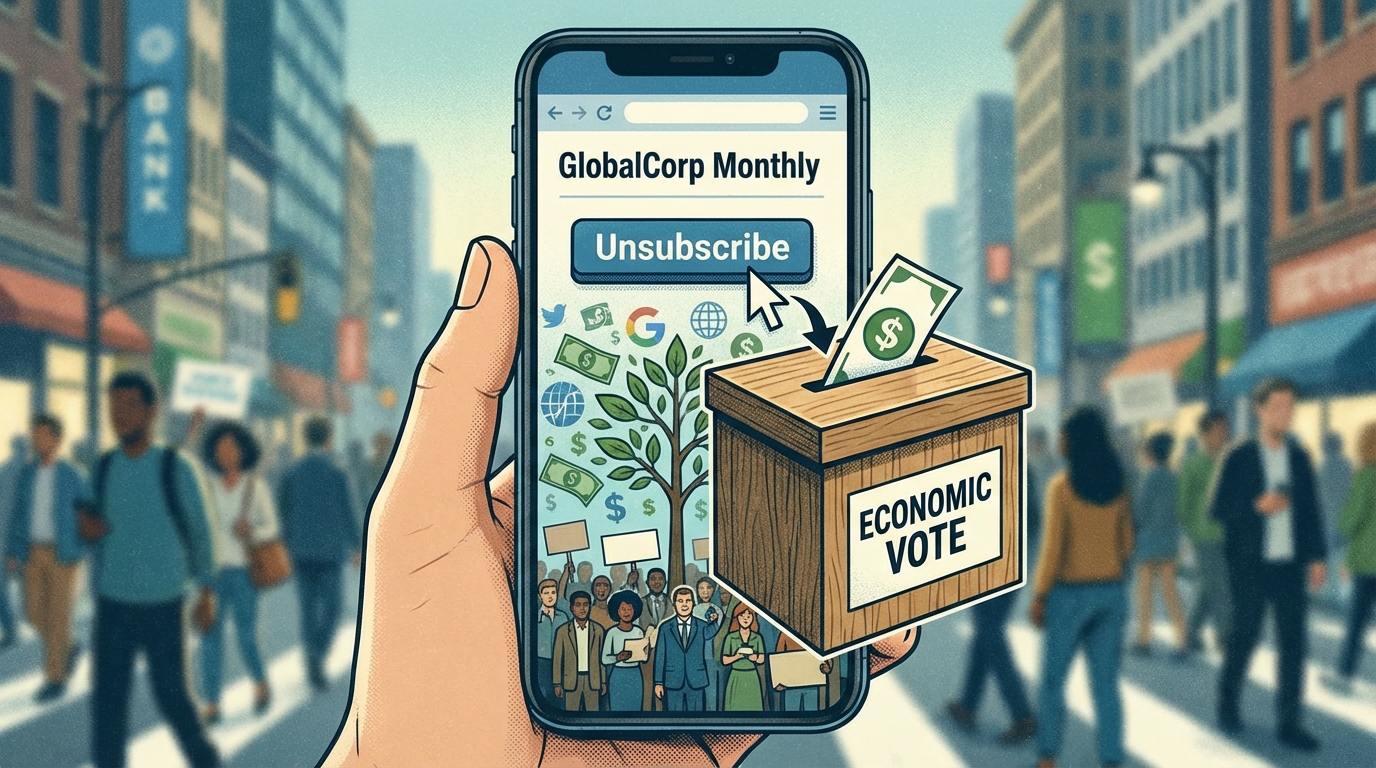
Scott Galloway: The Wallet as a Weapon Against Politics
The Wallet as a Weapon: Can You Bankrupt a Presidency?
In the modern era of political polarization, the most distinct sound of resistance might not be the chanting of a crowd, but the quiet click of a cancellation button. Scott Galloway, the outspoken NYU marketing professor and tech pundit, has ignited a fierce debate with his latest proposal for political action. He argues that traditional proteststhe marches, the slogans, the pink hatsare increasingly obsolete in a world driven by algorithmic governance and shareholder value. His solution is a campaign dubbed “Resist and Unsubscribe,” a calculated economic strike aimed at the corporate pillars supporting the current political establishment. But as the dust settles on his manifesto, the question remains: Is this a stroke of strategic genius, or a fundamental misunderstanding of American consumer addiction?
TL;DR
- The Strategy: A coordinated mass cancellation of services from tech monopolies (Amazon, Google, X) to hurt their stock prices.
- The Goal: Force corporations to withdraw support for the Trump administration’s deregulation agenda by threatening their bottom line.
- The Targets: Primary targets include Amazon Prime, Netflix, Google services, and Elon Musk’s X.
- The Critique: Skeptics argue that these services are near-utilities, making meaningful boycotts impossible for the average consumer.
- The Reality: While morally satisfying, the movement faces the “collective action problem” where individual inconvenience outweighs theoretical political gain.
The Scott Galloway Strategy: Asymmetric Warfare
The premise of Galloway’s argument is rooted in a cynical but perhaps accurate assessment of power dynamics. In a recent analysis for the Daily Beast, Galloway posits that the Trump administration is insulated from social shame but highly vulnerable to economic volatility. He suggests that the administration’s primary directive is to serve the interests of a specific class of corporate donors who thrive on deregulation. Therefore, the most effective way to cripple the political agenda is not to attack the politicians directly, but to attack the revenue streams of their benefactors.
Galloway explicitly identifies companies like Amazon, Google, and Meta as the engines of this new political economy. These corporations, he argues, are desperate to avoid antitrust enforcement and are willing to support any administration that promises a hands-off approach. By launching a mass movement to “unsubscribe”canceling Amazon Prime memberships, stopping Netflix subscriptions, and abandoning the X platformGalloway believes liberals can depress stock prices. In the boardroom, a dipping stock price screams louder than a million people on the National Mall. The logic is that if CEOs fear a consumer revolt more than they covet deregulation, they will withdraw their support for the administration.
The Targets of the “Resist and Unsubscribe” Movement
The movement is not vague about its hit list. According to reporting by the Citizen-Times, the campaign specifically targets the digital infrastructure of daily life. The call to action involves severing ties with Amazon, Google, Netflix, and X (formerly Twitter). The inclusion of Elon Musk’s X is obvious given Musk’s direct involvement in political machinations, but the inclusion of Amazon and Netflix points to a broader strategy targeting the “attention economy.”
The rationale is that these companies rely on recurring revenue models. A churn ratethe percentage of subscribers who cancelis a metric that Wall Street watches with obsessive intensity. If a movement could spike the churn rate of Amazon Prime by even a few percentage points, it would trigger a sell-off. Galloway’s thesis rests on the idea that the left controls a significant portion of the disposable income in the United States. If the “blue economy” decides to close its wallet, the “red administration” loses its financing. It is a weaponization of capitalism against capitalists.
Comparison Table: Methods of Political Resistance
| Option | Best for | Pros | Cons | Pricing/Cost |
|---|---|---|---|---|
| Unsubscribing (Boycott) | High-income consumers with alternatives | Directly impacts corporate metrics; low physical effort | Requires lifestyle sacrifice; hard to coordinate mass adoption | $0 (Saves money) |
| Street Protests | Media visibility and community building | High visibility; emotional solidarity | Easy for corporations/politicians to ignore; physical risk | Variable (Travel/Time) |
| Political Donations | Direct support of opposition candidates | Funds legal battles and campaigns | Competing with unlimited corporate “dark money” | High |
| Strategic Voting | Long-term structural change | The only legal way to change leadership | Slow feedback loop; gerrymandering limits impact | Free |
The “Feel-Good Fantasy” of Digital Abstinence
Despite the clear logic of hitting opponents in the bank account, the practical application of this strategy faces withering criticism. Writing for Adweek, industry analysts describe the “Unsubscribe Uprising” as a “feel-good fantasy.” The core problem is the nature of the products being boycotted. Amazon Prime is not just a streaming service; for many American households, it is the primary logistics network for food, diapers, and medicine. Google is not merely a search engine; it is the operating system for the majority of the world’s smartphones and the backbone of email communication.
The Adweek critique highlights a concept known as “inelastic demand.” When a product becomes a utility, consumers will continue to pay for it even if they despise the provider. The critique suggests that Galloway underestimates the “stickiness” of these ecosystems. Asking a modern family to forgo Amazon is akin to asking them to forgo electricity because they dislike the utility company’s CEO. Furthermore, the critique notes that conservative boycotts (like those against Bud Light) often work because the product is a commodity with easy substitutes. Liberal boycotts of tech monopolies fail because there are no viable substitutes. You cannot switch to a “liberal” version of Google Maps because one does not exist.
Pros and Cons of the Galloway Plan
Pros
- Financial Leverage: Unlike protests, which can be ignored, a drop in quarterly revenue forces an immediate corporate response.
- Resource Conservation: It saves the activist money, rather than asking them to donate to political super PACs.
- Data Privacy: Leaving platforms like Google and X reduces the amount of personal data harvested for surveillance capitalism.
- Asymmetric Impact: A small percentage of high-value users leaving can have a disproportionate impact on stock valuation.
Cons
- Lack of Alternatives: There is no functional equivalent to Amazon’s logistics or Google’s search index for most users.
- Collective Action Problem: Unless millions participate simultaneously, individual cancellations are statistically noise.
- Collateral Damage: Boycotts often hurt low-level workers (warehouse staff, drivers) before they impact executive compensation.
- User Apathy: Convenience usually overrides political conviction for the average consumer.
The Psychology of the Wallet
The debate ultimately centers on the psychology of the American consumer. Galloway is betting that anger toward the Trump administration is strong enough to overcome the addiction to convenience. However, history suggests otherwise. The “Resist and Unsubscribe” movement requires a level of discipline that is rare in a consumerist society. It asks individuals to voluntarily lower their standard of livingwaiting longer for packages, dealing with inferior search results, losing access to entertainmentfor a theoretical political gain.
Furthermore, the tech giants are insulated by diversification. Amazon makes the bulk of its profit from Amazon Web Services (AWS), the cloud infrastructure that powers the internetincluding, ironically, many of the websites used to organize boycotts. You cannot “unsubscribe” from AWS without disconnecting from the internet entirely. This structural reality makes the Scott Galloway proposal feel more like a symbolic gesture than a tactical nuke. It allows participants to feel they are “doing something” without actually threatening the structural integrity of the corporate state.
FAQ
Q: Is the ‘Resist and Unsubscribe’ movement actually hurting stock prices? A: Currently, there is no evidence of a statistically significant dip in Amazon or Google stock directly attributable to this specific political boycott. These companies are so large that they can absorb minor fluctuations in subscriber count.
Q: What are the alternatives if I want to unsubscribe from Amazon? A: Consumers can switch to buying directly from retailer websites, using Walmart+ (though this may not align with liberal political goals either), or shopping locally. However, few services match Amazon’s two-day delivery speed.
Q: Why does Scott Galloway target Netflix? A: While Netflix is not a monopoly in the same sense as Google, it is a discretionary expense. Galloway argues that cutting discretionary recurring revenue is the fastest way to signal consumer discontent to the broader market.
Q: Can this movement work if only a few people do it? A: No. The strategy relies on “churn” metrics. If only a few thousand people cancel, it is a rounding error. It requires hundreds of thousands of cancellations in a single quarter to panic shareholders.
Conclusion
The “Resist and Unsubscribe” movement is a fascinating evolution in political activism, acknowledging that the true seat of power in America has shifted from the Capitol to the cloud. By identifying the corporate revenue streams that fuel political deregulation, Scott Galloway has correctly diagnosed the disease, even if his prescribed cure is difficult to swallow. The strategy exposes the fragility of the modern consumer’s conscience: we may hate the politics of the oligarchs, but we love their same-day delivery. Unless the opposition can find the will to embrace inconvenience, the crystals of corporate power surrounding the administration will likely remain unbreakable.