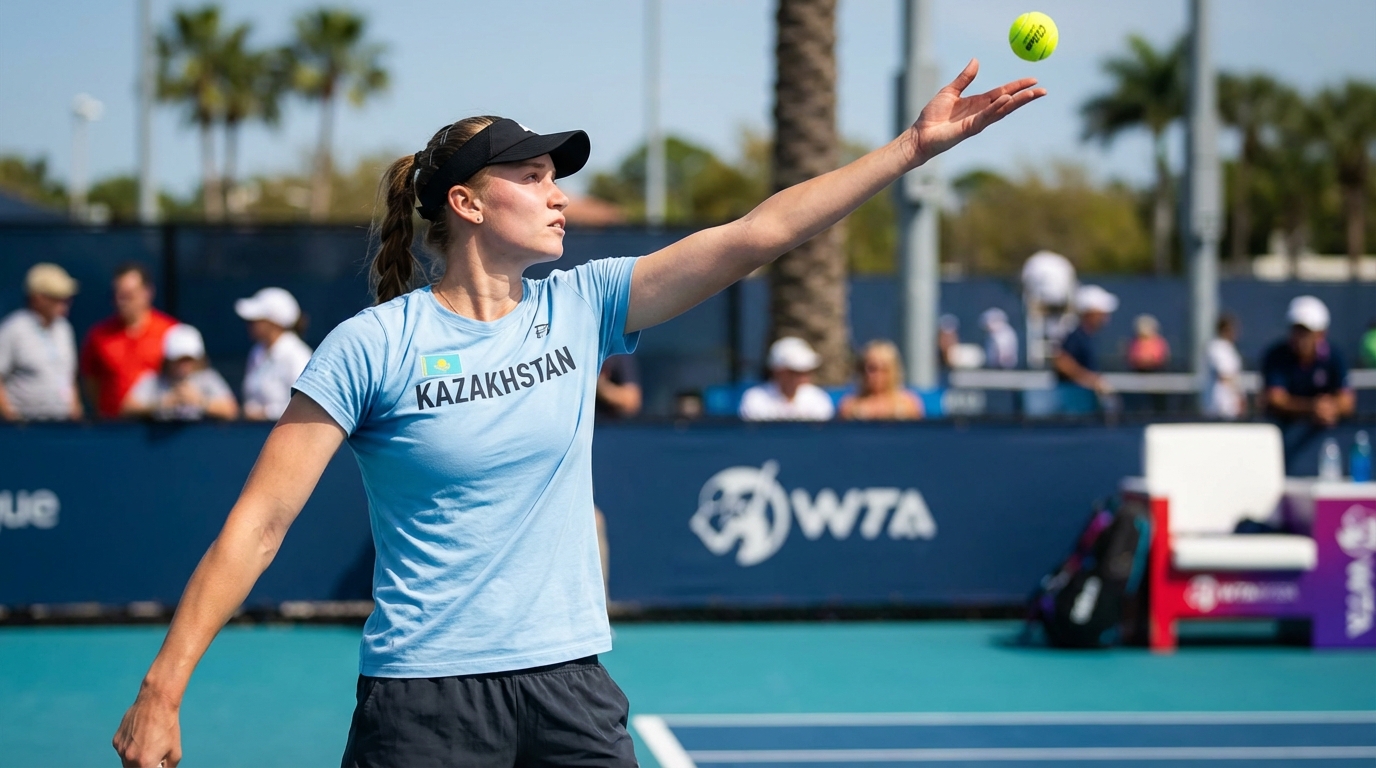
Elena Rybakina Hires Ivanisevic to Challenge Top Rank
The silence of the tennis off-season is rarely broken by seismic shifts, but the recent maneuvers within the camp of Elena Rybakina have sent tremors through the WTA landscape that will likely be felt well into 2025. For the past two years, the women’s tour has been defined by a rigid hierarchy, often reduced to a “Big Three” narrative that, in practice, frequently devolved into a duopoly of Iga Swiatek and Aryna Sabalenka. Rybakina, despite her immense talent and a Wimbledon title, often played the role of the dangerous outlierthe player capable of beating anyone but struggling to maintain the week-in, week-out consistency required for the top spot. That narrative is being rewritten in Dubai this winter.
In a move that blends ambition with a necessary tactical reset, Rybakina has not only declared her intention to capture the World No. 1 ranking but has hired the one man arguably most qualified to engineer such an ascent: Goran Ivanisevic. This is not merely a coaching change; it is a declaration of war on the status quo. As an investigative observer of the tour’s dynamics, one must look past the press release quotes and understand the mechanics of this partnership. Rybakina is attempting to transform from an erratic champion into a dominant force, and the 2025 season represents the crucible where this transformation will be tested.
The Ivanisevic Intervention
The hiring of Goran Ivanisevic is the single most significant coaching acquisition of the WTA off-season. Ivanisevic, the erratic genius of the 90s who became the stoic architect behind Novak Djokovic’s late-career dominance, brings a specific pedigree that Rybakina has lacked. While her previous partnership with Stefano Vukov yielded a Grand Slam title, it ended under a cloud of scrutiny regarding the intensity and tone of the coaching dynamic. Ivanisevic offers a stark contrast: a figure of immense authority who has navigated the highest pressure cookers in tennis history.
According to recent reports from the Middle East, the chemistry is already palpable. Rybakina has described Ivanisevic as a “great champion,” noting that their collaboration has begun with high energy and a clear strategic vision. “He is a great champion and he has so much experience and I want to learn.” This humility, paired with Ivanisevic’s tactical acumen, suggests a focus on the finer margins of the gamespecifically the serve and the first-strike capability.
Ivanisevic’s influence on Djokovic was most visible in the Serbian’s serve statistics. Under Goran, Djokovic transformed his serve from a liability into a precise weapon. Rybakina already possesses one of the most feared serves on the women’s tour, but it has been prone to fluctuations during high-stress moments. If Ivanisevic can refine her spot-serving and instill the “lockdown” mentality he perfected with Djokovic, Rybakina’s service games could become statistically unbreakable. This is the foundation upon which a World No. 1 ranking is built: the ability to hold serve with such regularity that it exerts immense pressure on opponents’ return games.
Anatomy of a Reset: Leaving 2024 Behind
To understand the magnitude of Rybakina’s 2025 goals, we must first autopsy her 2024 season. It was a year defined by brilliance interrupted by fragility. She started strong, capturing titles in Brisbane, Abu Dhabi, and Stuttgart, yet the narrative quickly shifted to withdrawals and unexplained illnesses. The “gastrointestinal issues” and “insomnia” cited during her withdrawals from Indian Wells, Rome, and the US Open painted a picture of a player whose physical durability was not matching her talent.
The split with Vukov just days before the US Open was the climax of this turbulence. It left Rybakina exposed and seemingly drifting. However, the current preseason in Dubai indicates a successful physical rehabilitation. She has explicitly mentioned that she feels fresh and ready, a stark contrast to the fatigued figure that exited the WTA Finals in Riyadh. The decision to base her preseason in Dubai is strategic; the conditions mimic the heat of the Australian summer, allowing for acclimatization that European training bases cannot offer.
In a candid discussion about her recovery, Rybakina emphasized the importance of this reset. As detailed by Gulf News, her primary focus has been regaining full physical health to withstand the rigors of a full calendar. “The main goal is to be healthy and to play as many tournaments as I can,” she noted, acknowledging that consistency is the prerequisite for ranking points. The World No. 1 ranking is a mathematical accumulation of durability as much as it is a measure of peak performance.
The Mathematical Path to World No. 1
The ambition to dethrone Iga Swiatek and Aryna Sabalenka is not just about winning matches; it is about point defense and accumulation. Swiatek and Sabalenka have separated themselves from the pack by reaching the deep stages of almost every mandatory event. For Rybakina to bridge the gap, she must convert her quarterfinal appearances into titles. In 2024, Rybakina often faltered in the semi-finals or withdrew before crucial matches, leaving thousands of ranking points on the table.
Rybakina has issued a clear warning to her rivals regarding this ambition. She is no longer content with being a “threat”; she wants to be the standard-bearer. Citing her intentions in a recent interview, she made it clear that the top spot is the ultimate objective. According to Tennis World USA, Rybakina stated, “The goal is to be number one one day and to win Slams.” This dual focus is critical. One can become No. 1 through consistency without Slams (a la Jelena Jankovic or Dinara Safina), or win Slams without reaching No. 1. Rybakina wants both, mirroring the dominance of the players she is chasing.
The surface dynamics favor Rybakina in the first quarter of the season. The hard courts of Australia and the Middle East swing (Doha, Dubai) are perfectly suited to her flat, penetrating groundstrokes. If Ivanisevic has tweaked her return position to be slightly more aggressivetaking time away from Swiatek’s heavy topspin forehandwe could see a shift in the head-to-head records early in the year. Rybakina is one of the few players who historically matches up well against Swiatek, possessing the power to rush the Pole. The challenge has always been doing it consistently.
Tactical Evolution: The Serve-Plus-One
Investigating the technical aspects of the Rybakina-Ivanisevic alliance reveals the likely tactical adjustments we will see in 2025. Ivanisevic is a proponent of the “Serve-Plus-One” strategya massive serve followed by an immediate, aggressive forehand to end the point or seize control. Rybakina’s game is naturally built for this, but she has occasionally become passive in rallies, allowing elite defenders like Sabalenka to reset the point.
Under Ivanisevic, we can expect Rybakina to shorten points. The logic is twofold: firstly, it maximizes her power advantage; secondly, and perhaps more importantly, it preserves her physical energy. Given her history of health issues and fatigue, playing three-hour grinding matches is not a sustainable path to World No. 1. Efficiency is key. By sharpening her serve placement and encouraging earlier net approaches, Ivanisevic can help Rybakina conserve the energy required to survive the two-week gauntlet of a Grand Slam.
Furthermore, the mental aspect of the game cannot be overstated. Ivanisevic helped Djokovic develop a mental fortress, an ability to play his best tennis when facing break points. Rybakina has often been described as the “Ice Queen” for her lack of emotion, but internal nervousness has manifested in her serve crumbling at critical junctures (most notably in the 2023 Australian Open final). Ivanisevic’s mentorship will likely focus on channeling that stoicism into clutch performance rather than passive acceptance of errors.
The Dubai Crucible
The choice of Dubai as the staging ground for this new campaign is significant. The Dubai Duty Free Tennis Championships is not just a tournament; for many top players, the city serves as a second home and a rigorous training block. Rybakina’s presence there, training specifically with the Australian Open in mind, suggests she is looking to peak immediately in January.
The conditions in Dubaifast hard courts and varying wind conditionsare excellent preparation for Melbourne. By committing to a heavy training block here, Rybakina is testing her body’s response to the new training regimen. Reports indicate she is working on agility and movement, areas where she naturally trails the more athletic Swiatek. If she can improve her defensive movement out of the corners even by 5%, her reach and wingspan will make her virtually impossible to hit through.
Conclusion: A New Era or False Dawn?
The 2025 season looms as the defining chapter of Elena Rybakina’s career. The pieces are in place: a world-class coach with a proven track record, a renewed physical baseline, and a publicly stated ambition that leaves no room for ambiguity. The hiring of Goran Ivanisevic is a statement of intent that transcends standard off-season adjustments. It signals that Rybakina believes she belongs not just in the conversation, but at the very top of the rankings.
However, the path to World No. 1 is paved with the wreckage of talented players who could not sustain the grind. Swiatek and Sabalenka have proven their durability; Rybakina has not. The burden of proof lies with the Kazakhstani star. If the “Ivanisevic Effect” takes hold, the WTA tour will no longer be a story of two dominant forces, but a ruthless triumvirate where the serve is the ultimate judge. As the tour pivots to Australia, all eyes will be on Rybakina’s service box, waiting to see if the new partnership can deliver the consistency to match the power.
Frequently Asked Questions
Q: Who is Elena Rybakina’s new coach for the 2025 season? A: Elena Rybakina has hired Goran Ivanisevic, the former Wimbledon champion and longtime coach of Novak Djokovic. This high-profile partnership is aimed at refining her game to capture more Grand Slam titles and the top ranking.
Q: What are Elena Rybakina’s main goals for 2025? A: Rybakina has explicitly stated that her primary goals are to win more Grand Slam titles and to reach the World No. 1 ranking, challenging the current dominance of Iga Swiatek and Aryna Sabalenka.
Q: Why did Elena Rybakina split with her previous coach? A: Rybakina split with Stefano Vukov just before the 2024 US Open. While official reasons were kept private, the partnership had been under public scrutiny for some time, and the split coincided with a period of health issues and a need for a fresh voice in her camp.
Q: How does the Dubai preseason preparation help Rybakina? A: Training in Dubai allows Rybakina to acclimatize to warm weather conditions similar to the Australian Open. It also provides a high-quality base for working on physical rehabilitation and tactical changes with her new coach before the season begins.