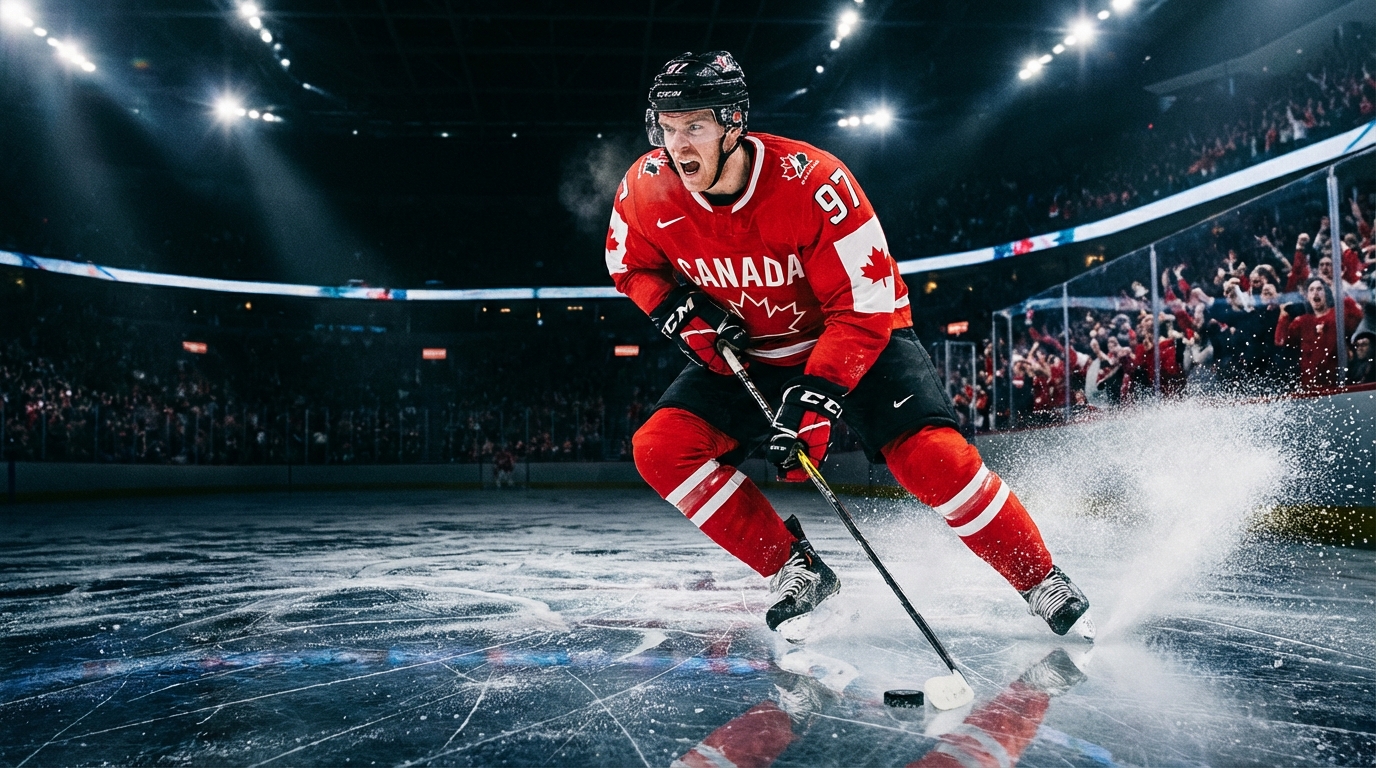
Connor McDavid Leads Canada to Olympic Final After Crosby Injury
The script was written years in advance, or so we thought. The 2026 Winter Olympics in Milan were intended to be the grand intersection of two distinct hockey timelines: the twilight of Sidney Crosby’s golden era and the prime of Connor McDavid. It was supposed to be a partnership, a mentorship, and a passing of the torch performed on Olympic ice. However, sports rarely adhere to sentimental screenplays. With Crosby sidelined by a groin injury suffered against Czechia, the timeline collapsed. The torch wasn’t passed; it was dropped, and McDavid had to pick it up mid-stride. What followed in the semifinal against Finland was not just a hockey game, but a definitive statement on the future of the Canadian national team.
TL;DR
- The Injury: Sidney Crosby suffered a groin injury in the quarterfinals, forcing him out of the semifinal vs. Finland and likely the gold medal game.
- The Response: Connor McDavid dominated the semifinal with a goal and two assists, leading Canada to a 4-0 victory.
- The Shift: The team’s identity has instantly pivoted from Crosby’s grinding leadership to McDavid’s speed-driven dominance.
- The Stakes: Canada faces the United States for gold, placing the entire weight of national expectation solely on McDavid’s shoulders.
The Premature End of the Crosby Era
The image of Sidney Crosby leaving the ice against Czechia sent a shudder through the Canadian hockey establishment. According to the Pittsburgh Post-Gazette, the injurya groin issuewas severe enough to keep the captain out of the semifinal and cast significant doubt on his availability for the final. For nearly two decades, Crosby has been the safety blanket for Hockey Canada. When the game tightens, when the neutral zone clogs, the strategy has always been: Send out Sid.
His absence created a vacuum that could have imploded a lesser team. The psychological weight of losing “Captain Canada” before a medal round is immense. However, the immediate aftermath revealed that the roster construction for 2026 was designed with this contingency in mind, even if no one wanted to admit it. The reliance on Crosby was emotional; the reliance on McDavid is structural.
The Coronation Against Finland
If there were doubts about how Canada would function without its long-time patriarch, they were erased within the first period of the semifinal against Finland. Canada’s 4-0 victory was a masterclass in speed and transition, orchestrated entirely by number 97. As reported by ESPN, McDavid finished with a goal and two assists, but the box score fails to capture the sheer inevitability of his play.
Without Crosby slowing the game down to a grind along the boards, the Canadian attack became vertical and relentless. McDavid’s goal was a signature burst of acceleration that backed the Finnish defense into their own crease, opening passing lanes that simply didn’t exist earlier in the tournament. The “Next One” is no longer next; he is the current, undisputed sovereign of the ice. The chemistry he displayed with his linemates suggested that while the team respects Crosby, their pace of play is naturally better suited to McDavid’s engine.
Analyzing the Torch Passing
The transition of power in Canadian hockey is a rare periodic event, moving from Gretzky to Lemieux, Lemieux to Crosby, and now Crosby to McDavid. This specific handover, however, is unique because of the abruptness caused by the injury. As noted by The Athletic, this wasn’t the ceremonial lap many expected. It was a crisis management situation that McDavid navigated with stoic efficiency.
The cultural impact of this shift is profound. Crosby’s leadership is vocal and grounded in “doing it right” in the defensive zone. McDavid’s leadership is performed through acts of impossible skill that dare his teammates to keep up. Against Finland, we saw the team adopt McDavid’s personality: faster, looser, and more dangerous off the rush. The “Golden Goal” era of 2010 is officially history; the 2026 squad is defined by the rush, not the cycle.
Comparison Table: Leadership Models
The shift from Crosby to McDavid represents a fundamental change in how Team Canada operates. Below is a breakdown of these two distinct leadership options available to the coaching staff, though the choice has now been made for them.
| Option | Best for | Pros | Cons | Strategic Cost (Risk) |
|---|---|---|---|---|
| The Crosby Model | Grinding out low-scoring wins and controlling possession. | unmatched experience in high-pressure finals; defensive reliability; board-battle dominance. | Slower pace of play; relies on aging physicality; less dynamic in transition. | High: Reliance on a 38-year-old’s durability (proven fatal). |
| The McDavid Model | Breaking open defensive traps and high-scoring affairs. | Unparalleled speed; forces opponents to back off; generates power-play opportunities. | Less proven in “lockdown” defensive scenarios; higher turnover risk due to speed. | Medium: Requires younger linemates to match extreme pace. |
| The Hybrid Committee | Balanced attack using both centers (Original Plan). | Depth matching; impossible for opponents to line-match against. | Potential chemistry clashes between two different playstyles. | Low: Spreads the injury risk across two superstars. |
Pros and Cons of a McDavid-Centric Team
With Crosby out, the team is now fully optimized around McDavid. This singular focus brings distinct advantages and disadvantages as they head into the gold medal game against the USA.
Pros:
- Speed Mismatch: Few defensive cores, even the Americans’, can skate with a Canada team that commits fully to the rush.
- Clarity of Role: There is no deferring to the veteran. Every player knows McDavid is the primary option, simplifying decision-making.
- Power Play Potency: McDavid’s zone entries are virtually unstoppable, guaranteeing offensive zone time.
- Psychological Edge: Opponents often panic when McDavid winds up in the neutral zone, breaking their defensive structure.
Cons:
- Defensive Exposure: Without Crosby’s two-way conscience, the team is more susceptible to counter-attacks.
- Faceoff Liability: Crosby is one of the best faceoff men in history; McDavid is average, which matters in critical defensive zone starts.
- Leadership Vacuum: In a tied game late in the third period, the voice of a player who has won three Stanley Cups and two Olympic golds is irreplaceable.
- Target Fixation: The USA can focus their entire defensive scheme on stopping one line, rather than splitting resources.
The Final Test: Canada vs. USA
The narrative arc leads to the inevitable conclusion: Canada versus the United States for the gold medal. This rivalry has intensified over the last decade, fueled by the influx of American talent that rivals Canada’s best. However, the dynamic has changed. It is no longer a battle of depth; it is a battle of stars.
The Americans boast a fast, skilled lineup that mirrors the style McDavid prefers. This plays into Canada’s hands offensively but poses a massive threat defensively. If the game becomes a track meet, Canada has the fastest runner, but the US might have more sprinters overall. The key for McDavid will be to manage the game’s tempoknowing when to push for the breakaway and when to cycle the puck, a nuance Crosby mastered years ago.
FAQ
Q: Is there any chance Sidney Crosby plays in the Gold Medal game? A: It is highly unlikely. Reports from the Post-Gazette indicate the groin injury is significant. While hockey players are known for playing through pain, a soft tissue injury of this nature usually prevents the skating stride necessary to compete at the Olympic level.
Q: How did Connor McDavid perform in the semifinal? A: McDavid was the best player on the ice. He scored one goal and assisted on two others in a 4-0 shutout of Finland, directly contributing to 75% of Canada’s offense.
Q: Who will captain Team Canada if Crosby is out? A: While Crosby remains the captain on paper, Connor McDavid effectively serves as the on-ice captain. He wears an alternate captain’s “A” but assumes the duties of the leader in Crosby’s absence.
Q: Has Connor McDavid won an Olympic Gold Medal before? A: No. This is McDavid’s first genuine opportunity to win Olympic gold, as NHL players did not participate in the 2018 or 2022 Winter Games. This victory would fill one of the few remaining holes in his trophy cabinet.
Conclusion: The Solitary Walk
The dream of the “Super Team” led by the two greatest centers of the 21st century has evaporated. What remains is perhaps something more compelling: a singular superstar facing the ultimate pressure test. Connor McDavid has won Hart Trophies and Art Ross Trophies, but he has never carried a nation to the summit of the Olympic podium. With Sidney Crosby watching from the press box, the safety net is gone. The 2026 Gold Medal game will not be a coronation of a partnership, but a referendum on whether the fastest player on Earth can outskate the weight of history. The torch wasn’t passed; McDavid had to take it. Now, he has to carry it across the finish line.