Mass Start Speed Skating: The Chaotic Olympic Finale
The Chaos and the Crown: The High-Stakes Gamble of the Mass Start
In the pristine, controlled world of long-track speed skating, athletes usually exist in solitude. They are separated by lanes, racing primarily against the relentless ticking of a clock. But on the final Saturday of the Olympic program, the lane markers are ignored, the solitude is shattered, and the oval transforms into a gladiator pit. This is mass start speed skating, a discipline that strips away the sterile predictability of time trials and replaces it with kinetic chess played at thirty miles per hour. As the 2026 Winter Games draw to a close, the focus shifts to a singular narrative: can Jordan Stolz, the Wisconsin wonder who has already dominated the traditional distances, survive the chaos to claim a historic third gold medal?
The Mechanics of Mass Start Speed Skating
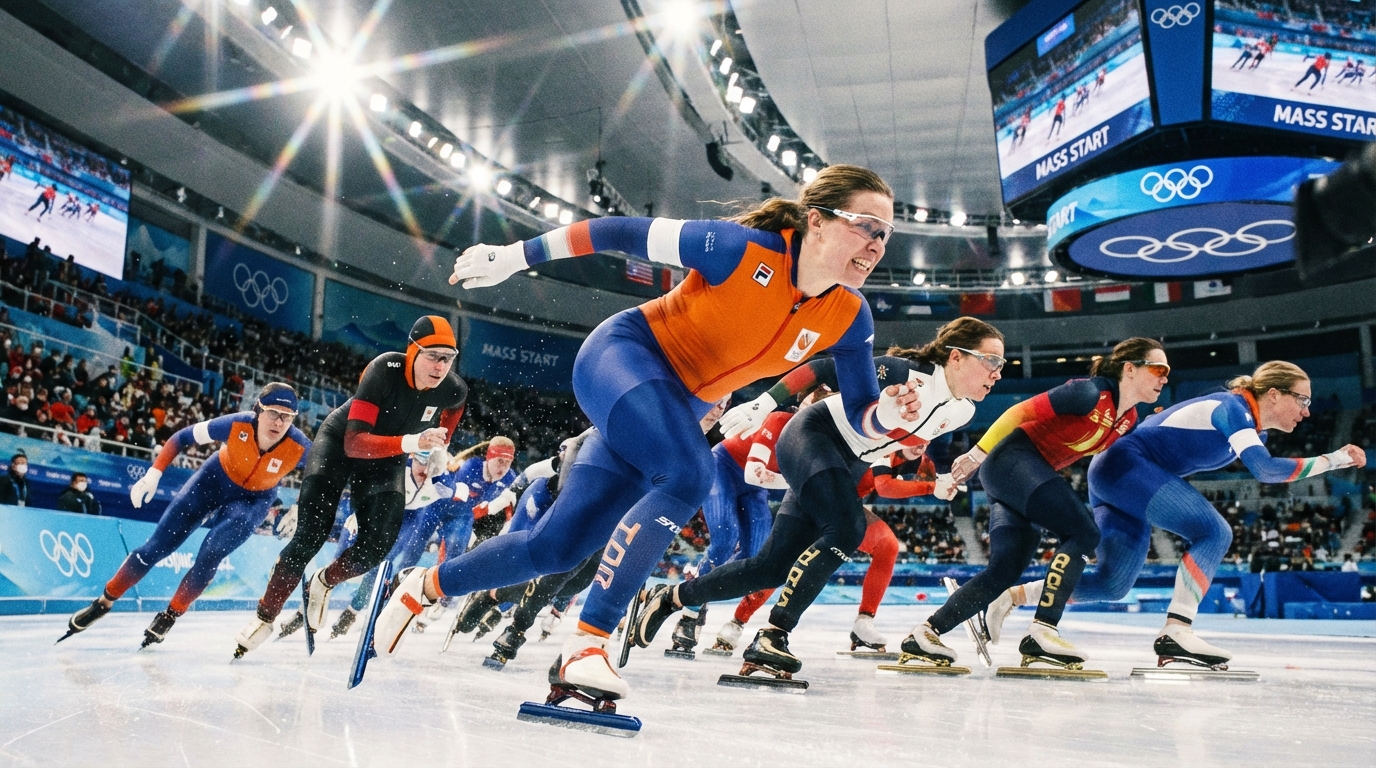
To understand the magnitude of the challenge facing the American team, one must first appreciate the unique brutality of this format. Introduced to the Olympic program in 2018, the mass start is the only long-track event where competitors race head-to-head in a pack, rather than in separate lanes against the clock. It is a hybrid beast, borrowing the physical endurance of long track and marrying it to the elbow-throwing, slipstreaming tactics of short track.
The race consists of 16 laps for both men and women. However, it is not simply a dash to the finish line. The event utilizes a points system that rewards skaters for intermediate sprints occurring after laps four, eight, and twelve. While the first three across the finish line after the final sixteenth lap are awarded the bulk of the points (60, 40, and 20 respectively)essentially guaranteeing them the medalsthe intermediate sprints allow savvy tactical racers to accumulate points that can determine ranking placements outside the podium. This structure forces a constant, agonizing decision-making process: do you burn energy early to secure sprint points, or do you conserve everything for the final, mad dash?
The absence of lanes changes the physics of the race. Aerodynamics become the primary currency. A skater leading the pack is expending significantly more energy than those drafting behind them, cutting through the air resistance for their rivals. This creates a peloton dynamic similar to road cycling, where teammates often work together to shield their designated sprinter until the critical moment. However, unlike cycling, the ice is unforgiving, and the blades are razor-sharp. One misstep, one crossed skate, and a medal hope can vanish into the padding.
Stolz’s Pursuit of the Triple Crown
Jordan Stolz has already cemented his legacy as one of the greatest skaters of his generation. His performance in the individual distances has been nothing short of clinical. However, the mass start requires a different set of tools. It is not enough to be the fastest; one must also be the smartest and, occasionally, the luckiest. According to JS Online, Stolz is skating for his third gold medal today, a feat that would elevate him into the rarest air of American winter Olympians.
The challenge for a skater like Stolz, whose primary asset is overwhelming speed and technique, is the “traffic.” In a time trial, Stolz can dictate his own pace. In the mass start, the pace is often dictated by the slowest common denominator in the pack until the breakaway occurs. He must navigate around skaters who may be physically blocking him, intentionally or otherwise. The transition from the pure, rhythmic skating of the 1000m to the erratic, surging tempo of the mass start is jarring.
Critics and analysts often debate whether the mass start belongs in the same category as the classic distances. Purists argue it introduces too many variables outside of pure athletic ability. Yet, proponents argue that this is exactly why it is the ultimate test of a skater. It demands situational awareness and adaptability. For Stolz, winning here would prove he is not just a time-trial machine, but a complete racer capable of handling the psychological warfare of the pack.
The American Veteran and the Women’s Field
While the spotlight burns bright on Stolz, the women’s competition features a compelling narrative in Mia Manganello Kilburg. A veteran of the sport, Manganello Kilburg brings years of pack-racing experience that is vital in this format. As noted by NBC Olympics, both Stolz and Manganello are taking the ice as the Olympic speed skating program concludes this Saturday.
Manganello Kilburg’s approach differs from the raw power of the younger sprinters. Her game is one of positioning. In the women’s mass start, the pack often stays tighter for longer, leading to a crowded and perilous final two laps. The key for Manganello Kilburg will be to maintain a position near the frontavoiding the “accordion effect” at the back of the pack where skaters have to constantly brake and acceleratewithout taking the wind for the leaders. It is a delicate balance of energy conservation and assertiveness.
The US women’s team has historically used team tactics effectively in this event. If a teammate is present in the final, they can act as a disrupter, chasing down breakaways or blocking lanes to allow their lead skater to conserve energy. However, in the chaos of the Olympic final, plans often disintegrate within the first few laps, leaving every skater to fend for themselves.
A Grand Finale on Ice
The scheduling of the mass start as the closing event of the speed skating program is no accident. It provides a crescendo of excitement. Unlike the 10,000m, which can be a slow burn appreciated mostly by aficionados, the mass start is television-friendly chaos. It encapsulates the modern Olympic spirit: faster, higher, stronger, and significantly more dangerous.
As the US team prepares for this final showdown, the broader context of the Games looms large. The performance of the speed skating team often anchors the overall medal count for the United States. With other events wrapping up, including the US women’s curling team playing for bronze as reported by Yahoo Sports, the attention of the American sporting public is funneling toward the oval.
For Jordan Stolz, the mass start is an opportunity to put an exclamation point on a career-defining tournament. A third gold would not just be a personal victory; it would validate the US development program’s focus on creating versatile skaters who can transition between sprint, distance, and pack racing. For Manganello Kilburg, it is a chance to leverage experience against youthful exuberance.
Strategic Nuances: The “Spring”
One of the most critical tactical elements viewers should watch for is the “spring.” This is the moment, usually with three or four laps remaining, when the pack accelerates from a cruising speed to sprint speed. The timing of this injection of pace is critical. Go too early, and you burn out before the line, swallowed by the drafting pack. Go too late, and you get boxed in, unable to find a lane to unleash your speed.
Top contenders often try to “break the draft” by surging violently on the back straightaway, hoping to catch their rivals napping. If a skater can open a gap of ten meters, the aerodynamics shift in their favor, forcing the chasers to work individually rather than as a unit. However, the ice quality late in the race plays a role. After 16 laps of carving by a full field of skaters, the ice becomes rutted and snowy, increasing friction and the risk of a fall. The skater who can find the cleanest ice while maintaining the shortest line will often have the edge.
Frequently Asked Questions
Q: How is the winner determined in mass start speed skating? A: The winner is determined by points, but practically speaking, it is the first person to cross the finish line after 16 laps. The top three finishers receive 60, 40, and 20 points respectively. Intermediate sprints offer smaller points (3, 2, 1), which determine the rankings for skaters who do not finish on the podium.
Q: Is physical contact allowed during the race? A: While some contact is inevitable in a pack, blatant impeding, pushing, or blocking is illegal and can result in disqualification. Skaters cannot intentionally move sideways to block a competitor who has established a passing lane.
Q: Do skaters wear different equipment for the mass start? A: Yes. Because of the risk of injury from skate blades in a crash, competitors are required to wear safety gear similar to short track skaters, including cut-resistant suits, shin guards, and helmets, which are not worn in traditional time trial events.
Q: Why is drafting so important? A: Skating behind another competitor reduces air resistance by up to 25-30%. This allows the trailing skater to conserve energy while the leader burns fuel fighting the wind. The strategy is to draft for as long as possible and only pop out into the wind for the final sprint.
The Final Turn
As the Zamboni clears the ice for the last time, the anticipation is palpable. Mass start speed skating may be the wild card of the Winter Games, but it is also the most human. It removes the abstraction of the clock and pits athlete against athlete in a visceral test of will. Whether Jordan Stolz secures his triple crown or a dark horse emerges from the pack, the event guarantees drama. In the end, it isn’t just about who is the fastest skater; it is about who is the ultimate racer.