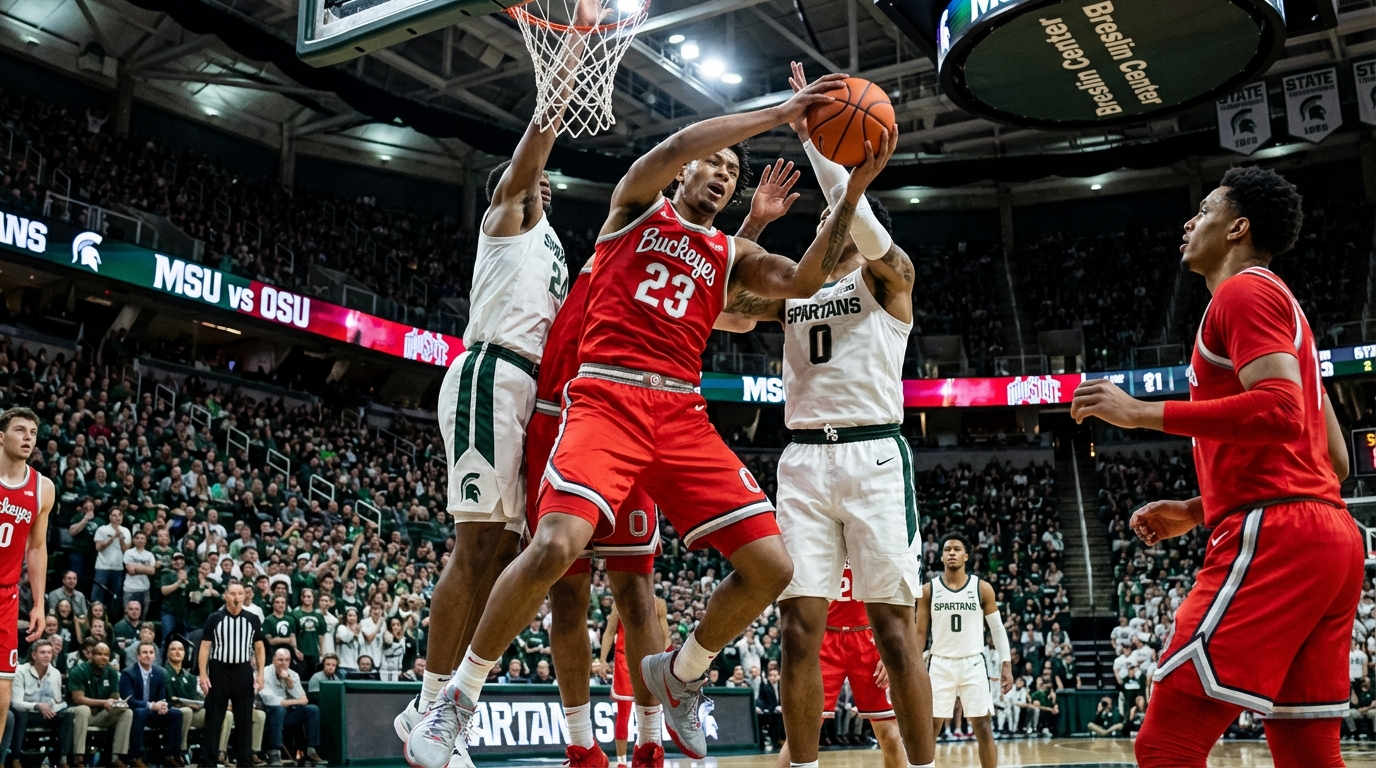
Ohio State vs MI State Preview: Critical Bubble Matchup
The calendar has turned to that frantic, desperate stretch of the college basketball season where blue-blood programs find themselves sweating through the final weeks of February. In the unforgiving landscape of the Big Ten, the upcoming Ohio State vs. MI State showdown is no longer just a battle for regional pride; it has devolved into a survival match for postseason relevance. Both programs, accustomed to deep March runs, are currently staring at the precarious edge of the bracket, making this contest one of the most significant metrics for the selection committee.
TL;DR
- High Stakes: This game is a “Bubble Watch” critical event; the loser risks falling below the NCAA Tournament cut line.
- Venue Factor: The Breslin Center provides Michigan State with a distinct defensive energy that often disrupts visiting offenses.
- Key Matchup: Ohio State’s perimeter scoring versus Michigan State’s transition defense will decide the tempo.
- Betting Angle: Margins are razor-thin, with oddsmakers expecting a possession-by-possession grind typical of late-season conference play.
- Implication: A win here is a “Quad 1” resume builder that could solidify a seed, while a loss compounds recent inconsistencies.
The Bubble Watch Reality
To understand the gravity of this game, one must look beyond the win-loss columns and into the metrics that drive Selection Sunday. The narrative surrounding this game is dominated by the “cut line,” that invisible barrier separating the field of 68 from the National Invitation Tournament (NIT). According to recent analysis regarding the NCAA Tournament cut line, both the Buckeyes and the Spartans are operating with zero margin for error.
Investigative analysis of the bracketology landscape reveals that the Big Ten is cannibalizing itself. For Ohio State, the objective is clear: steal a road victory to offset previous stumbles. For Michigan State, holding serve at home is the bare minimum requirement to stay afloat. The pressure is not merely about winning; it is about avoiding the “bad loss” label while securing a “quality win.” The committee looks favorably upon road resilience, making this a potential season-defining moment for the visitors.
Tactical Warfare in East Lansing
The stylistic contrast between these two teams often leads to friction-filled, low-scoring affairs. In a detailed men’s basketball preview, analysts note that Ohio State’s success hinges on their ability to space the floor and neutralize the Spartans’ aggressive help defense. The Buckeyes struggle when forced into isolation plays late in the shot clock, a trap that Michigan State’s defense is designed to spring.
Conversely, Michigan State’s offense has often been described as a work in progress. Their reliance on transition scoring means that if Ohio State can control the rebounding battle and prevent run-outs, the Spartans’ half-court offense can bog down. The tactical battle will likely be won in the paint, where physical play is not just allowed but encouraged by Big Ten officiating crews.
The Vegas Perspective and Prediction
When money is on the line, sentimentality regarding rivalries disappears. The betting markets view this game as a coin flip heavily influenced by venue. As noted in local coverage regarding the prediction and betting line, the spread typically favors the home team in these matchups by a slim margin, often hovering around 2 to 4 points.
Graham Couch’s analysis suggests that while Ohio State may have the more fluid offensive weapons, the Spartans’ desperation at home is a quantifiable metric. The “sharp” money often looks at turnover percentages in these spots. If Ohio State’s guards can protect the basketball against the perimeter pressure of the Spartans, the betting value shifts toward the underdog. However, the atmosphere at the Breslin Center historically inflates the home team’s defensive metrics, forcing oddsmakers to respect the Spartans’ ability to grind out wins.
Comparison Table: Breaking Down the Matchup
| Feature | Ohio State | Michigan State | Best For | Pros | Cons | Betting/Cost Context |
|---|---|---|---|---|---|---|
| Offensive Style | Perimeter-oriented, spacing | Transition, physical inside | High-scoring affairs | High 3-point potential | Prone to cold streaks | Over/Under volatility |
| Defensive Style | Man-to-man, gap integrity | Aggressive help, physical | Grinding out wins | Forces turnovers | Foul trouble risks | Favors the Under |
| Venue Impact | Road disadvantage | Home dominance (Breslin) | Home team | Crowd energy momentum | Pressure to perform | MSU -3.5 (Est.) |
| Bubble Status | Precarious (Last 4 In/Out) | Precarious (Last 4 In/Out) | Desperate bettors | High motivation | Nervous play | High variance |
| Coaching | Offensive adjustments | Defensive discipline | Tactical bettors | Late-game sets | Rotation rigidity | Unknown |
Pros and Cons of the Matchup Dynamics
Pros
- Intensity: With both teams fighting for tournament lives, the defensive intensity will be playoff-caliber.
- Star Power: Despite team struggles, both rosters feature potential NBA talent capable of taking over the game.
- Coaching Pedigree: The tactical adjustments at halftime will be sophisticated, offering a chess match for astute viewers.
- Atmosphere: The Breslin Center provides one of the best backdrops in college basketball for a televised game.
Cons
- Offensive Stagnation: Both teams have shown tendencies to go minutes without scoring, which can lead to ugly stretches of play.
- Officiating: Big Ten games are notoriously physical; a tightly called game could disrupt the flow and turn it into a free-throw contest.
- Turnovers: High-pressure defense often leads to sloppy ball handling, resulting in unforced errors.
- Inconsistency: Neither team has proven to be reliable this season, making the outcome difficult to predict with confidence.
The Cut Line Consequences
The term “bubble” is thrown around casually, but for these two programs, the financial and reputational implications are real. Missing the NCAA Tournament is a failure for brands of this magnitude. As highlighted by CBS Sports, the “cut line” is moving daily. A loss here doesn’t just add a checkmark to the loss column; it removes a chance for a Quad 1 win, which is the currency of the selection committee.
If Michigan State loses at home, their path becomes mathematically difficult, requiring a deep run in the conference tournament. If Ohio State loses, they remain winless in key road metrics. The investigation into their resumes shows that both teams have “good losses” but lack the signature dominance required to feel safe on Selection Sunday. This game is the opportunity to change that narrative.
FAQ
Q: What are the primary stakes of this game? A: The primary stake is NCAA Tournament qualification. Both teams are on the “bubble,” meaning a loss could drop them out of the projected field of 68 teams.
Q: Who is favored to win? A: While betting lines fluctuate, Michigan State is typically given a slight edge (2-4 points) due to home-court advantage at the Breslin Center, despite similar team records.
Q: How does the venue impact the game? A: The Breslin Center is known for its loud, organized student section (the Izzone), which historically disrupts opposing offenses and influences momentum swings in favor of the Spartans.
Q: Where can I find the official betting line? A: Official lines are available at major sportsbooks. Local analysis, such as that found in the Lansing State Journal, often provides context on how the line is moving leading up to tip-off.
Conclusion
Ultimately, the Ohio State vs. MI State matchup is a microcosm of the brutal nature of Big Ten basketball. It is a collision of desperate programs, each possessing the talent to make a run but lacking the consistency to prove it. The winner will breathe a sigh of relief and move one step closer to March Madness, while the loser will be left analyzing a resume that looks increasingly fragile. In a season defined by parity, this game serves as a clear separator between contenders and pretenders.