No SSI Checks in March? Understanding the Payment Schedule
For millions of Americans living on the financial margins, the arrival of the first of the month is not just a date on a calendar; it is a lifeline. However, the rigid mechanics of federal bureaucracy occasionally collide with the Gregorian calendar, creating waves of confusion and anxiety. This is precisely the scenario unfolding now, as beneficiaries of ssi (Supplemental Security Income) prepare for a peculiar disruption in their cash flow. The headline is alarming if read without context: there will be no SSI checks issued in March. But the reality is a matter of timing, not a reduction in aid, revealing the fragile nature of subsistence on government benefits.
The Mechanics of the March Disappearance
To understand why the mailbox will be empty in March, one must look at the standard operating procedure of the Social Security Administration (SSA). Under normal circumstances, SSI payments are distributed on the first day of every month. This reliability is the bedrock upon which recipients build their monthly survival strategies, covering rent, utilities, and food.
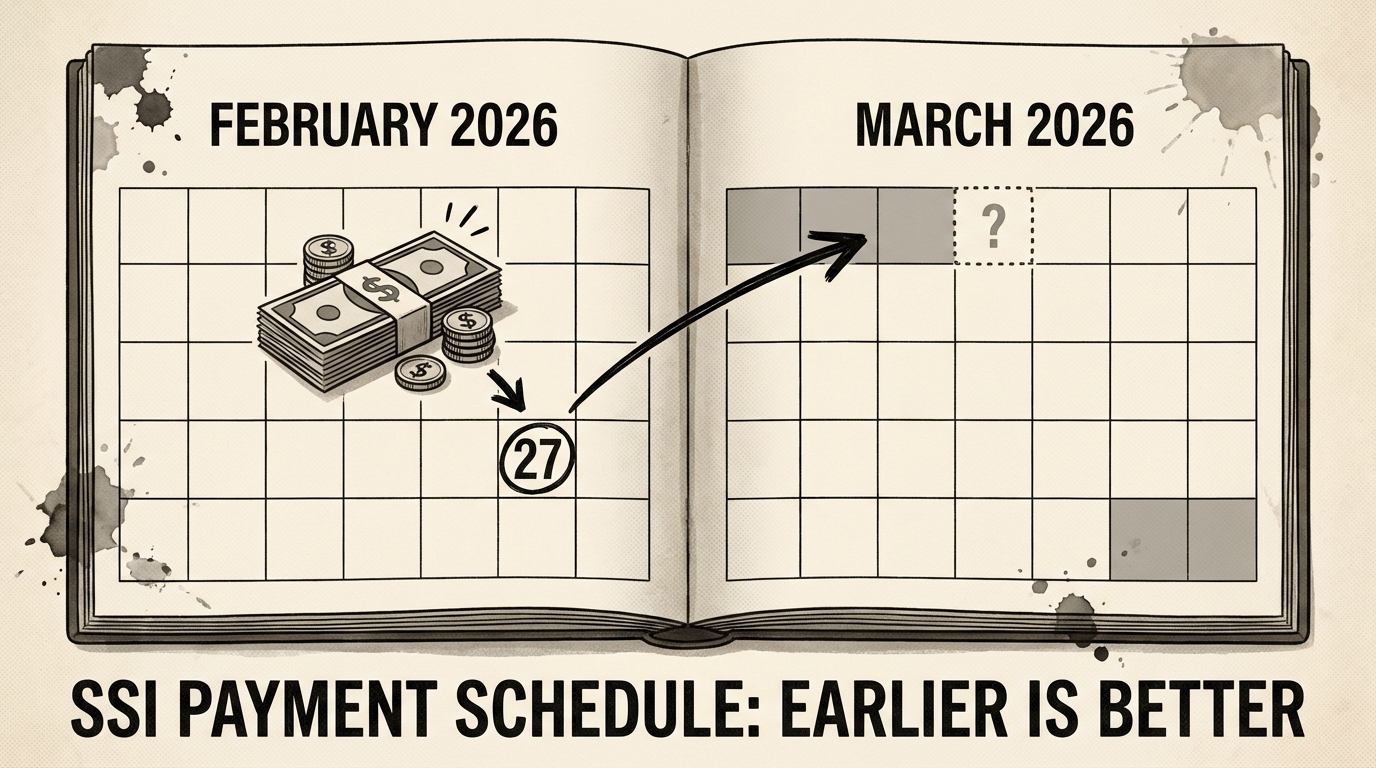
However, federal regulations mandate that if the first of the month falls on a weekend or a federal holiday, the payment must be issued on the immediately preceding business day. As reported by the Clarion Ledger, March 1, 2026, falls on a Sunday. Consequently, the SSA cannot process the deposit on that day. Instead of delaying the payment to Monday, the administration moves the payment date forward to the last Friday of the previous month. In this specific instance, the payment destined for March will land in bank accounts on Friday, February 27.
TL;DR
- No March Check: You will not receive a payment in the month of March 2026.
- Double February: You will receive two payments in February (Feb 1 and Feb 27).
- Not a Bonus: The second check is your March money arriving early; it is not extra cash.
- Budget Warning: You must make the Feb 27 payment last until April 1.
- Eligibility Remains: This schedule change does not mean your benefits have been cut or reviewed.
The Illusion of Abundance
This scheduling quirk results in what appears to be a windfall: two checks in a single month. Recipients received their standard February allocation at the beginning of the month, and they will receive the March allocation just 27 days later. According to the Statesman, this ensures that beneficiaries are never made to wait past their due date for funds. While the intention is benevolentpreventing a delay in essential fundsthe outcome creates a psychological and practical hurdle.
The danger lies in the “feast or famine” dynamic. A recipient seeing a double deposit in February might be tempted to catch up on overdue bills or make necessary household purchases immediately. However, because the March 1 payment is shifted to February 27, the next payment will not arrive until April 1. This creates a gap of roughly 32 days without new income. For a household operating on a strict hand-to-mouth budget, misallocating the “early” March money could lead to a catastrophic shortfall by the third week of the month.
Comparison Table: Understanding Benefit Schedules
Confusion often arises because SSI operates on a different heartbeat than standard Social Security retirement benefits. The following table breaks down how different beneficiaries experience the calendar shift.
| Option | Best for | Pros | Cons | Pricing/Cost |
|---|---|---|---|---|
| SSI Schedule | Low-income, aged, blind, or disabled individuals with limited assets. | Predictable 1st-of-month payment; funds often arrive early before holidays/weekends. | ”Double payment” months create long gaps before the next check; requires strict discipline. | Free (Federal Benefit) |
| SSDI (Pre-1997) | Disabled workers or retirees who started benefits before May 1997. | Aligns with SSI schedule (3rd of the month); consistent regardless of birth date. | Subject to similar weekend/holiday shifts as SSI, though less frequent. | Free (Earned Benefit) |
| SSDI (Post-1997) | Most retirees and disabled workers claiming after 1997. | Staggered payments (2nd, 3rd, 4th Wednesday) reduce banking congestion. | Payment date fluctuates monthly based on the calendar week; harder to align with rent due dates. | Free (Earned Benefit) |
Navigating the Long Gap
The immediate implication of this schedule is the necessity for financial foresight. When the SSA shifts a payment, they are effectively asking the most financially vulnerable population in the country to exercise superior cash-flow management. The Newsweek report on upcoming benefits highlights that while the schedule is rigid, the confusion it causes is fluid. Misinformation spreads quickly on social media, with rumors often circulating that the “extra” check is a cost-of-living adjustment (COLA) bonus or a retroactive payment.
It is vital to clarify that the amount of the check received on February 27 will be the standard benefit amount. There is no surplus. The only difference is the date on the deposit slip. For those with automatic bill payments set for the 1st of the month, the early deposit is generally safethe money will be there when the biller requests it. However, for those who withdraw cash to pay rent or buy groceries, the physical presence of the cash days early can trigger premature spending.
Pros and Cons of the Weekend Rule
The federal rule regarding weekend payments is designed to protect the beneficiary, but it is a double-edged sword.
Pros
- Avoids Late Fees: By paying on Friday instead of Monday, the SSA ensures recipients can pay rent due on the 1st without penalty.
- Banking Access: Funds are available during business hours before the weekend, allowing for physical bank visits if necessary.
- Certainty: The rule is absolute; there is never a guessing game about whether the check will be late.
Cons
- Budgeting Traps: The “long month” effect can leave recipients with zero cash flow for the final week of the following month.
- Asset Limit Risks: For SSI recipients with strict asset limits ($2,000 for individuals), holding two checks in an account at once (even briefly) can cause anxiety about eligibility, though the SSA generally accounts for these timing quirks.
- Confusion: Every time this happens, SSA field offices are flooded with calls asking why a check is missing in the empty month.
A Recurring Bureaucratic Phenomenon
This is not an isolated incident. The calendar rotates, and these shifts happen several times a year. In fact, depending on how dates fall, SSI recipients may see up to four months in a year where payments are shifted. The 2026 calendar just happens to place a significant shift right at the transition from winter to spring. The pattern of “two checks one month, none the next” is a predictable cycle for long-term recipients, yet it remains a stumbling block for new beneficiaries who have not yet navigated a full fiscal year on the program.
Investigative analysis of SSA payment structures suggests that while the system is efficient for the Treasury, it lacks a user-centric design for the recipient. A more flexible system might allow beneficiaries to choose a fixed date regardless of weekends, but the current banking infrastructure relies on business days for clearing massive federal transfers. Until real-time payments become the federal standard, the weekend rule will continue to dictate the rhythm of life for millions.
FAQ
Q: Did I lose my SSI benefits for March? A: No. You did not lose your benefits. The payment for March was simply paid early, on February 27, because March 1 is a Sunday.
Q: Is the check on February 27 a bonus? A: No. It is your regular monthly benefit payment. It is not a bonus, a tax refund, or a stimulus check. You must budget this money to last through the entire month of March.
Q: Will this affect my SNAP (Food Stamps) eligibility? A: Generally, no. SNAP caseworkers are aware of the federal payment schedule. Even though two checks appear in your bank account in February, they count as income for separate months (February and March) in the eyes of most assistance programs.
Q: When is the next payment after the February 27 check? A: The next SSI payment will be issued on April 1, 2026. This means you must wait over 30 days between the late February check and the April check.
The Long Wait for April
As we look toward the spring of 2026, the key takeaway for all stakeholdersrecipients, caregivers, and policy observersis awareness. The machinery of the Social Security Administration is moving exactly as designed, yet the human impact of that design requires adaptation. The “missing” March check is a myth; the money is real, but it is arriving on a schedule that demands discipline. For the millions relying on ssi, the challenge of the coming weeks will not be earning the money, but managing the time between the deposits. The calendar is indifferent to poverty, and in this instance, it demands that the vulnerable plan with the precision of an accountant.