
Elevated 10-Year Yields Keep Fixed Mortgage Rates High
Elevated 10-Year Yields: Navigating the Disconnect Between Fed Cuts and Mortgage Rates
The Federal Reserve’s projected rate cuts will provide necessary relief to corporate borrowers and consumers reliant on floating-rate debt, but they will fundamentally fail to deliver a return to cheap mortgages. The core tension in the current macroeconomic environment is a stark disconnect between the short and long ends of the yield curve. Elevated 10-Year Yields are establishing a stubbornly high floor under borrowing costs, signaling that massive fiscal deficits and the lingering threat of sticky inflation are overriding the traditional downstream effects of central bank easing.
Market participants must navigate a fractured debt landscape where short-term relief does not guarantee long-term affordability. The trajectory for short-term rates reflects a measured unwinding of tight monetary policy. Analysts at Charles Schwab project the Fed will execute two to three additional 25-basis-point rate cuts in the year following December 2024. This would lower the federal funds rate target range to between 3.0% and 3.5%.
While this easing will lower the cost of capital for floating-rate instruments, it will not rescue the housing market. Long-term yields are increasingly dictated by term premiums and deficit concerns rather than overnight lending rates.
The Transmission Chain: Central Bank Policy vs. Structural Forces
A distinct divergence exists between central bank policy and long-term bond market behavior. While the Federal Reserve is expected to continue its easing cycle, the long end of the yield curve resists the downward pull. Structural economic forces are overriding traditional monetary easing, establishing a rigid floor under long-dated Treasuries.
To visualize this mechanism, picture the Treasury yield curve as a heavy industrial crane. The Federal Reserve controls the short end, successfully lowering the boom via federal funds rate cuts. However, the far end is tethered by massive counterweights: persistent 3.8% wage growth and the broader market absorption of ongoing structural fiscal deficits. These macroeconomic counterweights prevent the long end from descending.
A remarkably resilient labor market generating persistent inflationary undercurrents drives this disconnect. As of September 2024, the U.S. unemployment rate stood at 4.4%, with average hourly earnings rising at a 3.8% year-over-year pace, according to Charles Schwab. For bond markets, wage growth approaching 4% is incompatible with a rapid return to ultra-low yields. Sticky wages inherently elevate long-term inflation expectations.
Consequently, bond investors demand a higher term premium to offset inflation risk over the lifespan of a long-dated bond. This tension physically steepens the yield curve. The era of the central bank single-handedly suppressing the entire yield curve has ended, replaced by a market where macroeconomic fundamentals dictate long-term capital costs.
Highest-Signal Evidence: The Mortgage Spread and Bond Market Realities
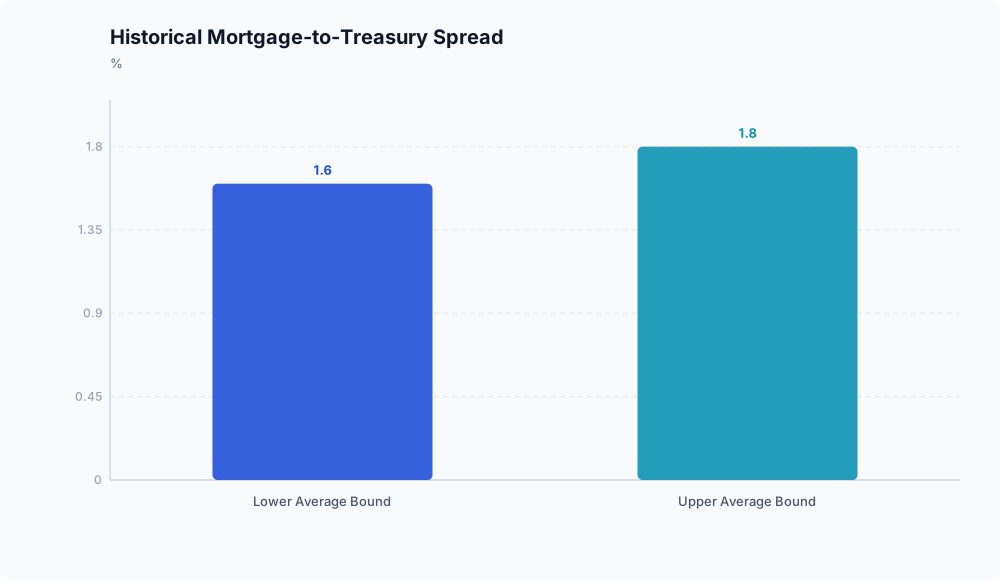
The structural wedge between mortgage rates and benchmark government debt further explains elevated borrowing costs. Historically, the spread between the 30-year fixed mortgage rate and the 10-year Treasury yield fluctuates significantly. It ranged from sub-100 basis points in 2021 to over 300 basis points during the 2007-2009 financial crisis, according to the Federal Reserve Bank of Boston.
By May 2024, this spread hovered around 200 basis points. The 30-year fixed mortgage rate sat at approximately 6.5% against a 10-year Treasury yield of roughly 4.5%. This illustrates that mortgage rates are not tethered exclusively to Federal Reserve policy. Instead, the spread acts as an independent variable, absorbing broader macroeconomic anxieties before pricing consumer debt.
The primary driver of this stubborn spread is the embedded prepayment option within U.S. residential mortgages. Data from the Federal Reserve Bank of Boston reveals that expectations about interest rates, rate volatility, and refinancing costs have explained approximately 80% of the variation in the coupon spread since 2006. High interest rate volatility forces mortgage-backed securities (MBS) investors to demand a steeper premium for extension and contraction risks.
Comparing mortgage yields against broader investment-grade debt contextualizes this landscape. As of late 2024, the Bloomberg U.S. Aggregate Bond Index recorded a yield-to-worst of 4.3% with an average duration of six years, according to Charles Schwab. This competitive baseline yield forces MBS issuers to maintain higher mortgage rates to attract institutional capital.
| Fixed Income Instrument | Current Yield / Rate | Target / Floor Projections |
|---|---|---|
| 30-Year Fixed Mortgage | ~6.50% | Highly dependent on prepayment risk |
| 10-Year U.S. Treasury | ~4.50% | 3.75% floor, upside risk to 4.50% |
| Bloomberg U.S. Agg Bond Index | 4.30% | N/A (6-year average duration) |
| Federal Funds Rate | N/A | 3.00% - 3.50% (Projected range) |
Because aggregate bond yields remain attractive, the premium required to hold complex mortgage debt keeps consumer borrowing costs structurally elevated. The 6.5% mortgage rate reflects a high volatility premium, not just a high baseline rate. Even if the Federal Reserve executes planned rate cuts, mortgage rates will likely remain rigid until broader bond market volatility subsides.
Scenario Mapping: The 2025 Housing and Credit Landscape
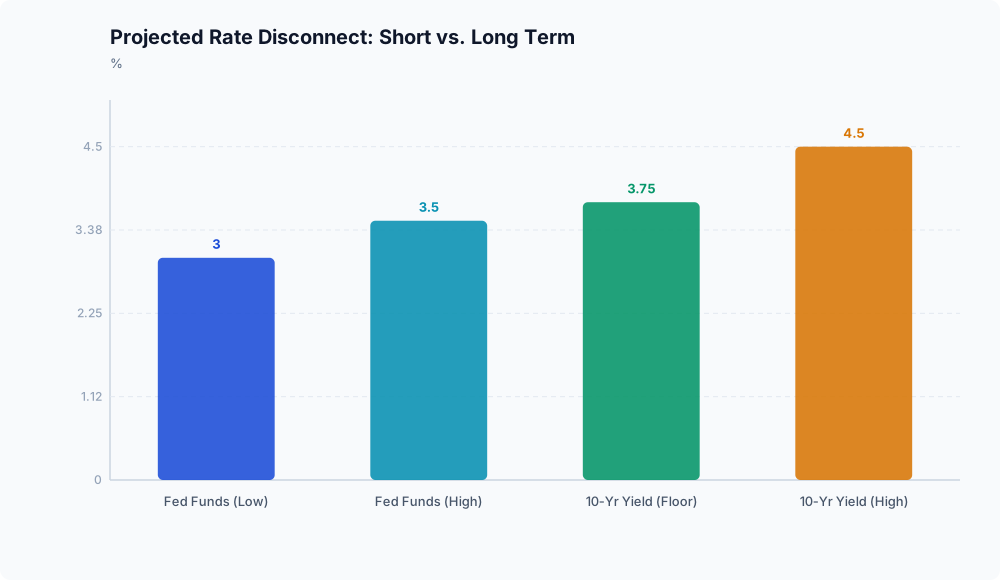
The 2025 housing market trajectory hinges on the disconnect between short-term monetary policy and long-term borrowing costs. While the Federal Reserve is projected to lower the federal funds rate, long-end rates are not expected to follow proportionally. Projections suggest 10-year Treasury yields will struggle to fall below the 3.75% threshold, establishing a defined trading range.
Base Case: Persistent Lock-in and Structural Gridlock The 10-year Treasury yield will likely hover near 4.3%, mirroring the yield-to-worst recorded by the Bloomberg U.S. Aggregate Bond Index in early December 2024, according to Charles Schwab. This sustained elevation guarantees a restrictive mortgage rate environment, continuing the inventory “lock-in effect.” Because millions of homeowners secured mortgage rates below 4% prior to 2022, new mortgage rates remain highly unattractive for prospective sellers. Discretionary existing home sales will remain paralyzed, leaving new construction as the primary reliable source of housing supply.
Upside Scenario: Marginal Relief and Forced Selling In an upside scenario for housing turnover, 10-year Treasury yields could drift downward to test a projected floor of 3.75%, according to Charles Schwab. This decline would offer marginal relief to prospective homebuyers by slightly compressing mortgage rates. Yet, yields are unlikely to fall significantly below this threshold. A 3.75% yield provides a softer financing environment but will not trigger a massive wave of existing inventory. Transaction volumes would see a slight uptick, driven primarily by forced sellers rather than opportunistic upgrades.
Downside Scenario: Yield Spikes and Market Paralysis The downside scenario presents a significant risk to housing market liquidity, with 10-year yields potentially spiking back toward the 4.5% threshold, according to Charles Schwab. Resilient macroeconomic data underpins this upward pressure. If persistent wage growth forces long-term yields to test this ceiling, mortgage rates will surge, paralyzing the existing home sales market. Buyer affordability would deteriorate rapidly, and investors holding assets tied to transaction volumes would face severe revenue headwinds.
What to Watch Next: Triggers and Indicators
Federal Reserve rate cuts will not automatically translate to lower long-term borrowing costs. Market participants cannot rely solely on headline monetary policy to forecast mortgage rates or bond valuations. Instead, investors must monitor three specific macroeconomic triggers that could reinforce or break this yield floor.
1. Wage Inflation and Labor Market Resilience The first critical metric is the trajectory of wage inflation. If wage growth remains near or above the 3.8% year-over-year pace recorded in September 2024, it will fuel persistent consumer demand and sticky services inflation, according to Charles Schwab. This could force the Federal Reserve to pause its easing cycle. Sustained wage pressure would validate the higher-for-longer thesis, cementing the 10-year Treasury yield closer to the 4.5% threshold. Conversely, a decisive deceleration in hourly earnings would provide the macroeconomic cover needed to break the 3.75% floor.
2. Treasury Auction Demand and Deficit Absorption The second indicator requires monitoring Treasury auction demand. The risk of 10-year yields reverting to 4.5% serves as a proxy for market anxiety over deficit absorption. Investors should watch bid-to-cover ratios and primary dealer allocations during upcoming 10-year and 30-year bond auctions. Weak demand would indicate that investors require a higher term premium to absorb the ongoing supply of government debt. If markets balk at financing the fiscal deficit, long-term yields will remain elevated regardless of short-term rate cuts.
3. Implied Bond Volatility and the Prepayment Premium The spread between government debt and consumer mortgages offers a distinct variable to track. Because approximately 80% of the variation in the mortgage spread since 2006 is driven by the value of the prepayment option, investors should monitor implied bond market volatility, according to the Federal Reserve Bank of Boston. If volatility compresses as the Fed stabilizes rates, the prepayment premium will shrink. A reduction in this premium could lower mortgage rates even if Treasury yields stall, narrowing the spread from its current ~200 basis points.
Conclusion

The fixed-income market reflects a new reality of higher-for-longer structural yields. Rather than relying on capital appreciation from plummeting long-term rates, investors must prioritize yield-driven total returns. The detachment of mortgage rates from Federal Reserve cuts is a rational pricing of prepayment option volatility and resilient long-term Treasury yields.
Ultimately, Elevated 10-Year Yields signify a persistently bifurcated credit environment. Corporations relying on short-term floating-rate debt will see margin expansion as the Fed cuts rates. Meanwhile, capital-intensive industries and residential real estate markets will remain bottlenecked by expensive long-term capital. Market participants waiting for a return to sub-4% mortgage rates are misreading the structural mechanics of the current bond market. Until interest rate volatility cools and wage pressures subside, borrowing costs will remain sticky. Capital allocators should seek strategic advantages in sectors that benefit from constrained housing turnover.
Disclaimer: This analysis is for informational purposes only and does not constitute investment, financial, real estate, or legal advice. Always consult a licensed financial advisor before making investment decisions.
FAQ
Why are 30-year mortgage rates still high if the Federal Reserve is cutting short-term interest rates? Mortgage rates are tied to the 10-year Treasury yield, not the Federal Reserve’s short-term federal funds rate. While the Fed cuts short-term rates, long-term yields remain elevated due to sticky wage inflation, resilient economic data, and massive fiscal deficits. Additionally, high bond market volatility causes investors to demand a steeper “prepayment premium” on mortgages, keeping consumer borrowing costs structurally high.
What is the housing ‘lock-in effect’ and why is it projected to last through 2025? The lock-in effect occurs when homeowners refuse to sell because doing so means forfeiting ultra-low mortgage rates secured prior to 2022. Because the 10-year Treasury yield is projected to remain anchored between 3.75% and 4.5% through 2025, new mortgage rates will stay restrictively high. Trading an existing low-rate mortgage for a new high-rate mortgage remains financially unattractive, paralyzing existing home inventory.
What drives the spread between the 10-year Treasury yield and fixed mortgage rates? Historically, the spread is primarily driven by the embedded prepayment option in U.S. residential mortgages. Expectations about interest rate volatility and refinancing costs have explained roughly 80% of the variation in this spread since 2006. When bond market volatility is high, mortgage-backed securities investors demand extra compensation for the risk that borrowers will refinance too quickly or not at all.
Is there a realistic chance the 10-year Treasury yield drops below 3.75% next year? Market projections suggest it is highly unlikely. Analysts caution that 3.75% acts as a strong structural floor due to underlying economic resilience, such as a 4.4% unemployment rate and 3.8% year-over-year wage growth. Unless there is a severe deterioration in the labor market, the 10-year Treasury yield will struggle to fall below this threshold and carries an asymmetrical upside risk of returning toward 4.5%.