
How OBBBA Fiscal Stimulus Impacts U.S. Equities in 2026
The Impact of Fiscal Stimulus on U.S. Equities in 2026: Analyzing the Proposed OBBBA
The potential passage of the One Big Beautiful Bill Act (OBBBA), proposed to be signed into law on July 4, 2025, according to Wolters Kluwer, would fundamentally alter the macroeconomic landscape for U.S. equities heading into 2026. By extending key tax provisions and introducing new deductions, the proposed legislation would act as a direct Fiscal Stimulus injected into corporate bottom lines and high-income households. Rather than a broad-based economic intervention, this highly targeted legislative package structurally favors affluent consumers and large corporate entities. Consequently, Schwab projects the U.S. economy will grow slightly above its long-term trend of 2% to 2.5% in 2026, directly supported by this intervention.
For market participants, this policy shift creates an environment where fiscal policy could rewrite traditional equity valuation rules. The bull case for equities must rely almost entirely on earnings per share (EPS) growth. Since the resulting deficit expansion threatens to keep interest rates elevated, broad multiple expansion is highly unlikely. Investors must focus on fundamental earnings delivery, navigating an environment where tax policy artificially supports revenue and EPS, while the bond market’s reaction to sovereign debt suppresses valuations. Ultimately, the OBBBA establishes a bifurcated market reality. Fiscal tailwinds will collide with deficit-driven headwinds, requiring rigorous analysis to identify companies capable of translating tax advantages into tangible earnings growth.
The Transmission Chain: From Policy to Premium Consumption
To translate these legislative mechanisms into actionable equity strategies, investors must map the flow of capital from tax mitigation to corporate earnings. According to Wolters Kluwer, the OBBBA would inject highly targeted liquidity into affluent households. Unlike broad-based tax relief, the OBBBA structurally favors high-net-worth individuals through specific deduction expansions. By focusing on asset-rich demographics, the legislation bypasses lower-income cohorts constrained by inflation. For U.S. investors, this creates a macroeconomic divergence where high-end consumer discretionary spending is artificially insulated from broader economic headwinds.
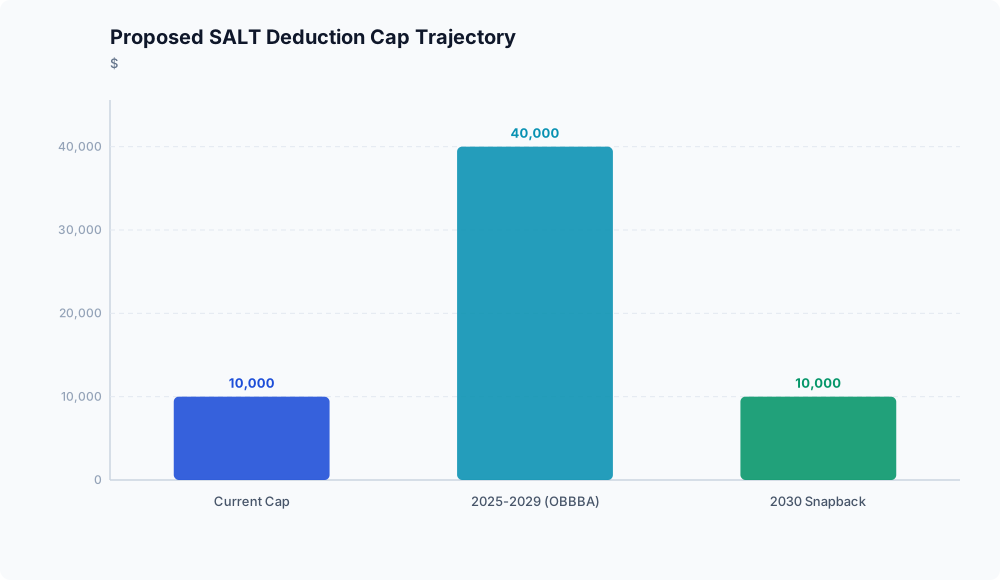
This policy’s transmission mechanism would flow predictably from federal tax savings into the revenue streams of premium brands, luxury retailers, and specialized service providers. The most immediate catalyst is the proposed expansion of the State and Local Tax (SALT) deduction. Wolters Kluwer notes that the OBBBA would raise the SALT cap from $10,000 to $40,000 ($20,000 for Married Filing Separately) for 2025 through 2029. This $30,000 expansion disproportionately benefits affluent taxpayers in high-tax jurisdictions, immediately increasing their after-tax pay.
The second-order effect of this liquidity is a high marginal propensity to consume luxury goods, as these households have already satisfied their baseline economic needs. This mobile capital will likely be deployed into premium experiential retail, high-end apparel, and luxury conglomerates over the next four years before the cap snaps back to $10,000 in 2030, as outlined by Wolters Kluwer.
Compounding this discretionary boost is a temporary personal-use car loan interest deduction. According to Wolters Kluwer, this allows up to $10,000 in deductions for post-2024 loans on new, U.S.-assembled passenger vehicles through 2028. While ostensibly aimed at supporting domestic auto manufacturing, the high threshold effectively subsidizes the financing of premium and luxury vehicles. This reduces the total cost of ownership for high-end buyers, acting as a targeted subsidy for domestic auto manufacturers and lenders.
Furthermore, Wolters Kluwer reports the OBBBA would increase the unified amount for estate, gift, and generation-skipping transfer (GST) taxes to $15 million (pre-inflation) for transfers made after 2025. This reduction in future tax liabilities generates a profound psychological wealth effect among the ultra-rich. By shielding more intergenerational wealth from taxation, the policy emboldens current consumption patterns and provides a durable tailwind for high-ticket discretionary purchases and wealth management services.
This predictable flow of capital would allow markets to price in future earnings beats for companies catering to the affluent demographic. The following table illustrates this policy-to-market transmission mechanism:
| Policy Mechanism | Immediate Household Effect | Consumer Behavior Shift | Market Implication |
|---|---|---|---|
| Proposed SALT Cap Raised to $40k (2025-2029) | +$30k in deductible income for high-earners | Increased discretionary liquidity | Revenue boost for premium retail & experiential luxury |
| Proposed Car Loan Interest Deduction (up to $10k) | Subsidized financing costs | Higher demand for premium US-assembled autos | Overweight luxury auto manufacturers & financing arms |
| Proposed Estate Tax Exemption to $15M (Post-2025) | Reduced generational tax liability | Enhanced psychological wealth effect | Sustained demand for ultra-high-end discretionary goods |
Highest-Signal Evidence: The Zero-Tax Corporate Reality
Economic projections reveal a stark macroeconomic dichotomy defining the 2026 investment landscape. On one side, major U.S. corporations are expected to demonstrate unprecedented efficiency in translating pretax income into bottom-line earnings. This is aided by the proposed revival of 100% bonus depreciation, which Wolters Kluwer notes allows businesses to immediately write off capital expenditures. On the other side, the structural cost of this corporate windfall will manifest in the bond market through expanding federal deficits and elevated sovereign borrowing costs.
The magnitude of this corporate tax efficiency is illustrated in 2025 fiscal year projections. According to ITEP, at least 88 of the largest U.S. corporations could reduce their federal income tax liability to zero despite generating billions in domestic pretax income. Semiconductor giant Nvidia is projected to avoid $6.8 billion in federal taxes, while Palantir could pay zero federal tax on $1.5 billion of U.S. income. Traditional consumer giants will also participate, with ITEP projecting Yum! Brands will shield $1 billion in pretax profits from federal taxation.
Analytically, these projections validate the recent corporate EPS upgrade thesis. Eliminating federal tax burdens allows revenue growth to flow directly to shareholder equity without traditional fiscal friction. The second-order effect is a highly bifurcated economy where government policy, rather than organic operational efficiency, artificially expands corporate profit margins. The immediate implication is a structurally entrenched advantage for large-cap equities over smaller, less tax-efficient peers.
However, surging corporate EPS is counterbalanced by deteriorating sovereign debt dynamics. The robust fiscal stimulus provided by the OBBBA carries a significant macroeconomic cost that will constrain broader equity valuations. According to Schwab, anticipated tax revenue shortfalls will drive large fiscal deficits, necessitating a massive increase in U.S. Treasury supply to fund the government.
Schwab forecasts this supply-demand imbalance will keep 10-year Treasury yields elevated throughout 2026, establishing a likely floor near 3.75%. Yields could also test the 4.5% threshold, even if the Federal Reserve actively cuts short-term interest rates. This implies a steepening yield curve dictated by fiscal reality rather than monetary policy, forcing investors to demand higher term premiums for holding duration.
For U.S. market participants, the tension between zero-tax corporate earnings and elevated long-term yields will be the defining dynamic. Sovereign balance sheets will essentially absorb the fiscal cost of corporate margin expansion. Consequently, fixed-income investors face persistent duration risk from Treasury oversupply, while equity investors must question the sustainability of tax-driven valuations. Upward movement in stock prices will likely be tethered to actual earnings beats rather than higher price-to-earnings premiums.
Market Scenarios: EPS Growth vs. The Cost of Capital
The OBBBA’s fiscal expansion creates critical macroeconomic tension: balancing upgraded EPS against the valuation drag of widening federal deficits. As the government issues more debt to fund tax cuts, increased U.S. Treasury supply threatens to keep long-term borrowing costs elevated. For investors, the 2026 market narrative will be dictated by which force prevailscorporate earnings growth or the rising cost of capital.
The Base Case: Earnings Outpace Valuation Drag In the base case, the OBBBA’s direct EPS boost outpaces the valuation drag of higher long-term yields. Corporate tax cuts and 100% bonus depreciation immediately flow to the bottom line, providing a structural floor for earnings growth. Conversely, Schwab forecasts 10-year Treasury yields may not fall much below 3.75% and could periodically test 4.5%. While equity multiples are unlikely to expand near 4% yields, absolute EPS growth will drive moderate index-level gains. Expect a rotation toward companies with strong free cash flow as investors prioritize immediate earnings over long-duration growth stories.
The Upside Scenario: The Multiplier Effect Absorbs the Deficit The upside scenario hinges on a robust economic multiplier effect triggered by high-income consumer spending. Because OBBBA tax cuts structurally favor higher-income cohorts, sustained discretionary spending could ripple through the broader service and retail sectors. If this generates robust organic economic activity, growing domestic savings and corporate cash reserves could help absorb the incoming Treasury supply. The financial system could then digest the deficit expansion without spiking rates to 4.5%, allowing both earnings and equity multiples to expand. This would broaden the equity rally into mid-cap and consumer discretionary stocks.
The Downside Scenario: Fiscal Dominance and Multiple Compression The downside scenario materializes if runaway 10-year yields compress equity multiples faster than tax cuts grow earnings. If the market struggles to absorb new Treasury issuance, yields could persistently breach 4.5%, aggressively increasing the corporate cost of capital. Uncertainty remains whether Federal Reserve rate cuts will anchor the 10-year yield near 3.75%, or if fiscal dominance will override monetary policy. Unconstrained yield spikes and higher discount rates would trigger severe multiple compression, neutralizing the OBBBA’s EPS benefits.
What to Watch Next: Key Indicators for 2026

To navigate this complex environment, investors must track specific, high-signal data points to confirm which scenario is unfolding. The following indicators serve as real-time gauges of the OBBBA’s impact on the economy and financial markets.
1. Treasury Auction Bid-to-Cover Ratios As the federal deficit expands to fund the OBBBA, the volume of new U.S. Treasury supply presents a critical risk. Investors must monitor 10-year Treasury auction bid-to-cover ratios as a real-time indicator of deficit absorption. Weak demand signals the market is struggling to digest the government’s debt. If buyers demand higher premiums, it could force yields toward 4.5% and tighten financial conditions, overriding Federal Reserve rate cuts.
2. Q1 Luxury Retail Forward Guidance Q1 earnings reports from the luxury retail sector will serve as a primary gauge for the stimulus’s consumer effectiveness. According to Wolters Kluwer, the SALT deduction cap increase to $40,000 immediately reduces the tax burden for affluent consumers in high-tax jurisdictions. Investors should watch forward guidance to verify if this newfound disposable income translates into discretionary spending. If high-earners hoard these savings, the anticipated multiplier effect will underwhelm market expectations.
3. Auto Sector Earnings and Demand Pull-Forward The domestic auto sector faces a distinct legislative catalyst requiring careful monitoring. Wolters Kluwer notes the temporary personal-use car loan interest deduction of up to $10,000 for post-2024 loans on new, U.S.-assembled vehicles effectively lowers financing costs. Investors should scrutinize auto earnings to see if this incentive preserves pricing power and expands margins. Analysts must also watch for a “demand cliff”the risk that this policy cannibalizes future demand by pulling purchases forward into 2025 and 2026 before expiring in 2028.
4. Corporate Capex vs. Shareholder Distributions Forward corporate tax guidance will reveal how businesses intend to deploy legislative windfalls. With the proposed revival of 100% bonus depreciation bolstering corporate balance sheets, as Wolters Kluwer reports, the critical metric during earnings calls will be the ratio of capital expenditures (capex) to shareholder distributions. Increased capex guidance would validate Schwab’s projection of sustained GDP growth. Conversely, a preference for share buybacks and dividends over physical investments could severely mute long-term productivity gains.
5. Wealth Management Inflows Investors must account for the structural shift in wealth transfer mechanics. Wolters Kluwer highlights that increasing the unified amount for estate, gift, and generation-skipping transfer taxes to $15 million provides a multi-year tailwind for wealth management and high-end financial services. Tracking net new asset inflows into premium wealth management divisions will indicate how aggressively the ultra-rich are repositioning capital away from federal taxation.
Conclusion

The 2026 macroeconomic environment could be defined by a historic collision between artificial earnings enhancement and the gravitational pull of sovereign debt. The proposed One Big Beautiful Bill Act would deliver a highly concentrated Fiscal Stimulus that structurally advantages affluent households and large-cap corporations, bypassing lower-income cohorts. By reviving 100% bonus depreciation, tripling the SALT deduction cap, and eliminating federal tax burdens for dozens of major corporations, the legislation provides a powerful tailwind to corporate EPS and premium discretionary spending.
However, this earnings momentum is aggressively financed by the expanding federal deficit. The resulting oversupply of U.S. Treasuries threatens to anchor the 10-year yield near 4%, creating persistent duration risk that will likely suppress broad equity multiple expansion. Portfolio outperformance in this bifurcated reality demands rigorous fundamental analysis. Investors must identify companies that can translate targeted tax advantages into tangible, debt-free earnings growth while maintaining a defensive posture against bond market-driven multiple compression.
Disclaimer: This analysis is for informational purposes only and does not constitute investment, financial, real estate, or legal advice. Always consult a licensed financial advisor before making investment decisions.
FAQ
How would the proposed One Big Beautiful Bill Act (OBBBA) change the SALT deduction cap for taxpayers? The proposed OBBBA would raise the State and Local Tax (SALT) deduction cap from its previous limit of $10,000 to $40,000 ($20,000 for Married Filing Separately) for the years 2025 through 2029. This $30,000 expansion is designed to immediately increase the after-tax take-home pay of affluent taxpayers residing in high-tax jurisdictions.
Why are elevated Treasury yields expected to prevent equity multiple expansion in 2026? The tax cuts and deductions in the proposed OBBBA are expected to drive large fiscal deficits, necessitating a massive increase in the supply of U.S. Treasuries. This oversupply is forecast to keep 10-year Treasury yields elevated between 3.75% and 4.5%. Higher risk-free rates increase the discount rate applied to future corporate cash flows, creating a structural headwind that prevents investors from paying higher price-to-earnings premiums.
Which equity sectors are positioned to benefit most from the proposed new car loan interest deduction? U.S.-based auto manufacturers and auto lenders are positioned to benefit most. The proposed OBBBA would introduce a temporary deduction of up to $10,000 for interest paid on post-2024 loans, explicitly restricted to new passenger vehicles assembled in the U.S. This would act as a targeted subsidy that lowers financing costs and is likely to drive demand for domestic premium and luxury vehicles through 2028.
How would the proposed fiscal stimulus impact corporate earnings per share (EPS) forecasts? The proposed stimulus would artificially boost EPS forecasts by significantly reducing corporate tax liabilities. Provisions like the revival of 100% bonus depreciation would allow businesses to immediately write off capital expenditures, directly shoring up profit margins. Projections show that 88 of the largest U.S. corporations could pay zero federal income tax, demonstrating how these policies would allow revenue growth to flow directly to the bottom line without traditional tax friction.