
How Recent Fed Policy Shifts Influence Tech Stock Valuations
Fed Policy Shifts: Navigating the Macroeconomic Landscape and Equity Valuations
The macroeconomic landscape shifted decisively following Philadelphia Fed President Anna Paulson’s recent remarks, which fundamentally alter the risk calculus for duration-sensitive technology equities. Speaking at the Federal Reserve Bank of Atlanta’s Financial Markets Conference, Paulson explicitly categorized recent inflation spikes as “classic supply shocks” driven by tariffs and Middle East shipping disruptions. By invoking the conventional wisdom that monetary policy should “look through” temporary supply shocks, she signaled a critical tolerance for elevated headline numbers. For U.S. investors, this distinction is paramount because it implicitly caps the terminal rate, removing the tail risk of aggressive, reactionary rate hikes. It suggests the central bank will not intentionally contract the broader domestic economy to cure inflation imported from geopolitical friction. Ultimately, this evolution in Fed Policy preserves the stable discount rates that underpin the elevated valuation multiples of the technology sector, setting a new baseline for how markets must price geopolitical risk.
The Transmission Chain: From Geopolitical Shock to Equity Valuations
To understand why this policy signal is favorable for tech equities, one must first understand the traditional mechanism by which global disruptions negatively impact domestic wealth. Geopolitical shocks historically transmit through the financial system by immediately elevating inflation expectations, which act as a severe, compounding headwind for equities.
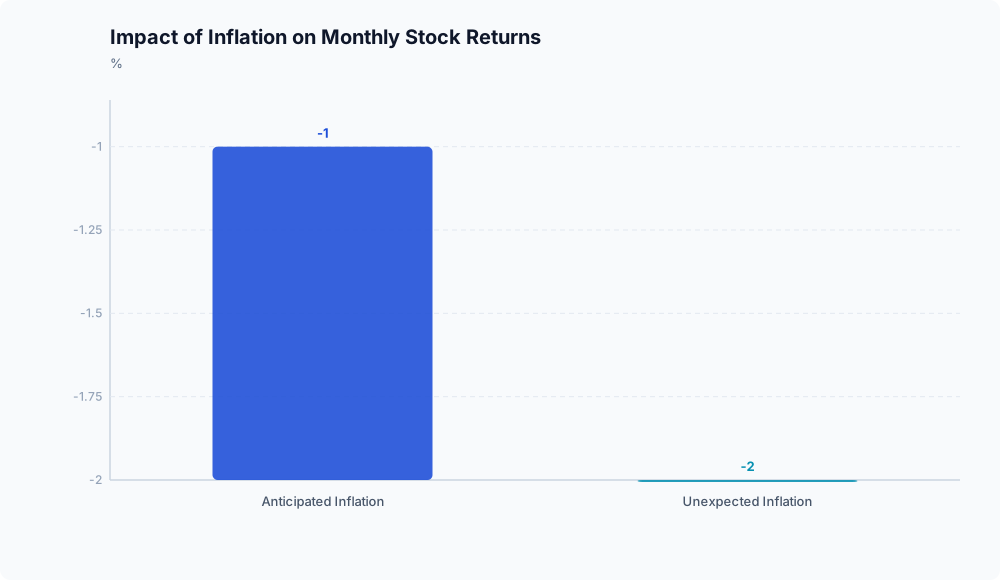
The baseline historical relationship is consistent. Unexpected inflation surprises depress monthly stock returns by more than 2%, effectively doubling the negative impact of anticipated inflation. For U.S. investors, this traditional transmission chain implies that supply-side shocks naturally erode equity risk premiums as markets price in a hawkish monetary response. Consequently, any geopolitical disruption that spikes energy or commodity prices traditionally forces a sharp repricing of risk assets across the board as investors brace for tighter liquidity and higher borrowing costs.
Within this traditional framework, equity duration dictates the severity of the drawdown, leaving growth stocks uniquely vulnerable. The transmission sequence typically unfolds as follows:
- The Exogenous Shock: A geopolitical event (e.g., shipping disruptions or tariff implementations) spikes input costs.
- The Expectation Shift: Consumer and professional inflation expectations rise. Empirical data shows that a 1% increase in consumer inflation expectations, as measured by the Michigan Survey, causes monthly growth stock returns to fall by nearly 1%, compared to a more muted 0.5% to 0.7% decline for value stocks.
- The Rate Response: The central bank raises the federal funds rate to cool demand, forcing the short end of the yield curve higher and tightening credit conditions.
- The Valuation Reset: The long end of the curve rises, increasing the discount rate applied to future earnings. Because growth stocks derive the vast majority of their present value from cash flows expected years in the future, their multiples experience sharp compression.
Interestingly, when professional forecasts are used to measure expectations rather than consumer sentiment, the negative impact shrinks to roughly 0.4% for growth and 0.1% to 0.15% for value. This divergence highlights that consumer sentiment heavily influences near-term equity volatility, driving selling pressure even when professional models forecast a milder structural impact.
However, the transmission chain from geopolitical shock to equity drawdown is not immutable. Recent signals from figures like Paulson suggest a critical shift in the central bank’s reaction function. Paulson is effectively using monetary policy to insulate the domestic economy from geopolitical volatility. When the central bank treats upside inflation surprises as transient supply shocks rather than symptoms of demand overheating, the traditional policy response is altered.
Instead of aggressively hiking rates, policymakers adopt a more measured stance. This approach stabilizes the long end of the yield curve, keeping borrowing costs manageable and anchoring the discount rates required to support elevated equity valuations. By conceptually isolating geopolitical inflation from domestic demand, the central bank ensures that the external effects of Middle East oil shocks and tariff battles do not freeze the domestic demand environment.
The Highest-Signal Evidence: Decoding the Macroeconomic Reality
The macroeconomic backdrop leading into Paulson’s address prompted a significant reassessment of inflation risk. The U.S. economy currently sits at an intersection of structural resilience and reaccelerating price pressures.
On the resilience front, verified macroeconomic data from the Philadelphia Fed confirms that U.S. real gross domestic product (GDP) recently expanded by a solid 2%, providing a robust foundation for corporate earnings. The labor market remains historically stable. The unemployment rate has shown modest cooling from the historic 3.4% low recorded in April 2023, though it reflects underlying stability. This baseline of steady growth and employment suggests the domestic engine is not currently contracting.
Despite this underlying stability, market inferences regarding stagflation are being fueled by a distinct reacceleration in consumer prices colliding with slowing consumer activity.
- Headline PCE inflation climbed significantly from previous lows.
- Core PCE inflation rose over a similar timeframe, according to the Philadelphia Fed.
- Energy costs have been the primary culprit, with a notable increase in gas prices recently.
- U.S. consumption growth has decelerated notably from the previous year’s pace, as reported by the Philadelphia Fed.
This dynamicrising input costs meeting a slowing consumer baseis a standard recipe for margin compression. Historically, markets interpret upside inflation surprises of this magnitude as stagflationary supply shocks, according to LinkedIn. When markets treat inflation as a cost-driven supply shock, the immediate results are stagnant nominal cash flows, flat real yields, and rising equity risk premiums.
The stakes of this economic dynamic are significant for modern portfolio construction. Over the previous decade, a low-inflation and accommodative monetary environment heavily skewed market rewards toward long-duration assets.
| Asset Class | Nominal Return Profile | Real Return Profile |
|---|---|---|
| Growth Stocks | Significant Outperformance | Significant Outperformance |
| Value Stocks | Underperformance relative to Growth | Underperformance relative to Growth |
Source: ResearchGate
If the current environment transitions from mere supply-shock inflation into true stagflation, the decade-long outperformance of growth stocks could face a structural reversal. The fear of this reversal drove investor uncertainty to exceptional levels. Recently, options traders were pricing in an average 4.7% post-earnings fluctuation for S&P 500 stocks, marking the highest implied volatility for an earnings season since 2022, per LinkedIn.
The broader implications extend far beyond individual stock performance. Prominent economic estimates, including those from figures like Gita Gopinath, warned that a severe U.S. market correction could erase over $20 trillion in U.S. household wealthequating to roughly 70% of the U.S. Gross State Product, as noted on LinkedIn. Furthermore, such an event would trigger nearly $15 trillion in correlated losses for foreign investors. By asserting that the current “mildly restrictive” policy is sufficient to keep inflation in check while maintaining a stable labor market, Paulson effectively counters those forecasts, averting a systemic wealth reduction event.
Forward Scenarios: Navigating the Supply-Shock Landscape
While the immediate tail risks have been mitigated, the path forward remains highly contingent on how supply shocks interact with domestic demand. Investors must weigh three distinct scenarios.
The Base Case: The Policy Stance Holds In the base case scenario, the central bank maintains its current “mildly restrictive” posture, successfully looking through energy and tariff-driven price increases as temporary noise, according to the Philadelphia Fed. Long-term yields stabilize, preventing a severe contraction in equity risk premiums. The broader market architecture remains intact, allowing the premium valuation multiples of dominant technology and growth stocks to hold steady.
However, this base case features a vulnerability: the lack of clarity regarding future trade policy. Evidence regarding the exact inflationary impact of unannounced tariffs remains thin. Without concrete legislative or executive frameworks, analysts cannot accurately model the true magnitude of impending cost-push pressures. Because growth stocks are uniquely vulnerable to shifting inflation paradigms, as shown by ResearchGate, any miscalculation regarding tariff impacts could force a revaluation of firms lacking pricing power. The mathematical reality of compounding input costs may eventually prompt the central bank to adjust its stance.
The Upside Scenario: Rapid Resolution and Preemptive Cuts In the upside scenario, global supply shockssuch as Middle Eastern shipping disruptions and initial tariff frictionsresolve more rapidly than the market currently anticipates. This swift resolution naturally deflates headline inflation. Because U.S. consumption has already cooled, per the Philadelphia Fed, the central bank would have the runway to execute preemptive rate cuts. With unemployment stable, these cuts would stimulate softening consumer demand without reigniting structural inflation. The second-order effect would be a broad-based equity rally extending well beyond mega-cap tech, benefiting value stocks and smaller capitalization firms previously constrained by elevated borrowing costs.
The Downside Scenario: The Stagflationary Cycle The downside risk materializes if domestic demand unexpectedly overheats precisely as supply shocks entrench themselves, creating a persistent stagflationary cycle. In this environment, the central bank is forced to abandon its tolerance for supply-driven inflation and raise rates to reduce demand.
The implications for equity markets would be severely negative. U.S. investors heavily allocated to long-duration growth assets would face steep drawdowns as rising equity risk premiums and flat real yields reprice the market, according to LinkedIn. A 1% increase in consumer inflation expectations typically causes growth stock returns to fall by nearly 1%. If forced rate hikes trigger a comprehensive market correction, the estimated $20 trillion in U.S. household wealth reduction becomes a highly probable reality, per LinkedIn.
What to Watch Next: Key Indicators and Market Triggers

To navigate this landscape, market participants must move beyond headline noise and strictly monitor a specific set of leading indicators that will dictate the central bank’s next policy adjustment.
- The Headline vs. Core PCE Spread: Headline PCE has visibly outpaced core PCE, according to the Philadelphia Fed. If headline inflation continues to drag core metrics upward, the current “mildly restrictive” stance will prove insufficient. Any upside surprise in upcoming core PCE releases could trigger immediate, defensive repricing across asset classes.
- Energy and Freight Futures: Because the current inflation spike is heavily driven by an increase in gas prices and shipping bottlenecks, investors must watch crude oil futures and freight rates as leading indicators for Treasury yield behavior. These metrics will signal whether supply shocks are transient or entrenching.
- Corporate Pricing Power in Earnings Calls: As macroeconomic uncertainty mounts, corporate pricing power is the critical differentiator for equity performance. Stagflationary shocks disproportionately harm firms lacking market power, leading to stagnant nominal cash flows, per LinkedIn. Investors must parse upcoming earnings calls not just for top-line revenue beats, but for explicit evidence of margin defense. High-quality, price-making monopolies will attract a significant premium over highly competitive, low-margin businesses.
- Real Consumption Data: With consumption growth slowing, signs of consumer exhaustion are emerging. If slowing consumption collides with persistent supply-driven inflation, the resulting squeeze could be the catalyst for market repricing.
Conclusion

The era of binary inflation tradingwhere any hot inflation print automatically triggers a broad sell-off in growth equitieshas been suspended. By conceptually isolating geopolitical friction from domestic demand, monetary officials have effectively deflated the systemic tail risks that affected markets over the past year. The central bank is choosing to act as a shock absorber rather than an amplifier of global supply chain disruptions. However, this reprieve demands active risk management rather than passive complacency. The mathematical reality of compounding input costs means that corporate pricing power will remain the defining characteristic of resilient equities in this cycle. As long as the labor market holds and consumer expectations remain anchored, this evolution in Fed Policy neutralizes the primary macroeconomic headwind for long-duration equities, structurally supporting the continued outperformance of the technology sector’s highest-margin leaders.
Disclaimer: This analysis is for informational purposes only and does not constitute investment, financial, real estate, or legal advice. Always consult a licensed financial advisor before making investment decisions.
FAQ
How does supply-driven inflation differ from demand-driven inflation in its effect on stock valuations? Supply-driven inflation acts as a cost shock that leads to stagnant nominal cash flows, flat real yields, and rising equity risk premiums, disproportionately harming firms that lack the pricing power to pass on rising input costs. In contrast, demand-driven inflation often correlates with robust economic growth and higher revenues, which can temporarily support valuations before central banks intervene to cool the economy.
Why are growth and tech stocks more sensitive to changes in the Fed’s terminal rate than value stocks? Growth and tech stocks derive a substantial portion of their valuation from cash flows expected far in the future. When the Fed raises its terminal rate, the discount rate applied to those future earnings increases, causing their present-day valuation multiples to experience sharp compression. Empirical data shows a 1% increase in consumer inflation expectations drops monthly growth stock returns by nearly 1%, compared to just 0.5% to 0.7% for value stocks.
Does the Fed’s tolerance for tariff-driven inflation mean interest rate cuts are still possible this year? Yes, if the supply shocks resolve rapidly and domestic demand continues to soften. With U.S. real consumption growth already cooling and unemployment stable, a swift deflation of headline shocks could give the Fed the runway to execute preemptive rate cuts to stimulate softening consumer demand.
How do stagflationary supply shocks impact companies that lack pricing power? Companies lacking pricing power suffer margin compression during stagflationary supply shocks. Because they cannot pass rising input costs (like surging energy or tariff expenses) onto a slowing consumer base, their bottom lines are directly eroded, resulting in stagnant cash flows and a penalty from investors repricing their equity risk.