
Evaluating FOMC Rate Hike Odds and CRE Refinancing Risks
Evaluating FOMC rate hike odds and CRE refinancing risks
How interest rate trajectories impact commercial real estate borrowers facing upcoming loan maturities
Commercial real estate borrowers facing debt maturities through 2027 are confronting a sizable refinancing shortfall. While market participants closely monitor the path of Federal Reserve policy, prediction market data from Polymarket showed rate hike odds (a 25+ bps increase) for the September 2025 FOMC meeting remained below 1%, with the contract resolving to a 25 bps rate reduction at 100%. Furthermore, MMG Real Estate Advisors notes that the Federal Reserve trimmed the federal funds rate by 25 basis points in both September and October.
Despite the lack of rate hikes and the arrival of modest rate cuts, borrowing costs remain substantially higher than when expiring loans were underwritten. Maturing debt originated during previous low-rate cycles cannot be replaced dollar-for-dollar, depressing debt service coverage ratios (DSCR) and forcing takeout loan proceeds to shrink.
Repricing shock: disrupted underwriting and doubled coupons
Credit data confirms that borrowers face severe rate resets regardless of marginal policy easing. According to middle-market observations from Tzortzis Capital, commercial loans originally written around 4% between 2019 and 2022 are facing repricing into coupons between 8% and 11%, accompanied by tighter covenants and accelerated amortization.
This repricing substantially increases debt service requirements. For properties with flat or moderate net operating income (NOI), the surge in financing costs depresses DSCR and debt yields, causing assets to fall short of standard lender takeout sizing constraints.
The scale of the 2026–2027 refinancing wall
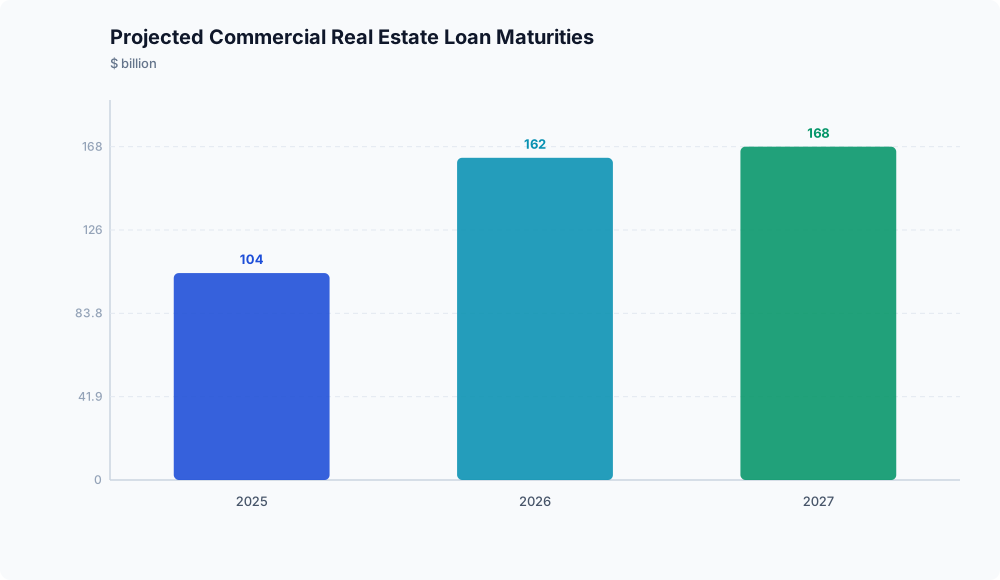
This repricing coincides with an unprecedented volume of maturing debt across property types:
- MMG Real Estate Advisors notes that nearly $1.0 trillion in CRE loans matured in 2025, with over $1.5 trillion and up to $1.8 trillion reaching maturity by year-end 2026.
- Kidder Mathews data cited by Apers AI tracks $1.26 trillion in commercial real estate debt maturing through 2027.
- Morningstar figures cited by Apers AI isolate over $100 billion of commercial mortgage-backed securities (CMBS) debt maturing in 2026 alone, with $57.7 billion facing default risk.
Mounting distress and multifamily vulnerability

Higher debt constants have translated into growing distress metrics across several commercial sectors.
According to MMG Real Estate Advisors, total distressed CRE volume reached $126.6 billion in the third quarter of 2025, an 18% increase year over year. Multifamily accounted for $22.8 billion, or 18%, of that distressed volume.
This stress in the apartment sector coincides with a steep maturity curve. As reported by MMG Real Estate Advisors, multifamily debt maturities are projected to jump 56%, climbing from approximately $104.1 billion in 2025 to roughly $162.1 billion in 2026, before rising to $167.7 billion in 2027.
Delinquency metrics compiled by Apers AI show that office CMBS delinquency has reached 10% to 12%, while multifamily delinquency climbed past 6% in 2025.
Takeout shortfalls and cash-in recapitalizations

The core challenge of the 2026–2027 maturity wave is the capital gap between expiring debt balances and new takeout loans.
According to refinance gap modeling published by Apers AI, a 2014-vintage CMBS loan issued at a 4.5% coupon under a 10-year interest-only structure sizes to roughly 65% of its in-place balance under a 6.5% coupon and standard coverage constraints.
When senior refinancing falls short of the maturing principal, borrowers face a narrowing set of options:
- Inject fresh sponsor equity, mezzanine debt, or preferred equity to bridge the gap down to lender underwriting limits.
- Negotiate maturity extensions, loan modifications, or discounted payoffs (DPO) with existing lenders.
- Surrender underwater properties through foreclosure or deed-in-lieu transactions.
Analytical takeaways
Credit market data indicates that commercial real estate pressures are not driven by FOMC rate hike risks, which prediction markets showed as negligible, but rather by the reality that rates remain far above the coupons of expiring loans. Even with modest Fed rate cuts, debt service costs remain sharply elevated relative to legacy 3% to 4% borrowing costs. For borrowers facing maturities through 2027, resolving refinancing shortfalls will require committing fresh cash-in equity or working through structured loan workouts.
Disclaimer: This analysis is for informational purposes only and does not constitute investment, financial, real estate, or legal advice. Always consult a licensed financial advisor before making investment decisions.