
Commercial Real Estate Refinancing: The 2026-2027 Outlook
The 2026-2027 commercial real estate refinancing wall: rates, liquidity, and property realities
A multi-year wave of commercial real estate debt is coming due, but expected cuts to short-term benchmark interest rates will not resolve the sector’s structural refinancing gap. Lower short-term rates provide some relief to variable-rate borrowers, but replacing legacy debt requires securing long-term capital. Long-term benchmark borrowing costs are projected to remain well above the historical lows at which maturing loans were underwritten. Unless property-level net operating income (NOI) has expanded significantly, property owners must inject new equity to pay down loan balances or surrender assets to workouts and dispositions.
The scale of upcoming maturities and banking concentration
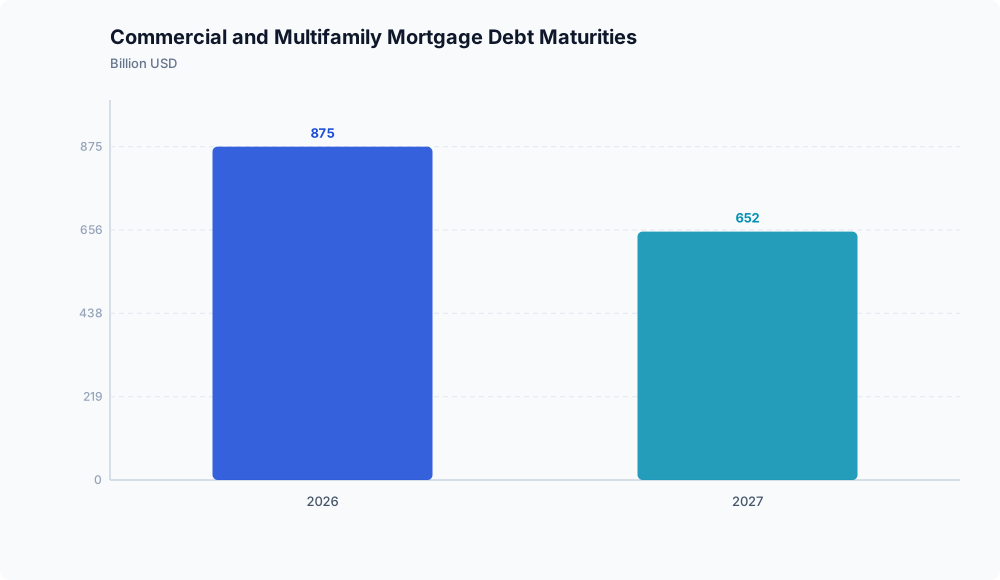
Demand for commercial real estate refinancing liquidity is rising sharply. According to Mortgage Bankers Association (MBA) data reported by Matthews, $875 billion in U.S. commercial and multifamily mortgage debt is scheduled to mature in 2026, followed by another $652 billion in 2027. Combined, more than $1.5 trillion in debt must be repaid, refinanced, or restructured over consecutive years.
U.S. Commercial & Multifamily Debt Maturities
2026: $875 Billion  (Depositories hold $396B / 21% of their portfolios)
2027: $652 Billion
Total: $1.527 Trillion
This maturity wall is heavily concentrated within the domestic banking system. Depository institutions hold $396 billion of the debt coming due in 2026, representing 21% of their total commercial and multifamily mortgage portfolios, according to Matthews.
Having more than a fifth of depository commercial real estate books mature within a single calendar year constrains bank balance sheets. Lenders cannot carry non-performing or unresolved loans indefinitely through extensions. When loans fail to qualify for standard refinancings, banks will be forced to demand balance paydowns, initiate formal workouts, execute note sales, or foreclose to preserve portfolio liquidity and protect credit ratings.
Rate transmission: short-term relief vs. long-term realities
When a central bank cuts its policy rate, the adjustment directly lowers short-term reference rates, such as the Secured Overnight Financing Rate (SOFR) and Term SOFR. For unhedged floating-rate loans, interest payments equal the benchmark rate plus a contractual credit spread. As short-term rates drop, periodic debt service declines.
Because the Debt Service Coverage Ratio (DSCR) measures net operating income against annual debt service, lower carrying costs expand the coverage buffer for qualifying floating-rate properties. However, available industry records lack broad empirical tracking of individual floating-rate Term SOFR tranches and specific loan covenants, meaning this relief cannot be measured uniformly across the market.
Floating-rate relief also does not translate automatically into viable permanent refinancing:
- Long-term benchmarks remain high. While central bank policy targets short-term rates, long-term mortgage financing prices off the yield curve. The MBA forecasts that the 10-year Treasury yield will average 4.2% across 2026, as cited by Matthews. An elevated 10-year baseline means replacement debt will carry substantially higher coupons than the legacy 5- to 10-year loans originated during previous ultra-low-rate regimes.
- Liquidity channels are selective. Government-sponsored enterprises (GSEs) provide a targeted capital backstop for residential assets. Fannie Mae and Freddie Mac are expanding their 2026 lending allocations by more than 20% to $88 billion each, according to John Chang’s Market Outlook. While this $176 billion in combined agency liquidity offers an exit for qualifying multifamily assets, it provides no structural relief for office, retail, or hospitality collateral facing the same elevated Treasury yields.
The operational unknown: property-level net operating income
Underwriting a compliant refinance ultimately requires collateral cash flows to support higher debt service coverage hurdles. If a new loan carries a higher coupon, the property’s NOI must be proportionately larger to achieve the same coverage ratio.
Refinancing Viability Formula:
Refinance DSCR = Property Net Operating Income (NOI) / Higher Replacement Debt Service
*If NOI cannot cover higher debt service at required lender thresholds, an equity gap emerges.*
The underlying health of property cash flows represents the primary unknown in the 2026-2027 reset. Macroeconomic headwinds, including slower corporate hiring, shifting remote-work patterns, and cooling consumer spending, pose downside risks to revenues. However, the available historical data does not include direct empirical measurements of physical office occupancy declines, labor market contractions, or retail foot traffic losses.
Without verified property-level operating data, the degree to which operational cash flows have deteriorated across non-multifamily sectors remains unmeasured. If tenant demand falters and effective rents stagnate, contracting operational margins will counter the benefits of short-term rate cuts and expanded GSE liquidity.
Strategic takeaways for borrowers and lenders

The data indicates a clear divergence between short-term rate expectations and the balance sheet requirements of long-term commercial real estate financing:
- Benchmark rate relief alone will not solve the shortfall. Because the 10-year Treasury is forecast to average 4.2% in 2026 (Matthews), debt service on replacement loans will remain elevated. Property owners cannot rely solely on benchmark cuts to restore compliant coverage ratios.
- Borrowers facing maturity shortfalls must inject fresh capital to write down principal balances to underwriteable levels. Those unable or unwilling to bridge the equity gap will be compelled to pursue recapitalizations or asset dispositions.
- With depositories managing $396 billion in 2026 maturities alone (Matthews), institutional capacity to grant short-term extensions is restricted, accelerating the pace of formal workouts and market-clearing transactions.
Disclaimer: This analysis is for informational purposes only and does not constitute investment, financial, real estate, or legal advice. Always consult a licensed financial advisor before making investment decisions.
Frequently asked questions

Why might a drop in SOFR still be insufficient to qualify a commercial property for refinancing in 2026?
A reduction in SOFR lowers monthly debt service only for unhedged floating-rate loans. Permanent takeout financing is typically priced against long-term benchmarks like the 10-year Treasury yield, which the Mortgage Bankers Association forecasts to average 4.2% across 2026 (Matthews). If long-term base rates remain elevated and property-level net operating income has not grown enough to cover the resulting debt service, the loan will fail lender coverage requirements regardless of lower short-term rates.