
Managing CRE Refinancing and Mortgage Rate Floor Shifts
Navigating the rate floor: how sovereign yield spikes constrain real estate refinancing
When long-term government bond yields rise abruptly, they lift the base cost of capital across the economy, independent of short-term central bank policy. For real estate and mortgage borrowers, higher benchmark yields elevate borrowing costs and make both fixed- and adjustable-rate financing more expensive, slowing refinancing transactions.
The decoupling of long-term benchmarks
Long-term borrowing benchmarks frequently diverge from short-term central bank policy expectations. Term premiums, inflation expectations, and secondary market supply and demand govern long-duration sovereign yields, rather than overnight policy rates alone.
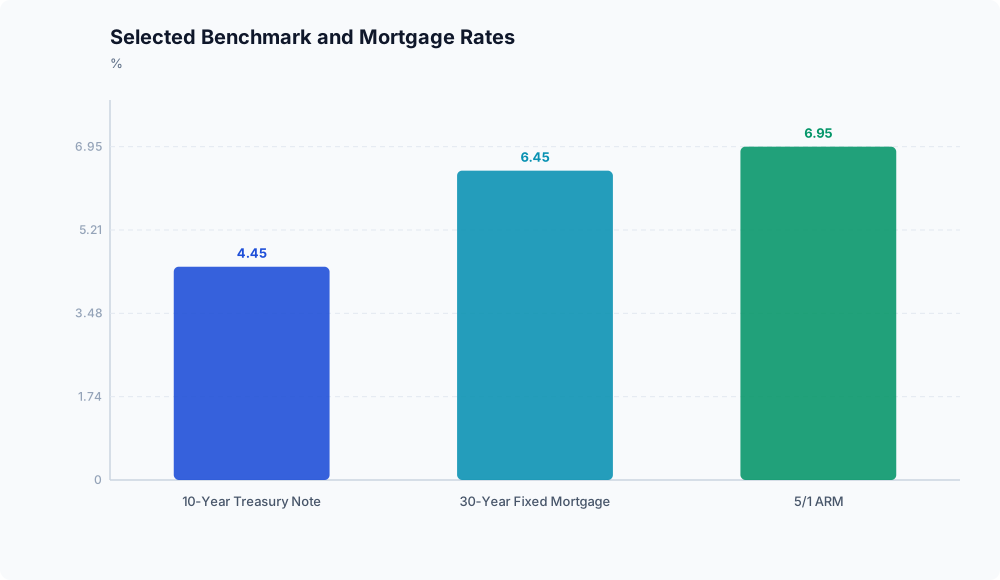
This divergence occurred on March 27, 2026, when the yield on the U.S. 10-year Treasury note climbed more than 13 basis points in a single session to 4.447%, up from 4.358% the prior session, as reported by TimeTrex. The rapid move showed fixed-income investors demanding higher returns to hold duration risk amid elevated inflation expectations and geopolitical turmoil.
The yield spike passed directly through to consumer lending and mortgage credit markets:
- The national average for benchmark 30-year fixed mortgage rates rose to 6.45% or higher in late March 2026 (TimeTrex).
- The 5/1 Adjustable Rate Mortgage (ARM) increased by 35 basis points in a single day to reach 6.95% APR (TimeTrex).
The sharp increase in the 5/1 ARM relative to fixed-rate products reflects an acute repricing of short-term credit risk and market liquidity. Adjustable-rate loans typically offer borrowers a lower initial rate when fixed borrowing costs rise, but pricing ARMs above fixed products removed that alternative for stretched borrowers (TimeTrex).
Immediate contraction in refinance activity
The reset in late March established a higher floor for borrowing costs heading into the spring market. Following the rate increase in late March 2026, weekly refinance application volumes fell by up to 18.5% in a single week, according to TimeTrex.
The decline shows how quickly borrowers respond to yield volatility. With benchmark 30-year rates rising to 6.45% or higher, borrowers faced significantly higher financing costs, and TimeTrex noted that the era of sub-4% mortgages has become structurally obsolete, cementing a “higher for longer” reality.
Managing refinancing pressure amid shifting rate floors
Managing property financing obligations becomes significantly more difficult when mortgage rate floors reset higher. Because mortgage rates are tethered to the 10-year Treasury note plus a mortgage spread, sovereign yield spikes immediately elevate financing expenses across loan categories (TimeTrex).
When borrowing rates establish a higher floor, property owners holding debt originated during lower-rate periods encounter substantial cost increases when seeking new financing. By early September 2026, rates remained sticky in the mid-6% range, with 30-year fixed mortgage rates recorded at 6.74% on September 2, 6.71% on September 4, and 6.67% on September 5 (Norada Real Estate Investments). Additionally, on September 4, 2026, 30-year fixed rates were up 21 basis points year-over-year while home prices reached a record $434,100 (Norada Real Estate Investments).
With higher borrowing costs prevailing and 5/1 ARMs surging to 6.95% APR in late March 2026 (TimeTrex), borrowers can no longer rely on adjustable-rate products to bypass expensive fixed-rate debt. Navigating this environment requires borrowers to manage higher ongoing debt service obligations rather than anticipating a swift return to earlier low-rate financing structures.
Outlook: a persistent borrowing floor
Refinancing conditions and borrowing rate floors over the medium term depend heavily on where the 10-year Treasury settles.
A market forecast by Transamerica Asset Management projects the 10-year U.S. Treasury bond yield to decline to 3.75% by year-end 2026, with an expected Federal funds target range of 3.00% to 3.25%.
If yields fall toward that projection, benchmark pressure would ease compared with the highs recorded in late March 2026, when the 10-year Treasury climbed to 4.447% (TimeTrex). Even so, with headline inflation projected by real estate economists to average 3.7% in 2026 (TimeTrex) and Federal Reserve policy rates forecast between 3.00% and 3.25% (Transamerica Asset Management), borrowing costs will remain elevated above prior low-rate cycles, maintaining a higher floor through 2026.
Disclaimer: This analysis is for informational purposes only and does not constitute investment, financial, real estate, or legal advice. Always consult a licensed financial advisor before making investment decisions.
Frequently asked questions

Why do 30-year fixed mortgage rates track 10-year Treasury yields instead of the Federal Funds Rate?
Mortgage rates are volatile instruments that track global financial market sentiment, inflation expectations, and sovereign bond yields rather than direct central bank consumer lending directives (TimeTrex). While the Federal Reserve sets overnight lending targets, mortgage rates are tethered to the yield on the 10-year U.S. Treasury note plus a risk premium known as the mortgage spread (TimeTrex). When inflation expectations rise, bond investors demand higher yields to compensate for inflationary decay, which pushes mortgage rates upward (TimeTrex).

How do Treasury yield projections affect the borrowing floor for mortgage rates?
Mortgage rates are tethered to the 10-year U.S. Treasury note plus a mortgage spread (TimeTrex). Transamerica Asset Management forecasts the 10-year Treasury bond yield to decline to 3.75% by year-end 2026, alongside a Federal funds target range of 3.00% to 3.25%. While lower Treasury yields would ease pressure relative to the 4.447% peak seen on March 27, 2026 (TimeTrex), TimeTrex reports that the era of sub-4% mortgages is structurally obsolete, establishing a persistent borrowing floor.