
Fed Rate Hike Equity Valuation Repricing: Earnings Impact
Can Corporate Earnings Growth Protect Equities Against 5% Treasury Yields?
In the near term, an extraordinary surge in corporate earnings can outpace the valuation drag of higher discount rates. That protective cushion is temporary, however. While forecasted profit growth exceeding 30% shields broad-market valuations against benchmark yields surpassing 5%, according to Enterprise Bank & Trust, that buffer weakens considerably once earnings growth moderates toward historical norms.
The capital cost shock: 5% yields and valuation math
Following the Federal Reserve’s September 2026 meeting, fixed-income markets adjusted to tighter debt financing conditions. The benchmark U.S. 10-year Treasury yield finished just above 5% for two consecutive trading sessions, while the central bank raised its overnight policy rate to a range of 3.75% to 4.00% and projected a resumption of rate cuts in 2028, as reported by Enterprise Bank & Trust.
The mathematical consequence for equity valuations is straightforward. When sovereign risk-free rates sustain levels above 5%, the weighted average cost of capital (WACC) and equity discount rates rise mechanically. In standard discounted cash flow models, higher discount rates penalize long-duration equities (companies whose projected cash flows sit furthest in the future) by compressing price-to-earnings multiples.
The earnings cushion: 2026 surge vs. 2027 deceleration
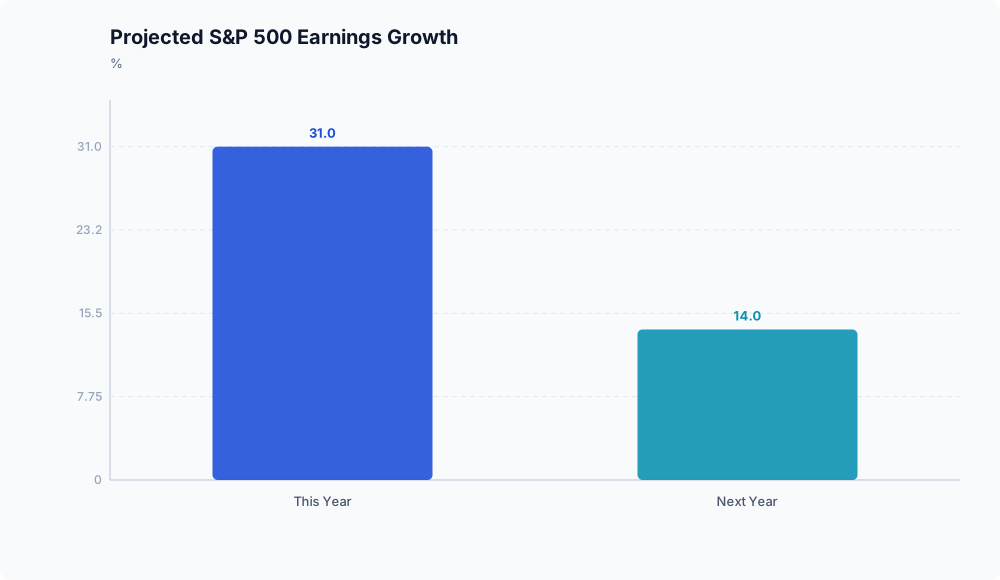
Offsetting this multiple contraction requires strong operational performance. In the near term, corporate profitability is expanding fast enough to counteract elevated capital costs. S&P 500 earnings are projected to grow by more than 30% in 2026, according to Enterprise Bank & Trust. Bill Merz of U.S. Bank Asset Management similarly projected S&P 500 earnings to expand by about 31% this year, as reported by Marketplace.
Nominal earnings growth above 30% can mathematically outpace discount-rate multiple compression, giving broad equity indices enough momentum to absorb higher yields. Yet the durability of this offset diminishes over a multi-year horizon. Forecasts compiled by Marketplace show S&P 500 earnings growth slowing to approximately 14% next year. If 10-year benchmark yields stay pinned around the 5% mark documented by Enterprise Bank & Trust, that step-down to 14% growth will leave valuations far more vulnerable to discount-rate pressure. Furthermore, because available estimates reflect aggregate index projections without isolating technology or artificial intelligence segments, it remains analytically uncertain whether specialized, high-multiple equities possess sufficient individual earnings momentum to prevent sector-level repricing.
Corporate debt and historical parallels

Beyond valuation models, sustained 5% yields establish a higher cost floor across long-term corporate debt channels. For companies facing debt maturities or holding floating-rate obligations, replacement debt will carry higher coupon rates than facilities secured during earlier low-rate regimes. Specific debt maturity schedules, aggregate interest coverage ratios, and default rates are absent from the available data, leaving the exact scale of balance-sheet stress among leveraged issuers unmeasured.
This rate cycle has not followed a straight trajectory. Prior to yields settling above 5%, the Federal Reserve lowered the Fed Funds Rate by 25 basis points on September 17, 2025, according to Federated Hermes.
History also shows that tightening financial conditions do not automatically dictate negative equity returns. Across 2004, 2005, and 2006, the Federal Reserve implemented 17 separate rate hikes while the S&P 500 posted positive annual returns throughout the cycle, as documented by Markets Insider. While this historical record illustrates that economic expansion can run parallel to monetary tightening, that correlation does not guarantee future results or eliminate the cash-flow burden of higher interest expenses for capital-intensive firms.
Analytical takeaway

High discount rates compress theoretical valuation multiples, but corporate fundamentals dictate the net market outcome. For 2026, an expected earnings expansion above 30% provides an effective cushion against 5% Treasury yields, according to Enterprise Bank & Trust. As profit expansion normalizes toward 14%, as reported by Marketplace, persistent borrowing costs will exert much greater downward pressure on equity multiples, making actual bottom-line growth, rather than multiple expansion, the primary support for asset prices.
Disclaimer: This analysis is for informational purposes only and does not constitute investment, financial, real estate, or legal advice. Always consult a licensed financial advisor before making investment decisions.