
Mortgage Rates and 10-Year Treasury Yield: Market Impact
Mortgage Rates and 10-Year Treasury Yield: Market Impact
How do shifts in benchmark government yields and home financing costs transmit through the economy as central banks tighten policy?
Long-term borrowing costs and government bond yields typically adjust well before central banks enact policy decisions. Ahead of interest rate increases by the Federal Reserve and the European Central Bank in September 2026, debt markets priced in persistent inflation pressures, lifting the 10-year Treasury note by approximately a quarter percentage point and pushing 30-year fixed home loans to 7.19%, as reported by CNBC.
Here is an analysis of how monetary tightening transmitted through government debt and mortgage markets, and what credit data reveals about broader borrowing conditions.
Credit Markets and Treasury Yields Move Ahead of Central Banks
Government bond yields and residential financing costs are determined by credit market trading rather than mandated overnight rates. Between the late-August Jackson Hole symposium and mid-September 2026, the yield on the benchmark 10-year Treasury note climbed about a quarter percentage point, standing roughly one full percentage point above its February low, according to CNBC. Over that same window, the average 30-year fixed-rate mortgage jumped roughly 38 basis points to reach 7.19%, standing more than a full percentage point higher than the prior year, based on Mortgage News Daily data cited by CNBC.
These yield surges anticipated synchronized monetary tightening across major economies:
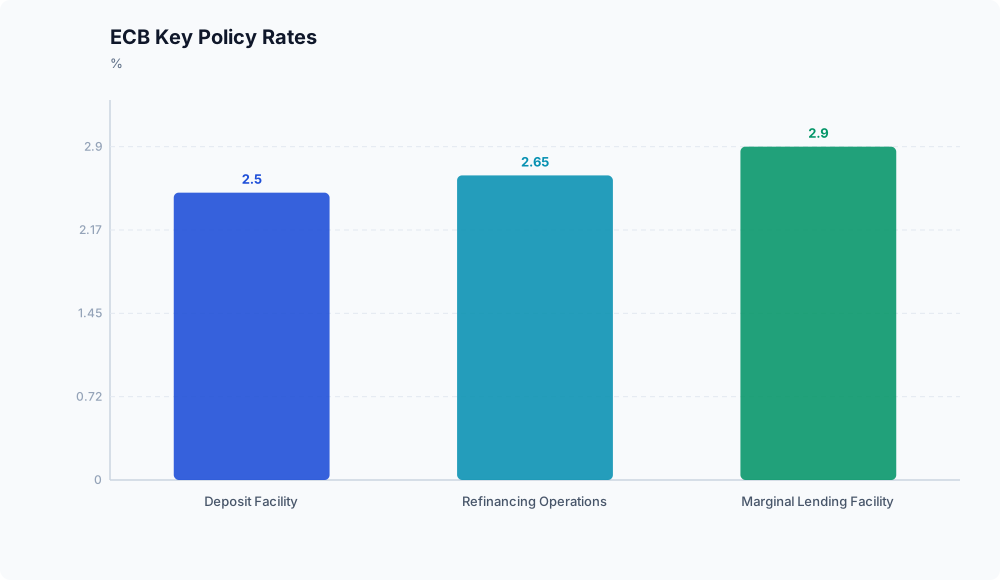
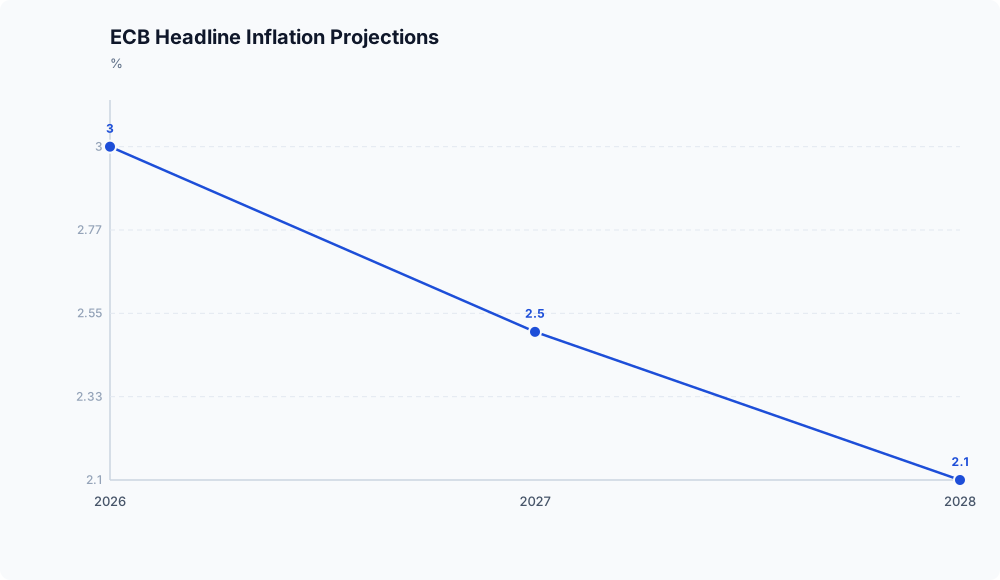
- European Central Bank (ECB): On September 10, 2026, the ECB Governing Council lifted its three key policy rates by 25 basis points—setting the deposit facility, main refinancing operations, and marginal lending facility rates at 2.50%, 2.65%, and 2.90%, respectively, effective September 16, 2026, as documented by the European Central Bank. ECB staff baseline projections forecast euro area headline inflation to average 3.0% in 2026, 2.5% in 2027, and 2.1% in 2028, according to the European Central Bank.
- Federal Reserve: On September 16, 2026, the Federal Open Market Committee (FOMC) voted 12–0 to increase the federal funds target range by 25 basis points to 3.75%–4%, as reported by CNBC.
In the immediate aftermath of the FOMC rate decision, Treasury yields moved lower as investors were encouraged by the central bank’s commitment to lowering inflation, as reported by CNBC.
Housing Market Trends Under Shifting Borrowing Costs
Fluctuations in long-term borrowing benchmarks directly influence real estate transactions and deal completions. When 30-year fixed home loan rates dipped below 6% toward the end of February 2026, pending home sales rose 4.2% year-over-year—marking the strongest annual growth in 15 months—while national contract cancellations eased to 7.2%, as reported by Realtor.com.
Cancellation rates varied across metropolitan areas during that lower-rate period, falling to 2.7% in New York City, 2.9% in Buffalo, 3.4% in Raleigh and San Jose, and 3.6% in San Francisco, where higher-income purchasers encountered fewer financing roadblocks, according to Realtor.com.
Conversely, elevated borrowing costs have historically constrained deal volume. In July 2025, when 30-year fixed rates averaged between 6.67% and 6.85%, pending home sales fell 0.4% month-over-month, and contract cancellations surged to 15% nationally, as documented by CNBC. As mortgage rates climbed back to 7.19% by mid-September 2026, higher financing costs once again tested residential purchasing power, as reported by CNBC.
Inflation Outlook and Policy Projections
Longer-term debt yields remain sensitive to central bank inflation horizons. Alongside its rate hike, the Federal Reserve updated its economic projections, estimating 2026 headline personal consumption expenditures (PCE) inflation at 3.7% and core PCE at 3.4%, while lowering its unemployment rate forecast to 4.1%, according to CNBC. The FOMC does not project reaching its 2% inflation goal until 2029, though it anticipates headline and core PCE slowing to 2.3% and 2.5% in 2027, as reported by CNBC.
In Europe, the ECB similarly confronted persistent price pressures driven by Middle East energy disruptions. Staff baseline estimates project euro area headline inflation at 3.0% in 2026, 2.5% in 2027, and 2.1% in 2028, alongside economic growth of 0.9% in 2026, 1.4% in 2027, and 1.5% in 2028, according to the European Central Bank. With both central banks indicating that price stability will require extended vigilance, benchmark yields must reflect sustained policy restraint.
Analytical Takeaway
The broader takeaway is that long-term debt costs respond dynamically to economic expectations and inflation trajectories before administrative decisions take place. With the ECB forecasting euro area headline inflation above its 2% target through 2028 per the European Central Bank, and the Fed projecting elevated PCE inflation toward 2029 while lifting benchmark rates to 3.75%–4% per CNBC, financing costs across debt and property markets remain closely tied to the persistence of inflation.
Disclaimer: This analysis is for informational purposes only and does not constitute investment, financial, real estate, or legal advice. Always consult a licensed financial advisor before making investment decisions.
Frequently Asked Questions

How did the 10-year Treasury yield react around the Fed’s September 2026 meeting?
Ahead of the September 16, 2026 rate decision, the 10-year Treasury note yield rose approximately a quarter percentage point following Chairman Kevin Warsh’s late-August Jackson Hole speech, putting it about a full percentage point above its February low, as reported by CNBC. Following the FOMC’s unanimous rate hike, Treasury yields moved lower as investors were reassured by the Fed’s proactive stance against inflation CNBC.
How do shifting mortgage rates affect home purchase contract cancellations?
Financing conditions play a significant role in transaction stability. When 30-year mortgage rates fell below 6% in late February 2026, contract cancellations declined to 7.2% and pending home sales rose 4.2% year-over-year, according to Realtor.com. In contrast, during periods of higher borrowing costs—such as July 2025 when rates reached 6.85% before fixed rates surged to 7.19% in September 2026—contract cancellations rose to 15% as buyers faced greater affordability hurdles, as reported by CNBC and CNBC.