
Fed Hike and 10-Year Yield Near 5% Pressure Valuations
Higher Rates vs. Corporate Earnings: Can Growth Outrun Valuation Headwinds?
Corporate earnings growth and productivity gains do not guarantee protection for equity valuations when interest rates rise. While solid underlying demand supports top-line corporate revenue, higher benchmark rates increase the discount rate applied to future cash flows. This compresses equity valuation multiples, particularly for long-duration growth stocks. Unless near-term earnings growth accelerates fast enough to offset this mathematical drag, elevated borrowing costs will continue to cap overall market valuations.
Resilient demand fuels restrictive monetary policy
Economic activity remained durable heading into late 2026. According to analysis from MRA Advisory Group, real final sales to private domestic purchasers expanded at an annualized rate of over 4% in the second quarter of 2026. This measure of private absorption indicates sustained domestic demand through mid-year, removing pressure on monetary authorities to ease financial conditions.
With ongoing economic momentum and persistent inflation, the Federal Open Market Committee (FOMC) voted unanimously (12-0) on September 16, 2026, to raise the federal funds target range by 25 basis points to 3.75% to 4%, as reported by CNBC. Alongside the rate hike, policymakers lowered their projection for the 2026 unemployment rate to 4.1% (CNBC). That labor market strength suggests the central bank is prepared to keep monetary policy restrictive for an extended period.
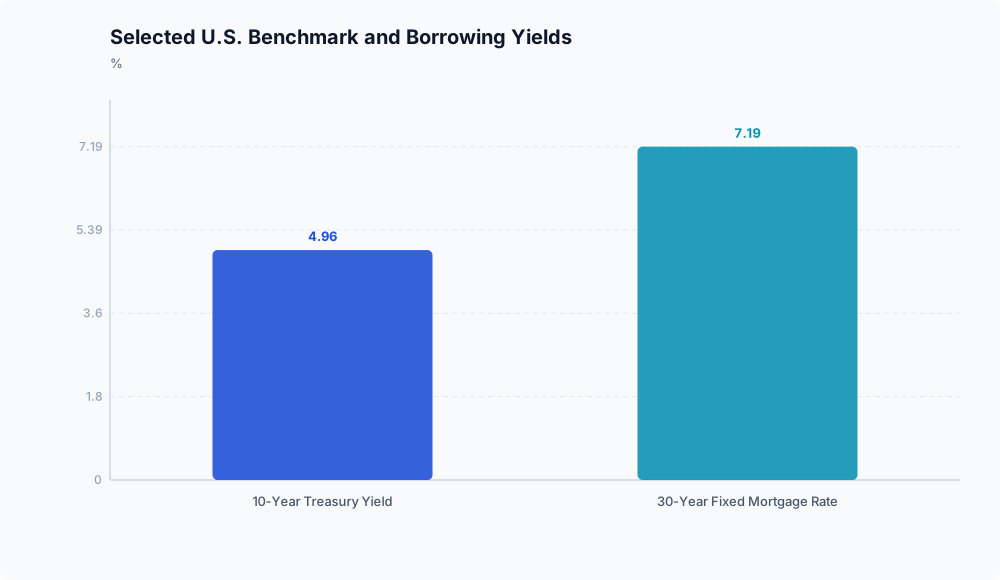
These policy adjustments filtered into broader financing conditions. Data from Mortgage News Daily reported by CNBC indicated that the 30-year fixed-rate mortgage reached 7.19%, while benchmark 10-year Treasury yields reached approximately 4.96% (SWBC). High long-term borrowing costs reflect market expectations that yields will stay higher as long as economic growth holds up.
The valuation squeeze on long-duration assets
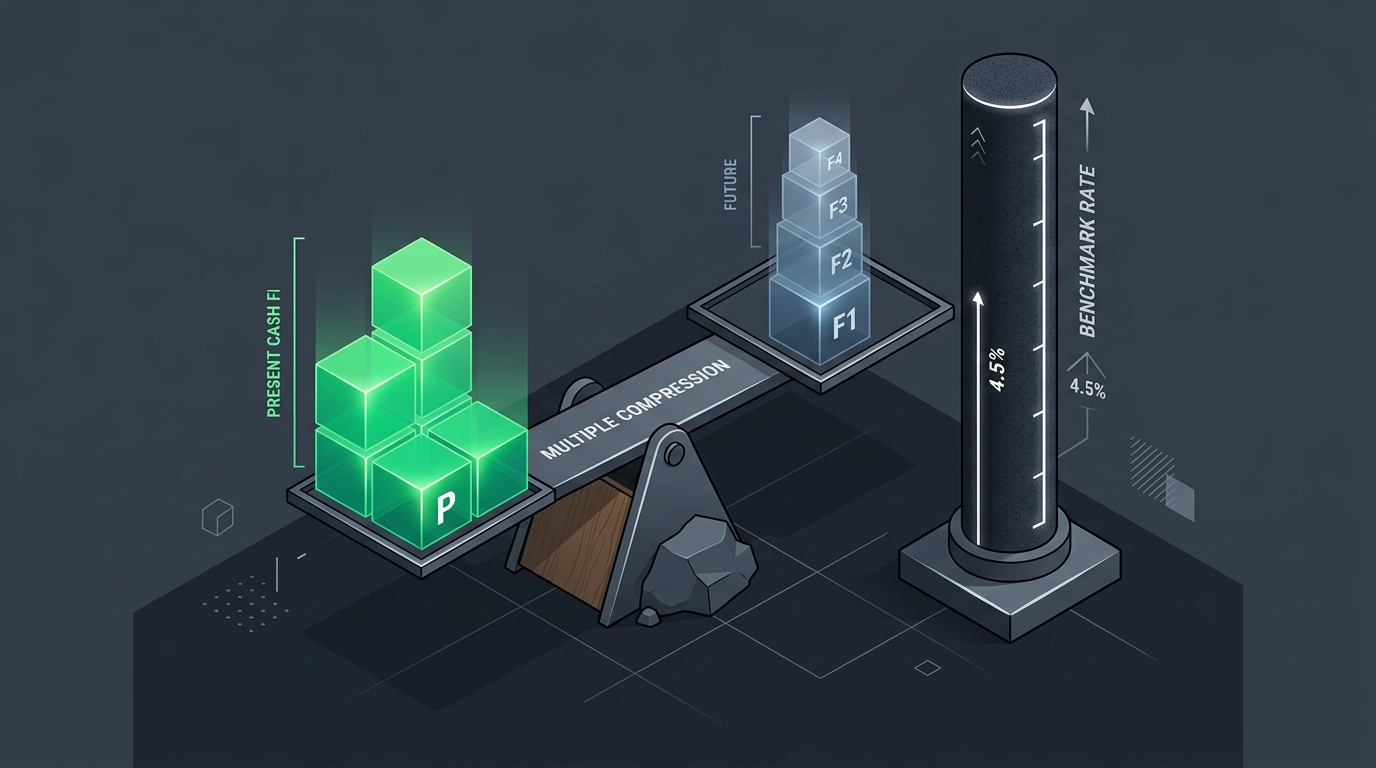
Equity valuations reflect the present value of expected future cash flows discounted by a hurdle rate linked to risk-free benchmark yields. When the FOMC raises policy rates and borrowing costs climb, that hurdle rate rises across financial markets.
Because discounting compounds exponentially over time, higher rates disproportionately affect long-duration assets, meaning companies where most projected earnings sit five, ten, or twenty years in the future. As alternative low-risk yields rise, investors demand higher returns from risk assets.
This dynamic compresses price-to-earnings (P/E) and enterprise-value multiples. Even if a growth company’s operational forecasts remain entirely intact, the present value of distant cash flows drops as the discount rate in the denominator rises.
Can earnings and productivity offset multiple compression?
To counteract rising discount rates, corporate cash generation must accelerate substantially. Steady domestic demand provides a starting point: the >4% expansion in Q2 2026 real final sales reported by MRA Advisory Group allows businesses to convert volume into revenue without immediate margin degradation.
Relying on earnings growth or artificial intelligence productivity gains to offset multiple compression carries several complications:
First, when discount rates rise, net income must expand quickly just to maintain existing share prices under lower multiples. Second, while aggregate demand has supported corporate top lines, current data does not show how much margin resilience comes from structural AI efficiency compared with cyclical demand. Finally, available evidence does not show that AI-driven productivity is lifting net earnings across non-technology sectors enough to protect broader market valuations from high financing costs.
Analytical takeaway

Strong economic momentum cuts both ways for equity investors. While steady demand supports corporate earnings, it also allows the Federal Reserve to keep policy rates elevated for longer.
Until inflation or growth moderates, long-term financing costs will likely stay high. Baseline equity multiples face ongoing downward pressure, leaving corporate earnings growth as the primary driver of incremental market returns.
Disclaimer: This analysis is for informational purposes only and does not constitute investment, financial, real estate, or legal advice. Always consult a licensed financial advisor before making investment decisions.
Frequently asked questions
How does a high benchmark yield mechanically reduce stock valuations?
In discounted cash flow (DCF) models, a stock’s valuation equals the present value of projected future earnings discounted by a rate tied to benchmark risk-free yields. When benchmark yields increase, the discount rate rises. Because cash flows are discounted exponentially over time, distant earnings lose substantial present value, reducing the multiples investors pay for growth companies.
Why does strong domestic demand create downside risk for equity market multiples?
Strong domestic demand, such as private absorption expanding above 4%, signals that the economy does not need monetary stimulus. That resilience lets central banks raise rates and maintain tighter financial conditions without causing an immediate downturn. By keeping benchmark yields and hurdle rates high, strong demand keeps valuation multiples from expanding.