
Fed Easing Trajectory, CRE Refinancing, and Mortgage Rates
Will Federal Reserve Rate Cuts Rescue Commercial Real Estate from Its Refinancing Wall?
Anticipated Federal Reserve rate cuts will not provide a sudden reprieve for the commercial real estate (CRE) sector. Even if the central bank reduces its benchmark policy rate, long-term borrowing costs remain anchored to the 10-year Treasury yield, which market forecasts from Apers place near 4.40% by mid-2026.
Because commercial mortgages price at a spread over long-term benchmarks, takeout financing for maturing loans will remain significantly more expensive than the legacy debt originated during previous cyclical lows. As a multi-year wave of loans originated at sub-4% interest rates matures, property owners face substantial equity shortfalls that short-term monetary easing cannot resolve.
The yield disconnect: overnight policy vs. long-term rates
The divergence between Federal Reserve rate reductions and commercial borrowing costs stems from the structural separation between overnight policy rates and long-term benchmark yields. According to Goldman Sachs Research, the federal funds target rate stood at 3.75% to 4.00% ahead of expected late-year easing, with the firm projecting a policy pause in January followed by 25-basis-point reductions in March and June to achieve a terminal corridor of 3.00% to 3.25%. However, easing policy rates does not guarantee an equivalent drop at the long end of the yield curve.
Commercial mortgages price against the 10-year Treasury yield instead of the federal funds rate. Data published by Apers projects the 10-year Treasury yield near 4.40% by mid-2026. When standard lending risk spreads are added to this benchmark yield, end-borrower coupons face a persistent floor.
As documented by Apers, prevailing institutional borrowing coupons benchmarked against this 10-year Treasury yield remain elevated: agency multifamily sits at 5.50% to 6.00%, commercial mortgage-backed securities (CMBS) conduits range from 6.00% to 6.50%, and commercial banks price between 6.50% and 7.00%.
This dynamic creates severe refinancing friction. According to Smart Capital Center, loans originally secured at sub-4% rates must now seek replacement debt at 6% or higher. Mechanically, a 200-to-300-basis-point increase in coupons reduces takeout financing proceeds by 25% to 35% under constant net operating income (NOI) and debt service coverage ratio (DSCR) constraints. Specifically, an interest-only coupon rising from 4.5% to 6.5% compresses the maximum supportable debt sizing to just 69% of the original loan balance, according to Apers.
Applying these macro mechanics also suggests that as long as the 10-year Treasury remains elevated, 30-year fixed residential mortgage rates will struggle to break below 6.0%, keeping legacy sub-4% residential borrowers disincentivized to sell. However, the direct data evaluated here tracks commercial mortgages, CMBS debt, and macroeconomic rates; specific empirical datasets on single-family home inventory metrics and residential lock-in rates are not present in this record. The conclusion that these spreads will indefinitely suppress single-family listings remains an analytical inference drawn from broader credit conditions rather than direct single-family tracking.
The scale of the CRE maturity pipeline
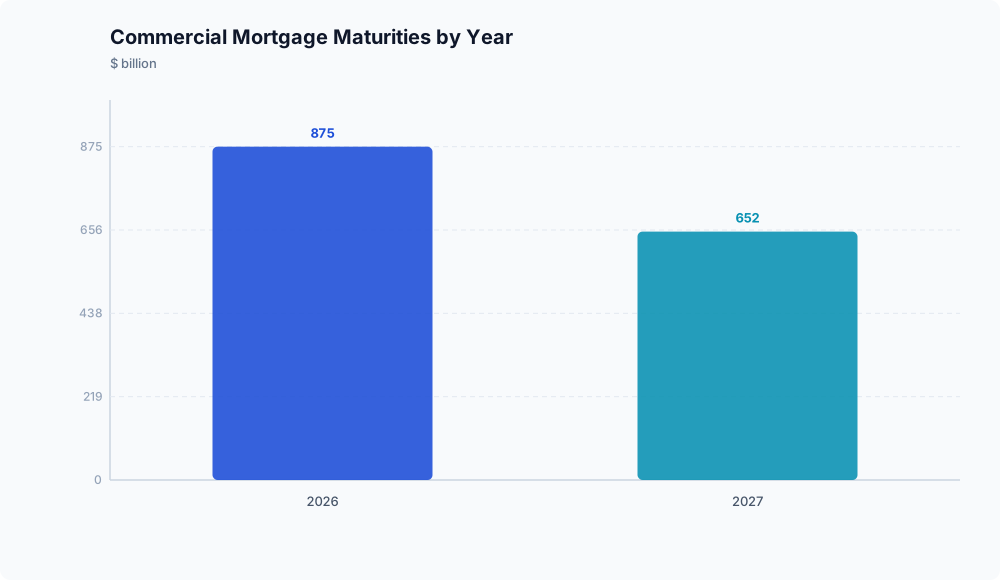
The commercial property market is now meeting a compounding maturity schedule, largely driven by maturing fixed-rate terms alongside short-term extensions granted during earlier periods of market disruption.
According to data from the Mortgage Bankers Association (MBA) released at the 2026 CREF Convention, 17% of the $5 trillion in outstanding U.S. commercial mortgage debt, amounting to $875 billion, matures in 2026. An additional $652 billion is scheduled to mature in 2027, creating a two-year commercial maturity volume of $1.527 trillion, as reported by Smart Capital Center. While the MBA noted that 2026 maturities mark a 9% decline from 2025 levels, research from MMG Real Estate Advisors projects that cumulative commercial debt reaching due dates by the end of 2026 could range between $1.5 trillion and $1.8 trillion.
As noted by Smart Capital Center, this backlog combines scheduled balloon maturities with 12-to-24-month loan modifications executed in 2023 and 2024 that deferred initial payoff deadlines directly into the 2026-2027 calendar window.
Multifamily debt faces compounding balance-sheet stress
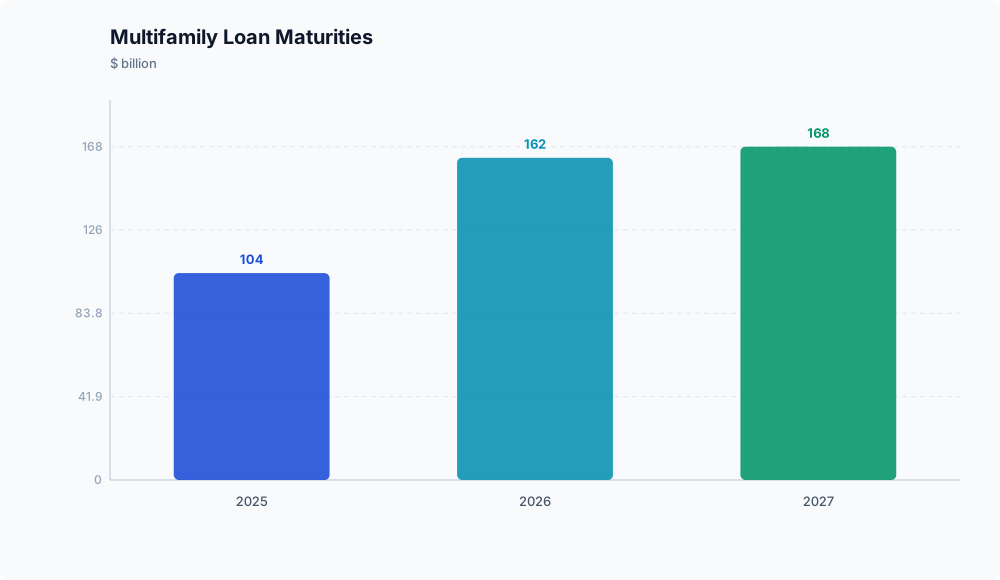
While office assets historically represented the bulk of distressed real estate, the multifamily sector is experiencing a rapid surge in refinancing exposure. Data compiled in the MBA’s 2025 survey indicates that multifamily properties account for roughly 13% of the debt maturing in 2026, compared to hotel/motel properties at 30% and industrial assets at 23%, as cited by Smart Capital Center.
The pace at which multifamily maturities are arriving represents a sharp operational pivot. Projections from MMG Real Estate Advisors show that scheduled multifamily loan maturities will climb 56%, jumping from roughly $104.1 billion in 2025 to $162.1 billion in 2026, before expanding further to $167.7 billion in 2027. This rapid increase concentrates balance-sheet demands on apartment sponsors who acquired assets at peak valuations using short-term, floating-rate, or interest-only financing.
Credit stress has escalated alongside this volume. According to MMG Real Estate Advisors, rolling 12-month troubled apartment volume grew from approximately $1.1 billion in early 2020 (0.2% of total investment volume) to $6.7 billion in January 2024, before reaching $13.8 billion by June 2025. Over the same span, multifamily real estate owned (REO) dispositions expanded from $1.2 billion in January 2024 to $2.7 billion by mid-2025, as tracked by MMG Real Estate Advisors, showing that troubled properties have increasingly moved past workouts into formal repossession. By the third quarter of 2025, total distressed commercial real estate reached $126.6 billion, an 18% year-over-year increase, with multifamily assets accounting for $22.8 billion, or 18% of that distress, according to MMG Real Estate Advisors.
Underlying securitized structures show similar distress. According to Commercial Real Estate Finance Council (CREFC) figures cited by Smart Capital Center, the effective delinquency rate across CMBS, which includes performing matured balloons, climbed to 8.75% in December 2025. Pushing maturities forward without addressing lower property valuations and debt-service shortfalls has carried legacy liabilities into a higher-rate market.
The exhaustion of “extend-and-pretend”
The practice of executing short-term loan extensions, often termed “extend-and-pretend,” is reaching its practical limit. With benchmark Treasury yields remaining elevated, lenders are increasingly reluctant to grant repeated concessions without additional collateral.
Because higher debt yields and expanded capitalization rates reduce the loan size an asset’s net operating income can support, maturing borrowers must bridge substantial capital gaps. Analytically, sponsors confronting maturities in this environment have three main options:
- Common equity recapitalizations. Sponsors can issue capital calls to existing partners or bring in outside equity to pay down principal to a supportable loan-to-value level, diluting original ownership stakes.
- Preferred equity and mezzanine debt. Borrowers can use private credit or subordinate preferred equity to cover payoff shortfalls without sacrificing nominal ownership. However, these tranches carry higher debt costs that absorb cash distributions ahead of common equity.
- Outright property dispositions. Sponsors unable or unwilling to inject fresh capital must sell. As reflected in rising REO totals and troubled volumes tracked by MMG Real Estate Advisors, persistent borrowing costs are forcing distressed asset sales, transferring property control to well-capitalized buyers who can re-underwrite assets at higher cost-of-capital assumptions.
The structural reset

Commercial real estate faces a structural valuation reset instead of a brief liquidity pause. While policy easing by the Federal Reserve may lower short-term borrowing costs, long-term financing remains constrained by 10-year Treasury yields and standard institutional lending spreads.
For property owners, the expiration of earlier loan modifications means that balance-sheet adjustments can no longer be deferred. With over $1.5 trillion in commercial debt coming due across 2026 and 2027 reported by Smart Capital Center and replacement coupons lingering 200 to 300 basis points higher than legacy debt according to Apers, resolving incoming maturities will require fresh capital, structured recapitalizations, or property sales.
Disclaimer: This analysis is for informational purposes only and does not constitute investment, financial, real estate, or legal advice. Always consult a licensed financial advisor before making investment decisions.