
Yield Curve Bear Steepening: Why Long-Term Rates Stay Up
Why long-term borrowing costs may stay elevated despite expected Fed rate cuts
Federal Reserve rate cuts may not significantly lower long-term borrowing costs across the economy. Even if the central bank eases monetary policy, long-term borrowing rates are poised to remain elevated in a yield curve bear steepener. In this environment, short-term policy rates drift downward while long-term yields stay sticky, driven by term premiums and heavy market debt issuance.
While policy easing lowers the front end of the yield curve, market forecasts indicate that the 10-year Treasury yield will remain anchored well above policy rates, sustaining higher capital costs for corporations and maintaining valuation pressures on long-duration assets.
Mechanics of the bear steepener
A bear steepener occurs when long-term interest rates face upward pressure or remain persistently elevated even as short-term policy rates decline, widening the spread between both ends of the yield curve.
On the short end, consensus expectations point toward monetary easing. According to analysis published by IMTC, most Fed watchers project two interest rate cuts in 2026, which would lower the federal funds target range to 3.0% to 3.5% by year-end. Under standard mechanics, this expected policy easing acts to anchor or pull down short-duration yields.
At the long end of the curve, however, yields are not projected to drop in tandem. The Breckinridge Investment Committee forecasts that the benchmark 10-year Treasury yield will remain range-bound between 4.0% and 4.5%, as reported by Breckinridge Capital Advisors. This divergence, with policy rates settling at 3.0% to 3.5% while the 10-year yield holds between 4.0% and 4.5%, illustrates the structural steepening dynamic: long-dated debt demands an independent term premium instead of tracking central bank policy downward.
Debt issuance and the durability of long-end ceilings
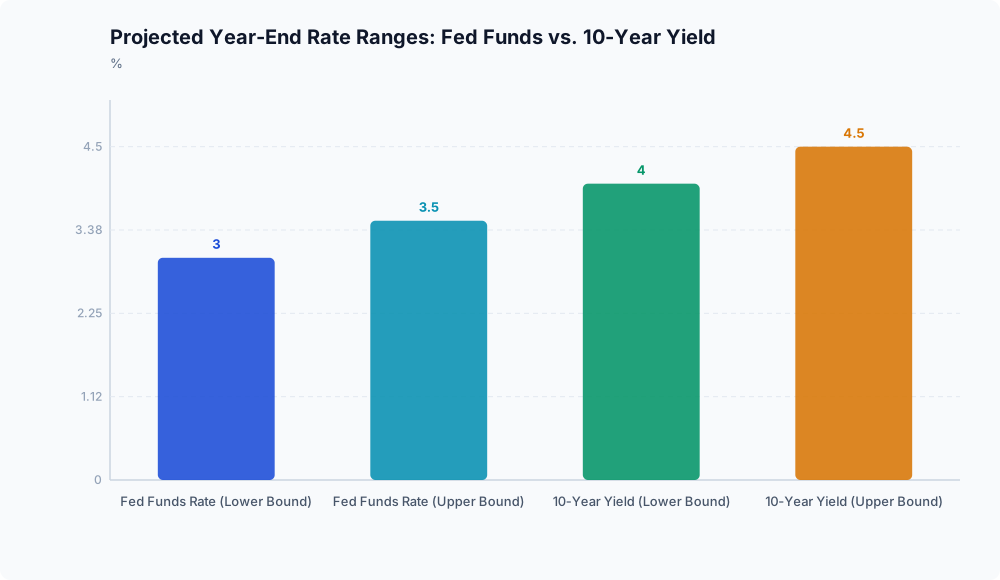
While the Breckinridge Investment Committee expects the benchmark 10-year yield to remain range-bound between 4.0% and 4.5% according to Breckinridge Capital Advisors, other analysts note that a bear steepening could push the yield as high as 4.50% or even higher, as reported by IMTC.
The fixed-income market has also had to absorb heavy supply. According to SIFMA figures cited by IMTC, U.S. corporations issued roughly $1.7 trillion in investment-grade debt in 2025, approaching the historic peak established in 2020. Furthermore, IMTC points out that large and rising U.S. fiscal deficits require increased Treasury issuance, which, together with inflation hovering near 3%, places persistent upward pressure on long-term Treasury yields.
Implications for corporate refinancing and equity valuations

The divergence between short and long rates carries direct operational and valuation consequences across markets.
While the roughly $1.7 trillion in investment-grade issuance cited by IMTC addressed immediate corporate funding and liquidity, it established substantial refinancing commitments. Because policy cuts at the front end do not automatically compress long-duration borrowing costs, corporate issuers face higher debt-servicing expenses during upcoming rollover cycles unless long-end yields drop materially.
Equity valuations face similar constraints from persistent long rates. According to State Street Global Advisors, higher yields increase the discount rate applied to future cash flows, compressing valuation multiples. Over the year leading into September 2026, the S&P 500 forward price-to-earnings multiple compressed from roughly 23x to approximately 19x as the 10-year real yield climbed to 2.6% (State Street Global Advisors). Furthermore, as Treasury yields moved toward 5%, the equity risk premium remained near lows, demonstrating that sticky long-term yields continue to impose a tangible valuation headwind even while central banks ease policy (State Street Global Advisors).
Analytical takeaway

For borrowers and investors, central bank rate cuts will not necessarily translate into cheap capital. The persistence of 10-year Treasury yields in the 4.0% to 4.5% range means that long-duration financing will remain relatively expensive. A lower federal funds rate provides relief to cash markets, but structural term premiums embedded in long-dated bonds dictate the true cost of corporate borrowing and equity risk pricing.
Disclaimer: This analysis is for informational purposes only and does not constitute investment, financial, real estate, or legal advice. Always consult a licensed financial advisor before making investment decisions.