
Treasury Yield Surge and Mortgage Rates: Market Impact
How the Treasury Yield Surge Reshapes Borrowing Costs and Real Estate Financing
Benchmark 10-year Treasury yields climbing past 5% establish a higher structural floor for debt across the broader economy. Because long-term risk-free rates serve as the baseline for both residential and commercial lending, this run-up lifts consumer mortgage rates and commercial financing baselines, raising debt service costs and tightening refinancing conditions across property markets.
The monetary catalyst: rate hikes and rising yields
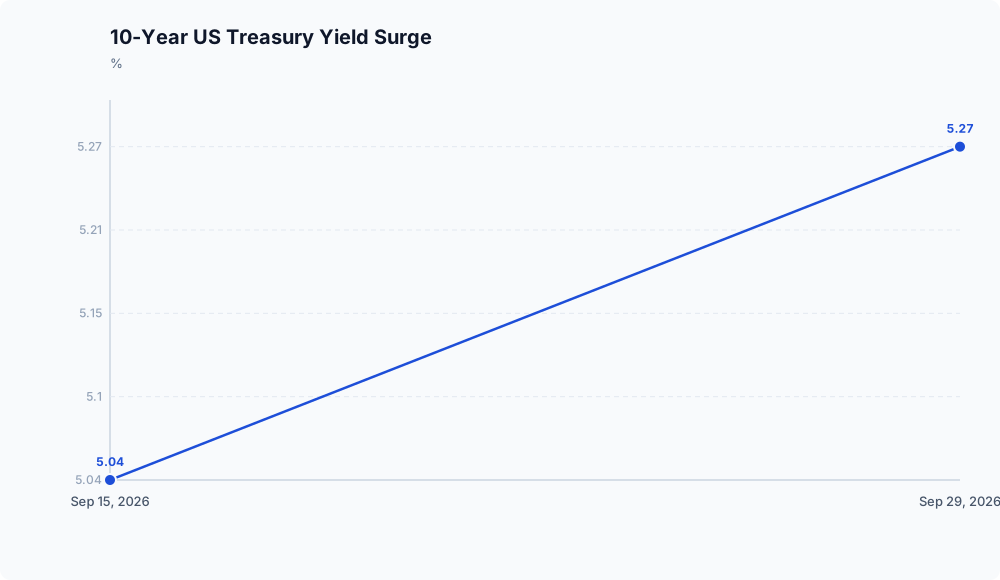
Long-term borrowing costs were already retesting multi-decade peaks heading into late September 2026. On September 15, the 10-year U.S. Treasury yield touched an intraday high of 5.04%, its highest level since July 2007, reflecting mounting pressure on the long end of the yield curve ahead of the Federal Reserve’s formal policy announcement, according to Crestwood Advisors.
Upward momentum continued after the central bank met. On September 16, the Federal Reserve voted 12 to 0 to raise the target range for the federal funds rate to 3.75% to 4%, as documented by Crestwood Advisors. Alongside the unanimous rate hike, policymakers signaled that the tightening cycle was not yet finished. The Fed’s Summary of Economic Projections showed a median year-end 2026 federal funds rate projection of 4.1%, consistent with one additional 25-basis-point increase, with 16 of the 18 participating officials projecting at least one more hike before year-end, per Crestwood Advisors.
Secondary markets repriced duration risk in response to the policy decision and forward guidance. The 10-year Treasury yield rose further over the following two weeks, reaching a session high of 5.27% by September 29, 2026, as reported by Crestwood Advisors. Beyond monetary policy, non-monetary pressures also propelled the long end higher, including oil prices elevated by conflict in Iran, heavy deficit-driven Treasury issuance, and rising corporate bond offerings from AI infrastructure build-outs, according to Crestwood Advisors.
Transmission to residential mortgages and housing
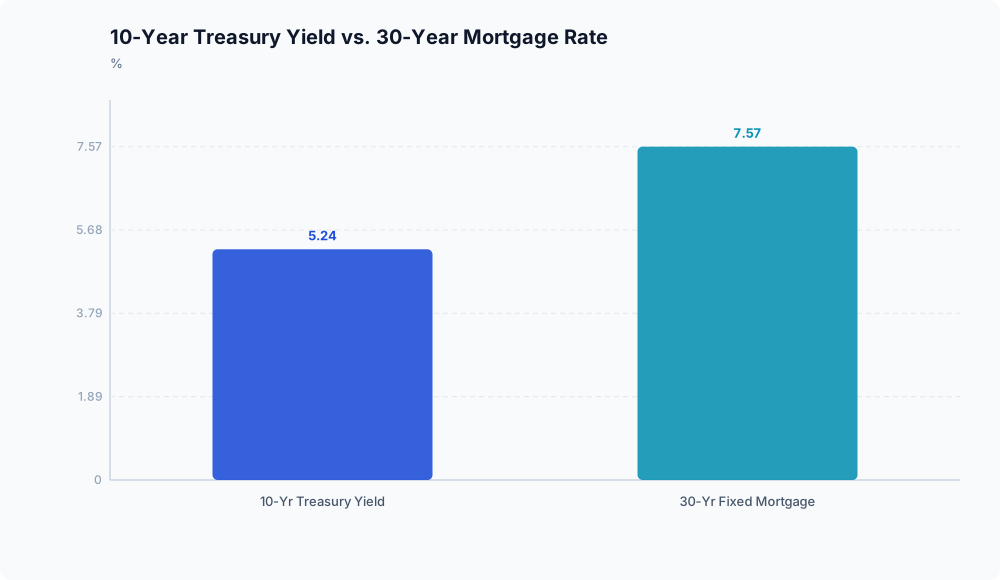
Elevated intermediate- and long-term risk-free rates directly affect consumer credit. Because the 10-year Treasury note is the primary benchmark for pricing 30-year fixed-rate residential mortgages, benchmark yields sustained above 5% apply upward pressure to home loans by lifting the baseline rate to which lenders add loan-specific spreads.
As Treasury yields climbed, the 30-year mortgage rate surpassed 7% for the first time since early 2025, according to Crestwood Advisors. By early October 2026, the 30-year fixed rate reached 7.57% against a 5.24% 10-year Treasury yield, producing a lender spread of 2.33% that sits wider than the historical norm of roughly 1.7%, as reported by The Right Trader.
These elevated financing costs reinforce the housing market’s “lock-in effect.” Existing homeowners holding lower-rate debt face a strong financial disincentive to sell, which restricts resale inventory and tightens market affordability.
Capitalization rates and commercial property distress
The surge in risk-free borrowing costs also affects commercial real estate fundamentals. When 10-year Treasury yields hold above 5%, they elevate base borrowing benchmarks for commercial debt, placing structural upward pressure on property capitalization (cap) rates.
Because commercial real estate investors require a spread over risk-free Treasuries to compensate for illiquidity and asset-level operating risk, higher underlying debt costs reduce prospective net cash flows. To restore adequate spreads, property yields must expand, which compresses underlying valuations. For property owners facing near-term debt maturities, refinancing at current yields requires replacing lower origination debt with more expensive capital.
Rate-sensitive sectors registered sharp adjustments during the yield run-up, with REITs declining between 5% and 7% in September 2026, as documented by Crestwood Advisors. While macroeconomic conditions point to ongoing valuation strain and maturity frictions, specific portfolio-level default volumes and precise valuation markdowns remain analytical projections.
Outlook for borrowing and real estate
The late September 2026 surge in the 10-year Treasury yield to 5.27% shows that debt pricing is adjusting to higher base rates, per Crestwood Advisors. As long as central bank policy expectations remain anchored near a 4.1% federal funds rate, financing long-duration assets will require absorbing higher debt service costs and navigating compressed property yields.
Disclaimer: This analysis is for informational purposes only and does not constitute investment, financial, real estate, or legal advice. Always consult a licensed financial advisor before making investment decisions.
Frequently asked questions

Why do 30-year residential mortgage rates track the 10-year Treasury yield rather than the federal funds rate? The federal funds rate is an overnight lending rate set by the Federal Reserve, making it a benchmark for short-term debt. In contrast, 30-year fixed mortgages typically prepay or refinance in roughly 7 to 10 years, meaning their duration closely mirrors intermediate sovereign debt. As a result, mortgage originators price consumer home loans against the 10-year Treasury yield as their primary risk-free baseline, adding a spread for credit, prepayment, and servicing risks, as documented by The Right Trader.
What specific threshold would 10-year yields need to reach for 30-year mortgage rates to move back below 6.5%? A single target yield cannot be isolated because mortgage rates depend on both benchmark yields and lender spreads. Current lender spreads sit around 2.33%, which is wider than the historical norm of roughly 1.7%, as reported by The Right Trader. When markets are volatile, lenders demand a higher cushion, meaning mortgage rates can adjust lower through spread normalization alone, even without a drop in Treasury yields.