
Commercial Real Estate Debt Refinancing: Key Market Pressures
Navigating the commercial real estate debt refinancing wall
Commercial property owners face liquidity constraints because loans originated during periods of lower interest rates must now be refinanced at benchmark borrowing rates above 5%. With higher borrowing costs reducing maximum loan sizing under debt-service coverage ratio (DSCR) limits, sponsors face capital shortfalls as debt maturities peak.
Macroeconomic drivers and negative leverage
On September 16, 2026, the Federal Reserve voted 12 to 0 to lift the target range for the federal funds rate to 3.75% to 4%. The decision followed economic reports showing that nonfarm payrolls rose by 162,000 in August, above the 53,000 consensus estimate, while unemployment held at 4.1%, according to Crestwood Advisors. August headline Consumer Price Index (CPI) inflation rose 0.4% month-over-month and 3.4% year-over-year (Crestwood Advisors).
These policy rates fed into long-term benchmark yields. The 10-year Treasury yield, which sets the benchmark for pricing commercial mortgages, traded between 4.36% and 4.67% across May and June 2026 before rising to 5.28% by October 7, 2026, as documented by Apers.
When base yields exceed 5%, adding standard lender credit spreads pushes nominal borrowing coupons above property capitalization rates. In this negative leverage environment, debt service exceeds property net yield and reduces equity returns. As a result, acquisition activity slows and replacement loans provide insufficient proceeds to retire maturing principal.
Scheduled maturities and capital shortfalls
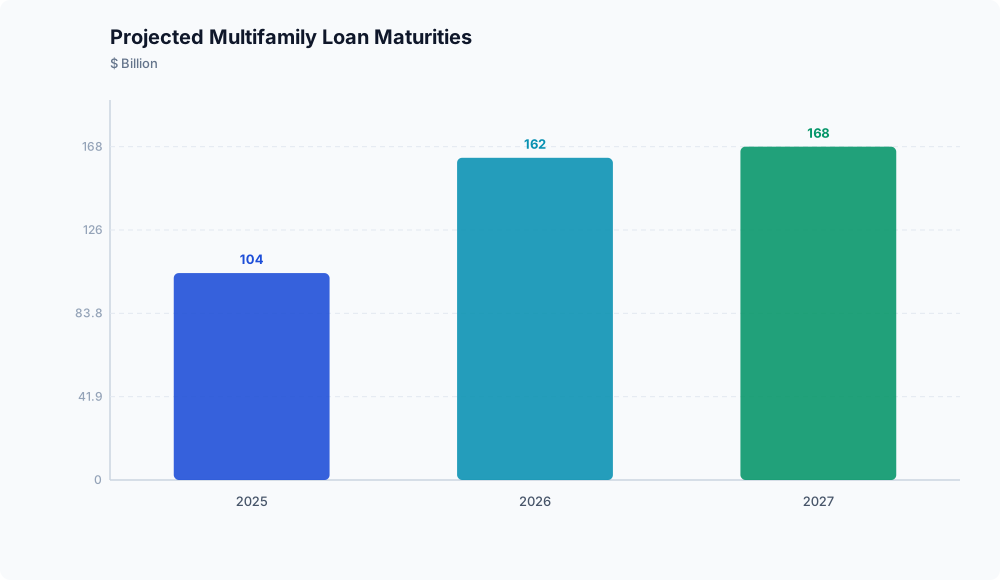
Maturing loans issued in lower-rate periods require resizing under DSCR requirements that evaluate net operating income against current coupons. When cash flows cannot support the original debt balance at higher rates, borrowers face a cash-in refinancing gap.
Multifamily debt faces substantial scheduled maturities. MMG Real Estate Advisors projects multifamily loan maturities will rise 56% from roughly $104.1 billion in 2025 to approximately $162.1 billion in 2026, and to $167.7 billion in 2027 (MMG Real Estate Advisors). In Q3 2025, total distressed commercial real estate volume increased 18% year-over-year to $126.6 billion, with multifamily accounting for $22.8 billion (18%) of that total (MMG Real Estate Advisors).
Meeting these maturities requires sponsors to supply fresh equity, obtain junior gap financing, or restructure terms with lenders.
Delinquency and special servicing trends

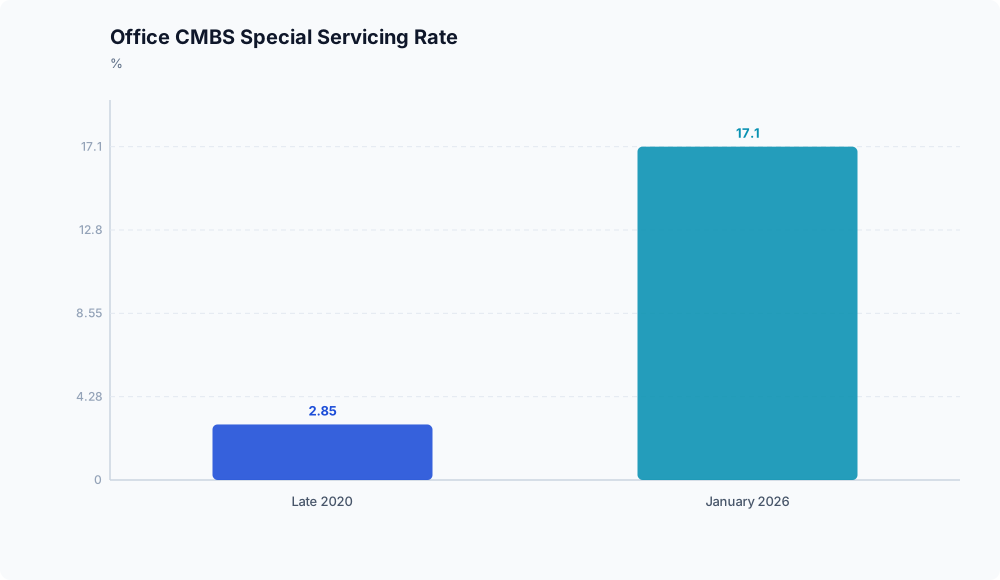
Operational strain is visible in commercial mortgage-backed securities (CMBS). Data from Trepp’s June 2026 report shows an overall CMBS delinquency rate of 7.35%, distributed across property types (Apers):
- Office: 11.57%
- Multifamily: 7.23%
- Retail: 6.91%
- Lodging: 5.22%
- Industrial: 1.20%
Office properties show the highest level of distress. As of January 2026, CMBS office delinquency reached 12.34%, 1.6% above peaks seen during the 2008 financial crisis. The office special servicing rate rose to 17.11%, up from roughly 2.85% in late 2020, according to Quinn Emanuel.
Refinancing outlook

Elevated inflation readings and labor market data have kept benchmark yields high as scheduled loan maturities mount.
Unless long-term interest rates drop or commercial property prices adjust to yield higher cap rates, addressing refinancing gaps will depend on additional sponsor equity. Without sponsor contributions or debt restructurings, default and special servicing volumes are likely to stay elevated across commercial property sectors through 2027.
This analysis is for informational purposes only and does not constitute investment, financial, real estate, or legal advice. Always consult a licensed financial advisor before making investment decisions.