
Fed Rate Hike Equity Multiple Compression and Valuations
How the Fed’s tightening cycle pressures valuations and corporate balance sheets
From a financial modeling perspective, higher benchmark interest rates reduce equity valuation multiples by raising the discount rate applied to future corporate earnings. When the risk-free rate rises, the present value of long-dated cash flows declines, placing downward mathematical pressure on price-to-earnings multiples, particularly for growth and technology companies.
Official economic releases report policy targets instead of equity index trading data. The observable macroeconomic evidence shows the conditions behind monetary tightening, while the specific magnitude of multiple contraction remains an analytical deduction outside the recorded empirical data.
Resilient macro data sparked the Fed’s policy shift
Persistent macroeconomic momentum, led by accelerated hiring alongside sticky inflation, prompted the Federal Open Market Committee (FOMC) to resume monetary tightening.
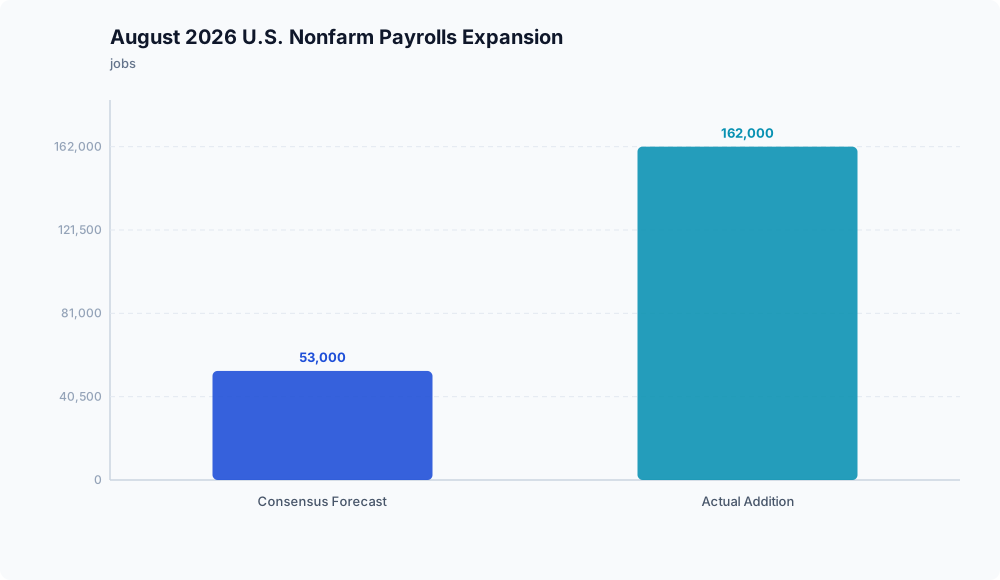
In August 2026, U.S. nonfarm payrolls expanded by 162,000 jobs, outpacing the consensus forecast of 53,000, according to reporting by Crestwood Advisors. Over the same period, U.S. headline Consumer Price Index (CPI) inflation rose by 0.4% month-over-month and 3.4% year-over-year.
This combination of an expanding labor market and elevated inflation countered expectations of a rapid economic cooldown, indicating to central bankers that aggregate demand remained firm enough to absorb additional monetary restraint.
The Federal Reserve shifted away from its extended policy plateau. On September 16, 2026, the FOMC voted 12 to 0 to lift the target range for the federal funds rate to 3.75% to 4%, as documented by Crestwood Advisors. In the Summary of Economic Projections, policymakers published a median year-end 2026 federal funds rate projection of 4.1%. The unanimous vote and the 4.1% year-end estimate indicate that policymakers planned further firming before the close of the calendar year.
The mechanics of equity multiple compression
Monetary tightening transmits directly into equity valuations through the discount rate used in discounted cash flow (DCF) frameworks.
An upward adjustment in the policy rate elevates the broader risk-free rate, increasing the denominator in valuation models. Long-duration equities, predominantly high-multiple growth and technology firms, derive the bulk of their intrinsic value from earnings projected far into the future. Because discount factors compound over time, higher rates exert a disproportionate mathematical drag on those distant cash flows, compressing valuation multiples even when underlying operational performance remains stable. By contrast, short-duration assets with front-loaded cash flows face a smaller mathematical penalty.
While standard financial mechanics point to downward pressure on long-duration multiples, the source data documents macroeconomic metrics and policy rates without recording observed equity price-to-earnings ratios, sector index levels, or empirical drawdowns. The directional pressure is mathematically clear, but the exact degree of multiple compression across specific technology cohorts cannot be quantified from the policy record alone.
Balance sheet pressures on leveraged issuers

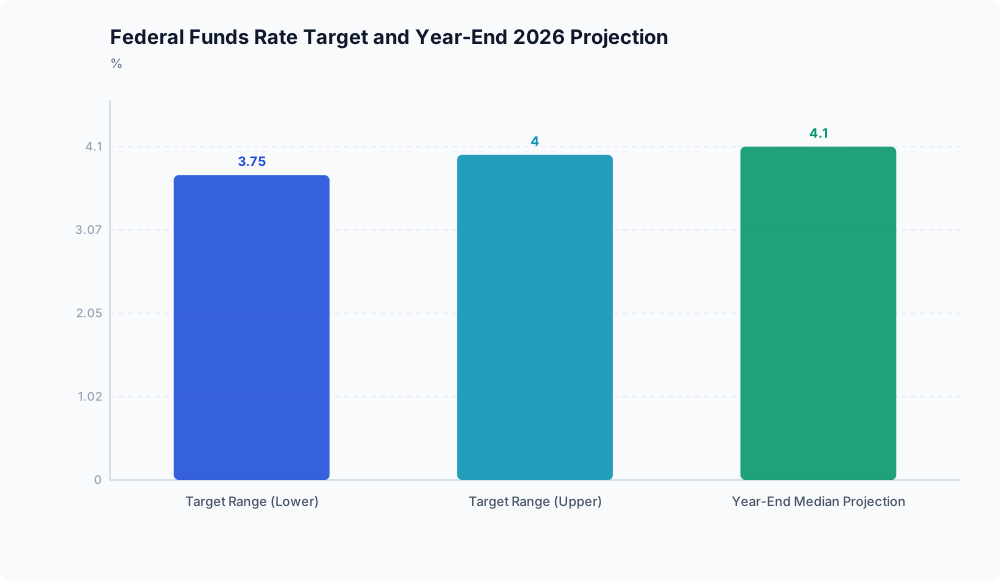
Beyond equity discount rates, sustained policy rates in the 3.75% to 4.1% range reported by Crestwood Advisors lift floating base rates across corporate credit lines and short-term debt instruments.
For leveraged smaller firms carrying floating-rate liabilities or facing near-term debt maturities, this stance leads to an upward reset in contractual debt service costs. In theory, that reset erodes free cash flow and weakens interest coverage ratios.
Available source reporting does not include individual balance sheet data, debt maturity schedules, or floating-rate debt percentages for small-cap indices like the Russell 2000. As a result, the exact scale of cash flow erosion and balance sheet deterioration across corporate borrowers remains an analytical inference subject to real-world uncertainty.
Market implications

The Federal Reserve’s September 2026 rate hike and its 4.1% year-end target reported by Crestwood Advisors confirm that policy rates will stay higher for longer to counter resilient labor growth and above-target inflation. For market participants, the evidence establishes a sustained environment of elevated baseline borrowing costs. While this environment exerts clear mathematical pressure on long-duration equity multiples and floating-rate corporate debt, the ultimate severity of that impact depends on balance sheet resilience and empirical earnings performance that macroeconomic data alone cannot capture.
Disclaimer: This analysis is for informational purposes only and does not constitute investment, financial, real estate, or legal advice. Always consult a licensed financial advisor before making investment decisions.