
Shelter Disinflation and Multifamily Rent Growth in REITs
Managing slower multifamily rent growth
How is cooling apartment rent growth impacting residential REIT performance?
Slowing market rent increases and incoming apartment completions have curbed organic pricing power, holding operational revenue gains to the low single digits. Facing lease-up concessions, tighter GAAP profit margins, and earnings dilution, operators are focusing on unit renovations, selective property sales, and share buybacks.
While economic theory suggests that decelerating shelter costs can reduce broader inflation and potentially lower benchmark yields and borrowing costs, macroeconomic indices and mortgage rate datasets are not included in available corporate filings. At the property level, multifamily real estate investment trusts (REITs) report slower organic growth and competition from newly completed supply.
Compressed same-store growth and margin pressure
Operating results reflect this moderation. For the second quarter ended June 30, 2026, residential landlord Independence Realty Trust Announces Second Quarter 2026 Financial Results reported that its same-store portfolio net operating income (NOI) grew by 1.2% year-over-year.
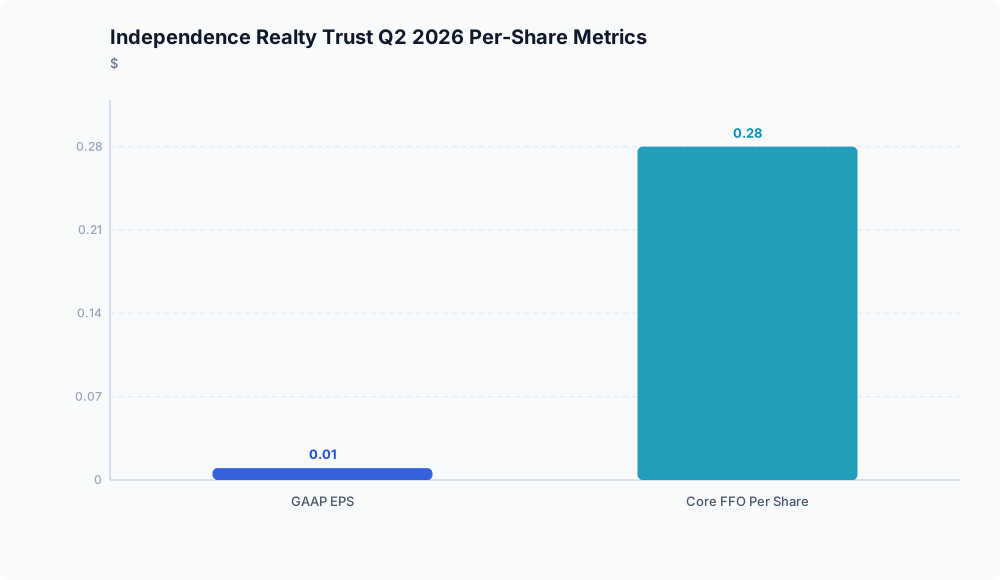
That revenue pace narrows margins once overhead and capital expenses are factored in. Over the same three months, Independence Realty Trust generated Core Funds From Operations (CFFO) of $0.28 per share, compared to GAAP earnings per share (EPS) of $0.01. When top-line gains slow, fixed debt service and depreciation absorb most of operating income, leaving net income near breakeven even as recurring operating cash flow continues.
Supply additions and capital allocation
Apartment completions have added supply across regional markets. In an investor presentation from Nareit REITweek, Mid-America Apartment Communities (MAA) projected that active and completed developments in lease-up would reduce full-year 2026 Core FFO by $0.07 per share. Management attributed this drag to interest expenses on newly delivered units alongside leasing concessions.
As supply lengthens absorption schedules and requires promotional rent terms, capital spending has shifted. MAA redirected proceeds from property sales toward repurchasing its stock. According to Nareit REITweek, the company completed $50 million in share buybacks in May 2026, bringing total year-to-date repurchases through May to $123 million. Management allocated capital toward discounted shares rather than expanding new development.
Value-add programs and balance sheet constraints

Operators have also turned to property improvements to lift revenue. During the second quarter of 2026, Independence Realty Trust renovated 600 units under its Value Add Program, reporting a weighted average return on investment of 16.4%.
Debt levels place boundaries on capital expenditures. Independence Realty Trust Announces Second Quarter 2026 Financial Results ended the quarter on June 30, 2026, with net debt to Adjusted EBITDA of 6.5x. With same-store NOI rising in the low single digits, this leverage level leaves little room to fund expansion with additional debt, requiring operators to pace reinvestment from internal cash flow or asset sales.
Portfolio implications

Filings from MAA and IRT document an operating environment with less landlord pricing power. Slower organic rent growth and supply additions mean portfolio performance relies on unit-level renovations, capital redeployment through asset sales and buybacks, and balance sheet management.
Disclaimer: This analysis is for informational purposes only and does not constitute investment, financial, real estate, or legal advice. Always consult a licensed financial advisor before making investment decisions.
Frequently asked questions
How does a 1.2% same-store NOI growth rate compare to historical residential REIT performance during high-inflation periods?
Historical performance figures from prior high-inflation cycles are not included in the corporate disclosures. The filings confirm that Independence Realty Trust produced a 1.2% year-over-year same-store portfolio NOI growth rate for the three months ended June 30, 2026, alongside slower market rent gains.
Why does shelter inflation have a disproportionately large impact on federal interest rate projections?
The corporate filings do not include macroeconomic data, consumer price index weighting schedules, or Federal Reserve policy models. While economic theory holds that housing costs affect broader inflation measures and interest rates, rate-setting mechanisms fall outside the property-level disclosures provided.