
Navigating CRE Debt Refinancing and Mortgage Lock-In
How higher benchmark yields reshape CRE refinancing and property debt
Elevated base interest rates are creating a structural refinancing gap across commercial real estate. When benchmark yields stay high, borrowing costs frequently surpass property capitalization rates, producing negative leverage and shrinking Debt Service Coverage Ratios (DSCR). For commercial real estate (CRE) sponsors holding maturing debt, new loan proceeds are often insufficient to pay off existing balances without fresh equity injections. At the same time, benchmark yields above 5% sustain elevated borrowing baselines across the wider economy, reinforcing locked-in legacy financing structures.
The monetary shift: rate hikes and benchmark repricing
Expectations of imminent monetary easing shifted sharply in late 2026. On September 16, 2026, the Federal Reserve voted 12 to 0 to raise the target range for the federal funds rate to 3.75% to 4.00%, according to Crestwood Advisors. Along with this unanimous policy decision, the Federal Open Market Committee’s Summary of Economic Projections outlined a median federal funds rate forecast of 4.1% for year-end 2026, signaling that policymakers intended to maintain restrictive borrowing conditions through the close of the calendar year.
This stance at the short end of the yield curve was accompanied by an aggressive repricing in long-term fixed income. Data tracked by Apers shows that the 10-year U.S. Treasury yield (FRED series DGS10) climbed to 5.28% by October 7, 2026, up from between 4.36% and 4.67% in May and June 2026.
Because the 10-year Treasury is the risk-free reference rate for commercial and institutional fixed-rate loans, this rapid climb directly elevated the underlying cost of capital across property debt markets.
The mechanics of negative leverage and refinancing gaps
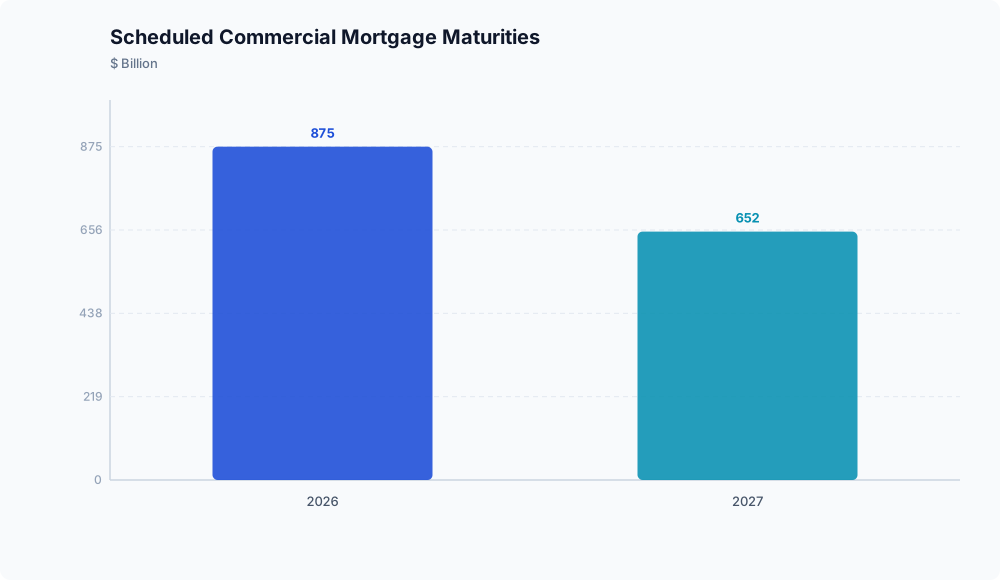
According to Mortgage Bankers Association survey data reported by Smart Capital Center, $875 billion in commercial mortgages—17% of the total outstanding debt—matures in 2026, followed by $652 billion in 2027.
When benchmark borrowing costs jump, commercial property yields face immediate mathematical friction. Negative leverage occurs when the overall cost of debt exceeds the capitalization rate (the property’s net operating income relative to its asset value), dragging down cash-on-cash equity returns.
With 10-year benchmark yields crossing 5.28%, typical lender credit spreads push total commercial mortgage coupons substantially higher. When acquisition cap rates remain anchored near historical lows, debt ceases to be accretive.
This environment compresses Debt Service Coverage Ratios (DSCR) through two related pressures. First, because DSCR measures net operating income (NOI) against required annual debt service, higher interest coupons expand the denominator. Second, unless a property generates corresponding NOI gains, reduced coverage prevents lenders from sizing replacement loans to match maturing principal balances. Sponsors face a refinance gap that must be resolved through capital injections, mezzanine financing, or loan modifications.
Credit stress was already visible in securitized markets before the autumn policy hike. According to Apers, the overall commercial mortgage-backed securities (CMBS) delinquency rate reached 7.35% in June 2026 (based on the Trepp print). While these June delinquency metrics predate the September rate increase and October’s 5.28% Treasury print, the subsequent rise in borrowing benchmarks indicates that borrowers seeking takeout financing face even steeper coupon hurdles.
Property valuation adjustments often lag these debt market shifts. Sponsors and lenders frequently use short-term extensions to avoid realizing losses, and appraisal lags obscure immediate declines. However, persistent benchmark yields eventually require capitalization rates to widen to restore an acceptable risk premium over underlying debt costs.
Broader borrowing transmission and the mortgage lock-in effect

The persistence of higher Treasury yields extends beyond commercial assets, setting the floor for long-term consumer credit and residential mortgages.
Analytically, holding the 10-year Treasury above 5.28% prevents the coupon relief needed to narrow the spread between current loan pricing and legacy low-rate mortgages. In financial theory, this dynamic reinforces the “lock-in effect,” where borrowers with low fixed-rate financing avoid selling or refinancing to prevent resetting into higher replacement coupons.
It is critical to distinguish between analytical models and reported data: the underlying source metrics tracked by Apers do not track residential mortgage-rate series or housing transaction volumes. The empirical evidence of distress in this dataset is confined to commercial real estate, illustrated by the 7.35% June 2026 CMBS delinquency rate. While the transmission from high Treasuries to restricted residential turnover aligns with standard financial mechanics, the exact contraction in housing volume remains an analytical inference rather than an empirically measured figure here.
Analytical takeaways

The convergence of a 3.75% to 4.00% federal funds rate, a 4.1% year-end Fed forecast reported by Crestwood Advisors, and 10-year Treasury yields reaching 5.28% via Apers signals an extended period of high capital costs.
For property markets, this environment leaves little room for debt-driven yield arbitrage. Maturing commercial loans face strict sizing limits from standard DSCR underwriting, forcing asset owners to either supply additional equity or negotiate workouts. Until capitalization rates adjust upward to re-establish a viable spread over baseline yields, property liquidity and transaction volumes across real estate sectors will remain structurally constrained.
Disclaimer: This analysis is for informational purposes only and does not constitute investment, financial, real estate, or legal advice. Always consult a licensed financial advisor before making investment decisions.