How Fed Stress Capital Buffer Rules Protected Bank Capital
How the Fed’s 2026 stress test adjustments insulated bank capital
How did the Federal Reserve’s adjustments to the 2026 supervisory stress test affect bank capital requirements and capital distribution plans?
The Federal Reserve softened hypothetical trading shocks and froze Stress Capital Buffer (SCB) requirements for 2026. This administrative pause offset an erosion in starting capital levels and prevented automatic curbs on bank dividends and share repurchases while broader framework revisions remain underway.
A lower starting baseline met moderated shocks
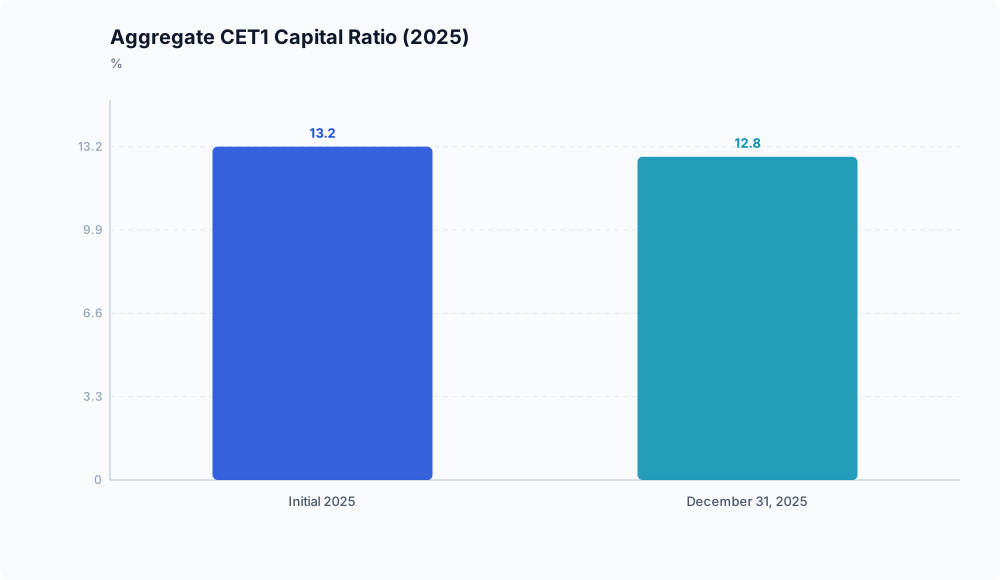
Heading into the 2026 cycle, large banks faced tighter initial conditions. The aggregate common equity tier 1 (CET1) capital ratio of participating institutions fell from 13.2 percent to 12.8 percent during 2025, which served as the balance sheet jump-off baseline as of December 31, 2025, according to the Board of Governors of the Federal Reserve System. Because supervisory stress testing measures capital depletion relative to starting balance sheets, entering the exercise with less capital leaves institutions with less headroom to absorb hypothetical shocks before nearing regulatory minimums.
To counter balance sheet sensitivity, the Federal Reserve altered the global market shock component in its finalized 2026 scenario. Regulators reduced the severity of shock magnitudes applied to agency pass-through securities and select commodities relative to initial proposals, as detailed by the Board of Governors of the Federal Reserve System. However, the public summary documentation omitted specific numerical basis-point calibrations and asset-level haircut formulas, leaving the precise quantitative scale of the reduction undisclosed.
This adjusted framework applied to 32 large banks over a nine-quarter stress horizon. Under these parameters, the exercise yielded an aggregate peak-to-trough CET1 drawdown of 1.6 percentage points across participating firms, according to the Bank Policy Institute.
The mechanics of “SCB creep” and capital distributions
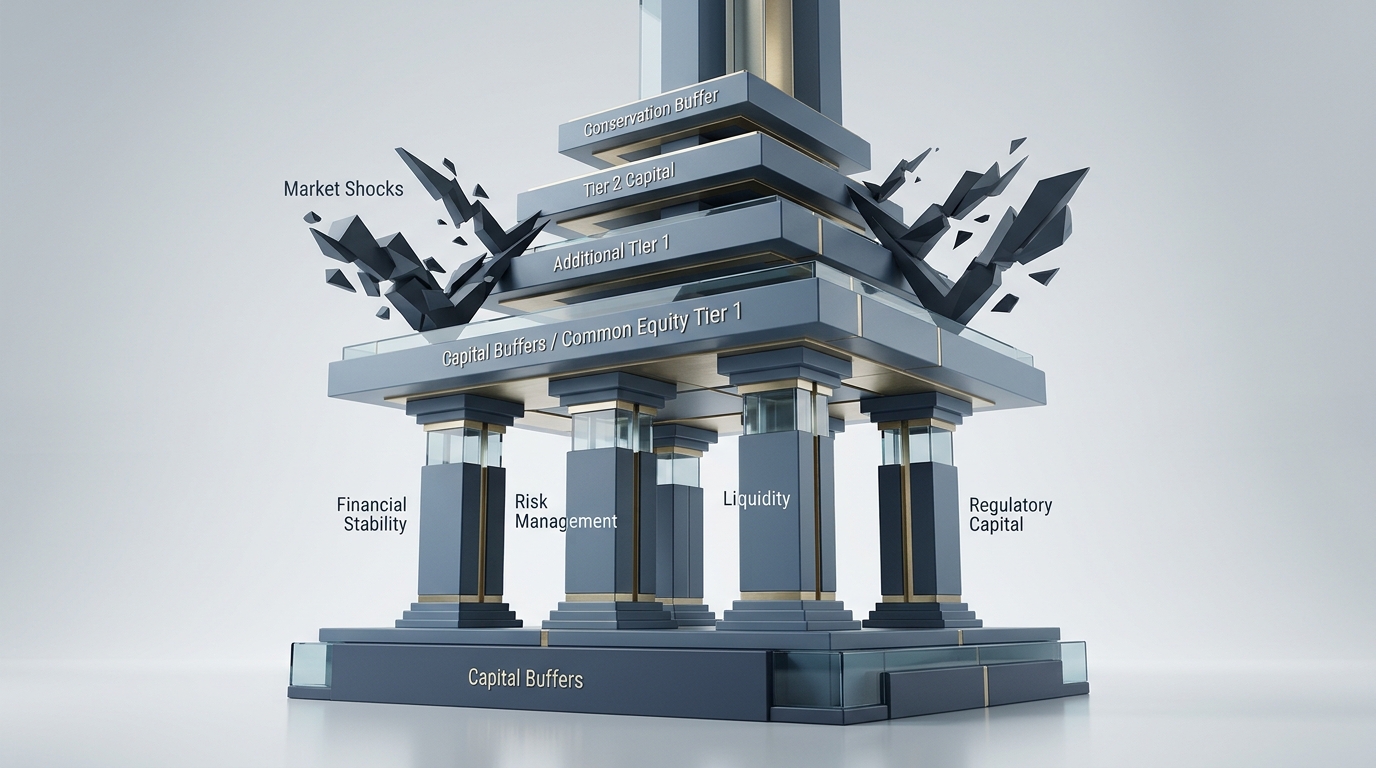
A bank’s Stress Capital Buffer is dictated primarily by its simulated peak-to-trough CET1 drawdown under supervisory stress. When modeled mark-to-market trading losses are tempered, simulated post-stress capital depletion is reduced. This mechanism curbs upward pressure on regulatory requirements, a dynamic often described as “SCB creep.”
Holding the buffer in check protects excess capital above regulatory floors. This buffer headroom is essential for capital planning: falling below prescribed thresholds triggers automatic regulatory curbs on discretionary capital distributions, such as share buybacks and dividend payments.
The Federal Reserve kept 2026 SCB requirements unchanged instead of allowing modeled results to establish binding capital floors, while it completes broader revisions to the stress testing framework following a public notice-and-comment process, as reported by the Bank Policy Institute. By moderating shock parameters and freezing buffer adjustments, regulators assessed sector resilience using fresh market data without imposing immediate, year-over-year capital volatility during an active regulatory transition.
Analytical caveats and evidentiary boundaries

While the mechanical relationship between softened trading losses and capital preservation is structurally clear, important analytical boundaries remain.
The Board of Governors of the Federal Reserve System did not publish the underlying calibration formulas for agency pass-through securities, preventing independent modeling of asset-level impact. In addition, although the Board of Governors of the Federal Reserve System verified the baseline aggregate CET1 decline to 12.8 percent, the disclosures do not quantify the dollar amount of trading losses avoided or the exact volume of capital preserved for shareholder returns.
Consequently, while the policy intent to limit short-term capital friction is clear, the exact degree to which moderated shocks prevented binding distribution constraints for individual institutions remains an analytical inference because the public disclosures lack empirical measurements.
Conclusion

The 2026 stress testing results demonstrate a regulatory holding pattern. Faced with lower bank starting capital and an evolving supervisory framework, the Federal Reserve used reduced trading shocks and a frozen Stress Capital Buffer to stabilize balance sheet requirements. For covered banks, this intervention decouples 2026 stress test results from immediate capital distribution constraints, deferring the impact of regulatory revisions until the updated framework is fully finalized.
Disclaimer: This analysis is for informational purposes only and does not constitute investment, financial, real estate, or legal advice. Always consult a licensed financial advisor before making investment decisions.